

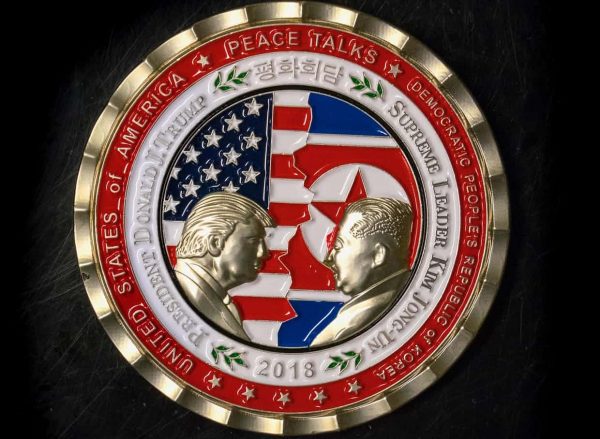
Wow, what a week. President Trump met in Singapore with North Korean dictator Kim Jong-un, an historical meeting the effects of which we still don’t fully know or understand. Will Kim stick to his pledge to denuclearize the Korean Peninsula? Can we trust him? Is President Trump playing another masterful round of 4-D chess, or simply legitimizing a brutal regime and its evil leader?
Questions abound, as do interpretations. Ben Shapiro at The Daily Wire (video below) argues that conservatives are getting too excited, too soon, and purely on a partisan basis. While I do think we should proceed with caution—the Kim family has promised denuclearization eight times before—there is reason for optimism.
Historically, I would point to Mikhail Gorbachev’s 1988 visit to the United States, in which he fell in love with the country. The same criticisms abounded then—“human rights abuses!,” “gulags!,” etc.—and, while those criticisms were as true for the Soviet Union as they are—and even more so!—for the Kim regime, the door was opened for diplomacy, leading to the Intermediate-Range Nuclear Force (INF) Treaty. Ultimately, the Soviet Union collapsed, largely peacefully.
Kim seems to have some similarities to Gorbie, and some key differences from other authoritarian and totalitarian regimes in the world today. For example, Kim seems genuinely to love Western culture—he hangs out with Dennis Rodman, he eats McDonald’s (clearly).
I keep hearing the usual objections from the Left—“conservatives criticized Obama for negotiating with Iran! How is this different!” For one, Trump didn’t load up palettes full of cash without congressional approval and fly it into the regime while it was under intense sanctions. He also didn’t give Kim everything he wanted so he could destabilize an entire region based on an AP Comparative Government-level of understanding of the nation’s political system.
Further, Iran is a regime based on a radical ideology—Shi’a Islamism—that doesn’t acknowledge the existence of Israel and is actively, if covertly, at war with its Sunni neighbors. Iran is the leading state-sponsor of terrorism.
North Korea is certainly a terrible, totalitarian place, but the old ideology of Juche seems quaint. No one is going to blow themselves up to wear coveralls made from refined clay.
Cuba, too, is an old-school Cold War frontier, but the Obama administration got nothing from Cuba when it lifted the embargo—not even the release of political dissidents! The Cuba analogy fails, too, because we’ve already defanged Cuba, and have nothing to gain from opening up relations. Keep grinding out the sanctions there, for the sake of Cubans.
Consider, too, President Richard Nixon’s “opening” of China in the 1972. He met with the bloodiest dictator of the 20th century, Chinese Chairman Mao Zedong, which caught the ire of conservatives and anti-Communists in the West. While Mao’s atrocities and lethal policies were devastating to human life and contributed to the annals of misery Communism has inflicted upon humanity, Nixon and Henry Kissinger realized the diplomatic opportunity that presented itself, and took the plunge. China is still authoritarian and aggressive, but it’s beginning to fit in with the respectable, stable nations of the world.
Similarly, North Korea must be a liability to China, which is surely fed up with its tin-pottery. While China dreads seeing a unified Korean Peninsula, that might be better than dealing with a client-state that is becoming less of a strategic asset and more of a liability. Trump’s “war of words” last summer—including the hilarious “my button is bigger” tweet—played the game that Kim and the ChiComs understand. That’s why the President and Kim met, and why Kim will come to the United States.
That brings us back to Gorbie’s 1988 visit—just as he was enamored by the USA, I predict that Kim will be similarly blown away (and not via assassination, as Ben Shapiro mused about in one of his recent podcasts [Note: I watch Shapiro’s podcast, The Ben Shapiro Show, daily, and at the time of writing I could not find in which recent podcast he talked about assassinating foreign leaders, but he quipped that he disagreed with the Carter-era prohibition on taking out particularly wicked heads of state; I’m just not willing to go back through hours of video to find it]).
Have you ever seen recent immigrants from other countries that have this really one-dimensional idea of America? They think it’s all fast cars, hot babes, overweight cowboys, New York City, and rap music—and they eat it up, assimilating whole-hog in the most cartoonish way possible. I would not be surprised if Kim took the same route. He’s already chillin’ with Dennis Rodman. Homeboy’s going to be wearing a Chance the Rapper ballcap and eating French fries by the end of his first round of golf at Mar-a-Lago.
And what of Dennis Rodman? My earliest memory of D-Rod was a picture of him sporting bright green hair and a bunch of piercings—keep in mind, this was probably the 1990s, when the average person didn’t color his hair and get covered in tattoos (“this one represents my individuality”)—and I always assumed he was a crazy attention hog. When I heard he was hanging out with Kim Jong-un, I figured he’d gone full Jane Fonda.
But… maybe he really was trying to create understanding between the United States and North Korea. Maybe he was trying to bridge a gap across political systems and cultures. And—maybe it worked.
I’ve watched Rodman’s interview with CNN’s Chris Cuomo (video below)—the one in which Rodman is sporting a “Make America Great Again” hat—and I don’t think his tears are fake. When I saw the clip originally on The Ben Shapiro Show, I was in awe. Here was a guy whose heart was open for all to see on national television. When he said (paraphrasing) “Even when no one would believe and no one would listen, I kept going, because I believed we could work out our differences,” my jaw dropped.
How many times, as a conservative in a progressive culture, have you felt alone, but you kept soldiering on, knowing that there was hope, that what you believed was right, even when you couldn’t articulate it in the face of overwhelming opposition? I doubt I’ll ever write this again, but in that moment, I identified with Dennis Rodman. I understood him.
Do not take anything I’ve written here as a trivialization of North Korea or the Kim family’s decades of atrocities. The people of North Korea are brainwashed and abused, put to death for exchanging James Bond DVDs, starving because their terrible government doesn’t function properly, and their leaders have purposefully isolated them from the world. It’s an hellacious place, and we shouldn’t legitimize an evil, totalitarian despot.
BUT—if President Trump can sway Kim Jong-un, and begin the liberalization of North Korea—if not the reunification of the Korean Peninsula—it will do the most since the opening of China in 1972 to improve the lives of millions of people. The North Korean people will be brought out of the darkness and into the community of nations.
Yes, China is still authoritarian, and denies its people their basic political and civil rights, but North Korea can have the chance to forge its own path forward. South Korea was under a military dictatorship until the 1980s; it’s now one of the freest, most prosperous nations in the world (and really good at Starcraft).
Only time will tell. My prayers go out to the people of North Korea, and I urge my readers to pray for them, as well—and that President Trump and Kim Jong-un have the wisdom and discretion to act in the best interest of liberty.


 The Portly Politico