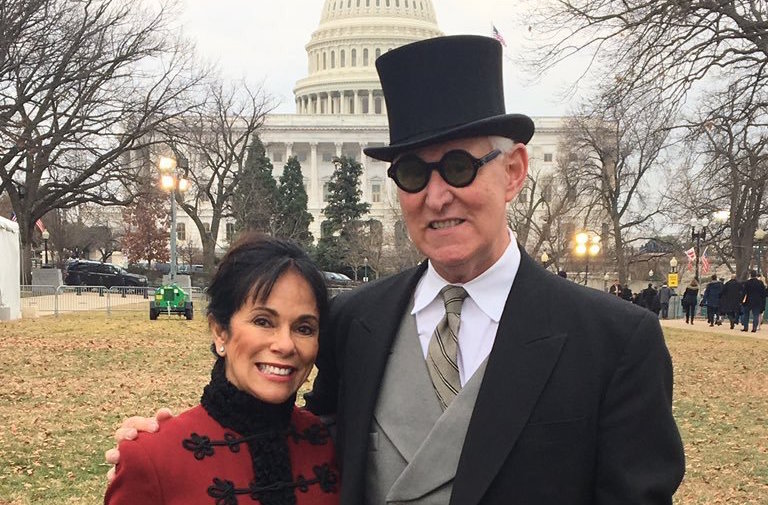
The Life of Roger Stone

Flamboyant political trickster and Barnum-esque huckster Roger Stone was arrested last week as part of the out-of-control Mueller investigation into alleged Russian collusion in the 2016 presidential election.  Stone’s arrest suggests the desperation in Mueller’s witch hunt.

Stone himself is an endlessly fascinating individual, and I have a soft-spot for over-the-top confidence men, which is essentially what Stone is (or how he presents himself).  In reading some of the news coverage about his arrest, I stumbled upon a 2007 profile of the famed master of the dark arts, “Roger Stone, Political Animal.”

The author is Matt Labash, one of the best long-form writers the now-defunct The Weekly Standard ever employed.  I’ve totally written off The Weekly Standard as a pathologically anti-Trump publication, especially with Bill Kristol going off the deep end politically (and maybe psychologically), actively encouraging the FBI’s mendacious, corrupt attempts to overthrow the duly-elected President of the United States.

That said, Labash is an excellent writer.  When I taught US Government regularly, I would assign students another Labash piece, a lengthy profile of former Louisiana Governor (and convicted felon) Edwin Edwards, entitled “Conviction Politician.”  Labash wrote that profile when Edwards, then 86, was attempting to run for Congress.  Edwards would go on to lose that race—the first time he ever lost a run for office—but Labash’s profile made me want to vote for Edwards, and not because it casts the corrupt four-time governor in a positive light.  Rather, Labash possesses a knack for drawing out the humor and humanity in deeply flawed, larger-than-life characters (some great Edwards quotes:  he said the only way he’d lose an election was if he was “caught in bed with a dead girl or a live boy”; when discussing Klansman David Duke, Edwards said the only thing they had in common was they’re “both wizards under the sheets”).

That jeweler’s eye for humanizing moral failure is beautifully apparent in the 2007 Stone profile.  Labash is also sympathetic to his subject, without necessarily condoning his trickiness:  unlike many reporters, Labash actually likes Roger Stone.

It’s also interesting reading about politics pre-2015-2016, what we might call “B.T.”:  “Before Trump.”  That’s especially the case when Donald Trump is involved (Stone, a longtime Trump friend and ally, only half-jokingly called Trump the p-word in reference to a botched run for the Reform Party nomination early in this century).  It’s hard to conceive now, after four years of Trumpism, of a time when The Donald didn’t dominate our political discussions, when we basically debated the merits between two or more members of both parties’ elites (I don’t completely buy the “Uniparty” theory—there were clearly important philosophical differences between Romney and Obama, for example, in 2012—but I’m willing to concede that elites in both parties are two sides of the same elitist coin in terms of their interests and positions in life).

Reading about Roger Stone in a pre-Trump political age, on the cusp of the Great Recession and before even the meteoric rise of Barack Obama is fun and a bit disconcerting:  it’s hard to remember exactly what it was like back then, as we’ve gone through the looking glass into a whole new paradigm.  Such is the power of the red-pilling that came in the wake of Trump’s rise.

But this post is (ostensibly) about Stone.  I highly recommend you carve out thirty minutes to read the Labash profile in full—after all, it’s Wednesday, and all the real work for the week got done Monday or will get done hastily Friday morning, before you ease your way into the weekend.  I had a hard time finding a “representative sample” to highlight from this piece, but I settled (and not entirely to my satisfaction) on this excerpt discussing a young Stone’s possible roll in splitting the Liberal Party of New York’s vote from the Democrats, giving Ronald Reagan the edge—and New York’s electoral votes—in 1980:

Stone, who going back to his class elections in high school has been a proponent of recruiting patsy candidates to split the other guy’s support, remembers suggesting to Cohn that if they could figure out a way to make John Anderson the Liberal party nominee in New York, with Jimmy Carter picking up the Democratic nod, Reagan might win the state in a three-way race. “Roy says, ‘Let me look into it.'” Cohn then told him, “‘You need to go visit this lawyer’–a lawyer who shall remain nameless–‘and see what his number is.’ I said, ‘Roy, I don’t understand.’ Roy says, ‘How much cash he wants, dumbf–.'” Stone balked when he found out the guy wanted $125,000 in cash to grease the skids, and Cohn wanted to know what the problem was. Stone told him he didn’t have $125,000, and Cohn said, “That’s not the problem. How does he want it?”

Cohn sent Stone on an errand a few days later. “There’s a suitcase,” Stone says. “I don’t look in the suitcase . . . I don’t even know what was in the suitcase . . . I take the suitcase to the law office. I drop it off. Two days later, they have a convention. Liberals decide they’re endorsing John Anderson for president. It’s a three-way race now in New York State. Reagan wins with 46 percent of the vote. I paid his law firm. Legal fees. I don’t know what he did for the money, but whatever it was, the Liberal party reached its right conclusion out of a matter of principle.”

I ask him how he feels about this in retrospect. He seems to feel pretty good–now that certain statutes of limitations are up. He cites one of Stone’s Rules, by way of Malcolm X, his “brother under the skin”: “By any means necessary.” “Reagan got the electoral votes in New York State, we saved the country,” Stone says with characteristic understatement. “[More] Carter would’ve been an unmitigated disaster.”

Who knows if that story is true or not—after all, this is Roger Stone—but there’s no doubt the Liberal Party nominated Anderson, and Reagan won a plurality in the Empire State.  If it’s true, Stone might have saved the Republic.

Labash’s piece also revealed to the world “Stone’s Rules,” which Stone has compiled into a book.  From Labash:

[Stone] often sets his pronouncements off with the utterance “Stone’s Rules,” signifying listeners that one of his shot-glass commandments is coming down, a pithy dictate uttered with the unbending certitude one usually associates with the Book of Deuteronomy. Some original, some borrowed, Stone’s Rules address everything from fashion to food to how to screw people. And one of his favorite Stone’s Rules is “Unless you can fake sincerity, you’ll get nowhere in this business.” He is honest about his dishonesty. “Politics with me isn’t theater,” he admits. “It’s performance art. Sometimes, for its own sake.”

The performance for the sake of itself is a recurring theme with Stone, who seems to embroil himself in controversy just for the thrill of it.  He could have had a lucrative, quiet career in political consulting, but from reading Labash’s piece—and from watching Roger Stone on television and YouTube—that doesn’t seem like a life that would appeal to him.

That, in my mind, is the appeal of Stone—like Milo Yiannopolous, he relishes the dirt and grime of the arena, and he digs into it while dressed impeccably.  He’s a despicable, perfidious, disreputable con man—and I love him for it.

The League of Nations

For the past five years, Western civilization has been observing and memorializing the Great War, what we now call the First World War. That war was so destructive, it single-handedly cost the West its mojo. Before the war, Western civilization was supremely confident, believing in the rightness and righteousness of its own ideals. After it, self-doubt and nihilism gripped the hearts of once-great nations.

Some of that antebellum self-confidence was founded on the sandy foundation of positivist idealism, and some of it on the misguided internationalism that tied European nations together in a strangling, inflexible web of secret alliances and global brinksmanship. But for all its faults—and the mostly pointless slaughter of millions of young men on the battlefields of Europe—the West was (and is) the best.

Friday, 25 January 2019 quietly marked another milestone in the rolling commemoration of the Great War: the opening, 100 years ago, of the Versailles Peace Conference, the gathering that planted the seeds for the Second World War. New Criterion published a short essay on the anniversary that discusses the maneuvering at the Conference with lively detail; it’s even more impressive when you realize the author, Daniel M. Bring, is still in college.

The League of Nations was the precursor to the United Nations, and the godfather of various supranational entities. In that context, it is rather inauspicious, and is the root of many evils. It was a stunningly ineffective organization, too, that failed to uphold its obligations to collective security.

The United States famously did not join the League, as the Senate refused to ratify the Treaty of Versailles, which included membership in the organization. Senator Henry Cabot Lodge of Massachusetts led the charge against ratification, arguing that Article X of the League charter would compel the United States to join in foreign wars that may have little bearing on actual American interests.

Such a degree of foreign policy realism would be refreshing in today’s political climate; as it was, Lodge’s reservations were entirely consistent with American foreign policy dating back to George Washington and John Quincy Adams. The United States did not formally make peace with Germany until 1921, with the signing of the Treaty of Berlin.

Without American support—and in the wake of the global Great Depression—the League of Nations floundered and failed. To quote Bring:

In discussions of (especially, recent) history, there is much said by historians about hindsight and counterfactual scenarios. What if the United States had lent its strength to the League’s success? What if the League had levied more effective sanctions and even executed military countermeasures? But in the end, these hypotheticals cannot change the past.
“All that matters is that which occurred. Within thirty years from the League’s creation, tens of millions, both soldiers and civilians, were dead in a second great war.”

The post Second World War global order has endured reasonably well, with its broad commitment to global security underpinned with American might. That order flourished, however, in the face of the long Cold War and the mostly-united fronts of a long ideological struggle with Soviet Communism. In the absence of such a major external threat—radical Islamism notwithstanding—the raison d’etre for open-ended, supranational regimes is largely gone, and such organizations are ineffective at best or tyrannical at worst.

The United Nations is a clown college for Third World dictators and their lackeys. The European Union is an undemocratic dystopia under German rule (didn’t we fight two world wars to prevent that outcome?). NATO (perhaps inadvertently) antagonizes Russia by extending into the Baltic region, and American lives are obligated to prop up those very regions should Russia interfere. Further, NATO is only truly effective with American backing and support—a major sticking point for President Trump, who wants member nations to meet their obligations to funding it (and they even balk at that minimal request).

Nineteenth-century isolationism no longer appears to be a viable option for the United States, but constant interventionism and multilateralism come with all the costs and none of the benefits of empire, and severely stretch America’s blood and treasure. An earnest reevaluation of the effectiveness of our international institutions is long overdue; kudos to President Trump for questioning the orthodoxy and probing new possibilities.

As part of that re-examination, let us look back to the idealistic, but unhappy, failure of the League—and the costs its failure entailed for humanity.

Reblog: New White Shoe Review for You

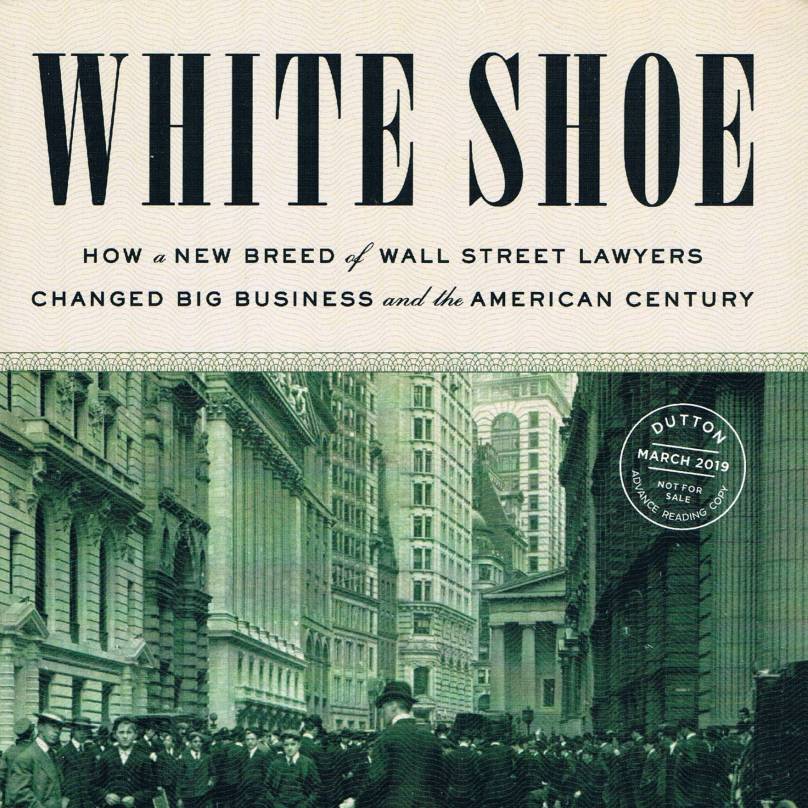
My good friend and fellow blogger Frederick Ingram of Corporate History International has written an intriguing review of what appears to be a quite intriguing book: historian John Oller’s White Shoe: How a New Bread of Wall Street Lawyers Changed Big Business and the American Century. Based on Ingram’s review alone, the book is a fascinating dive into the heady politics of early twentieth-century America, the transition from the relative laissez-faire capitalism of the so-called “Gilded Age” into the economic, political, and social reforms of the Progressive Era.

The Progressive Movement fundamentally transformed the United States, in many ways (constitutionally) for the worse. But it was an attempt to rectify some of the excesses of the Gilded Age, and to ensure that workers were not merely cogs in faceless corporate machines. In reading Ingram’s review, I heard echoes of Tucker Carlson’s recent on-air musings, particularly the idea that efficiency is not a god to be worshipped blindly, and that capitalism is great, but it should work for us, not the other way around.

The more things change, the more they stay the same: Carlson’s diagnosis of America’s current ills echoes attorney (and future Supreme Court justice) Louis Brandeis’s “curse of bigness,” the argument against efficiency-for-its-own-sake. I was struck, while reading Ingram’s review, how much our own age mirrors the period that, in many ways, begat our current crises: the Progressive Era of 100 years ago.

According to Ingram, a consensus of sorts was reached among these big Wall Street Lawyers (WSLs), which ultimately prevented radicalism and presented “capitalism with a human face”:

“The end of ‘The Last Great Epoch’ coincided with the end of World War I, flanked by the funerals of the earlier generation of great industrialists and white shoe pioneers. ‘Each year has the significance of a hundred,’ said William Nelson Cromwell in 1918, and this applied not just to armistice negotiations but vast swaths of human society. Business, law, and government in the US would be professionalized and regulated, but still relatively free by world standards. The reforms advocated by enlightened and informed WSLs formed a barrier against imported radicalism. Even rightwing attorneys backed movements such as social security, child labor prohibitions, and even minimum wage.”


Ingram, as I mentioned, is a good friend, and we’ve had some lively discussions over the years about the “big questions” of life. His thoughtfulness and reflexivity are in full display in his review here, as he links insights from this work to concurrent readings of Jordan Peterson and Christopher Andrews. He also brings in his own experiences working in “BigLaw,” as he calls it, the grueling world of billable hours and 80+-hour workweeks.

To (indulgently) block-quote Ingram once more:

“Having worked as a BigLaw accounting clerk myself, I have an issue with the Cravath System and the slavish devotion to billable hours. Is your spouse really going to leave you if you don’t make $250,000 this year? Will your children no longer look up to you? Is that worth being a cortisol-addled prick 80 hours a week, every weekday of your miserable life? Wouldn’t it be wiser to make, I don’t know, $100k or even $50k and have your peace of mind back?”


As much as I admire the energy and drive of the restless striver—and as much as I over-work myself—Ingram makes a compelling point. Money doesn’t buy happiness (although it certainly buys a great deal of freedom), and the pursuit of it can lead other, more enduring obligations—family, friends, faith—to wither.

An excellent review, from a good friend. Check it out at https://corporatehistory.international/2019/01/27/new-white-shoe-review-for-you, then pick up a copy of Oller’s book.

fridrix's avatarCorporate History International

White Shoe: How a New Breed of Wall Street Lawyers Changed Big Business and the American Century by John Oller (Dutton: 2019). Review by Frederick C. Ingram, CorporateHistory.International, January 27, 2019.

White Shoe promises to deliver an engaging and revealing tale regarding the handful of New York City attorneys who effectively created big business as we’ve known it, the “new high priests for a new century.” As an accomplished historian (The Swamp Fox: How Francis Marion Saved the American Revolution, Da Capo: 2016) and former Wall Street attorney himself (Willkie Farr & Gallagher), John Oller is well placed to fulfill this tall order.

20190127 white shoe cover squareIn a previous economy, I researched hundreds of corporations for the International Directory of Company Histories, so the prospect of peeking a little beyond the opaque public relations and investor relations curtain intrigued me. I’m also reminded of strolling along Fifth Avenue, whose equally opaque walls…

View original post 1,441 more words

Saturday Reading: SOTU and the Shutdown

A quick post today, as I have a jam-packed Saturday (after a jam-packed week, with another busy week on the horizon—it’s the Year of the Panther, baby!):  the President has reached an agreement to reopen the government for three weeks, it seems in order to get paychecks out to Homeland Security and federal law enforcement more than anything else, with the promise (threat?) to leverage another government shutdown in February to obtain border wall funding.

This compromise feels like a loss; I can only hope President Trump has some clever scheme up his sleeve.  From what I’ve been hearing (most recently on today’s episode of Radio Derb), the polls have shown Americans steadily blaming Trump for the shutdown.  Of course, this prompts me to ask, “do they see the shutdown as positive or negative?”

Certainly there are good federal employees who need paychecks, especially border patrol agents and federal law enforcement, but how many of you actually felt the effects of the shutdown?  At the very least, let’s hope the President took Ben Boychuck’s advice, as well as the advice of his anonymous senior official, to layoff permanently some of the dead weight in the federal bureaucracy.

As Boychuck writes in the Sacramento Bee:

Everyone knows the president cannot fire career government employees willy-nilly. Our civil service laws are ironclad. But a fairly obscure rule would allow the administration to lay off certain workers if they’ve been furloughed for at least 30 days. It’s called a “reduction in force” and it’s perfectly legal as long as the White House adheres to certain criteria, accounting for an employee’s tenure, total federal and military service, and work performance.

According to Boychuck, some 350,000 federal employees are eligible for “reduction in force” according to this obscure rule.  I don’t think anyone is advocating laying off all of those people—surely some 5-10% of them perform useful functions and/or aren’t totally subvervise to the President’s agenda—but I imagine we could do without at least some of them.  Surely even a token culling of the herd would send a powerful warning to feds:  you work for the American people, not your second home.

A part of me worries that our peacocking POTUS might be reopening the government simply to give the State of the Union Address in the House chambers.  That would be a bad move.  The Constitution doesn’t specify the form or venue for the SOTU address.  In fact, it doesn’t even have to be a verbal “address” at all!

Thomas Jefferson—timid about public speaking, and fearful of the kingly connotations—stopped giving a verbal address upon taking office in 1801.  Instead, his annual message was sent to Congress and read aloud by the Speaker or another member, then published throughout the States in newspapers.  Everyone could easily read it, and this approach made perfect sense in a pre-mass-communications age.

The Jefferson approach endured until the presidency of Democrat and progressive Woodrow Wilson.  Remember, Wilson hated our Constitution (PDF), and believed it was an archaic document that did not work adequately in the dynamic, industrial world of the early twentieth century.  He idolized the British Parliament, and sought to make the presidency more akin to the position of Prime Minister—the first among equal voting members in the legislature.  He believed that approach, called fusion of powers, was more efficient and democratic (“democratic” in those days being the Left’s preferred way to advance progressive ideology and policy, though in practice that meant electing representatives who would farm out their law-making powers to unelected technocrats in the federal bureaucracy).

Regardless, the die was cast, and with the advent of television, the State of the Union Address has become a ponderous, grandiose political event that doesn’t really tell us anything useful about the state of the nation, but just how awesome whoever the current president is.  This time, those boastful claims would be mostly true, but was it worth reopening the government to do it on time?

Boychuck, among others on the Right, were calling for the President to end the modern, monarchical spectacle of the State of the Union, returning it to Jeffersonian simplicity.  As much as I don’t want to deny the president his moment in the sun, that approach seems prudent, and more in accord with the republican nature of our Constitution.

TBT: Rustics Have Opinions, Too

I first launched The Portly Politico on Blogger back in 2009.  It was a different world back then, and I was a different conservative.  I was probably still deep in my Randian-libertarian economic conservative phase:  I sincerely believed neoliberal economics and mostly unbridled capitalism could solve almost all of the world’s problems, which meant I was fundamentally progressive in my outlook, “progressive” in the sense of taking a Whiggish view of human history—yes, some things are bad now, but they’ll inexorably get better as we expand free trade and free movement of peoples across borders.  Heck, I even thought that, as a Christian nation, America should take in illegal immigrants!

Such are the follies of youth.  Intervening years of lived experience—not to mention the increasingly overt radicalism of the Left—have convinced me that, as wonderful as free markets are, we’ve tended to sacrifice real lives and communities in exchange for cheap plastic junk.  I’ve also considerably altered my views on immigration; at this point, I think America needs 150 milligrams of Deportemal (and a healthy dose of limiting legal immigration, too).

One thing that hasn’t changed:  I still identify with the struggles and values of rural America.  In this 2009 post, I pointed out the growing contempt for rural Americans that the Democratic Party now openly embraces.  I think I was overly-generous to the author of the piece discussed herein, however; upon re-reading Kevin Baker’s essay “Barack Hoover Obama,” I’m chilled by how openly he argues for the usurpation of usual constitutional order and division of powers in order to push for “change.”  I apparently missed it completely ten years ago, much to my current chagrin.

Back then, I remember conservatives having some mild optimism that President Obama would govern as a pragmatic moderate—left-of-center, to be sure, but reasonable.  Then he forced through the Affordable Care Act on a purely partisan basis, alienating Republicans and contributing to the deep ideological divide in America today.  His administration doubled down on identity politics, reopening mostly-healed racial wounds.  Much of the cultural chaos we suffer today is the result of the twin evils of Senator Teddy Kennedy’s 1965 immigration bill and President Obama’s politics of racial grievance.

So, that’s my apology for my naivety as a young, portly man.  That said, here is 2009’s “Rustics Have Opinions, Too“:

I’ve noticed something about the American Left, specifically those members who claim to be “cultured”: they share a distrust and even hatred for rural Americans. They constantly mock the values, feelings, and politics of this oft-derided constituency, framing them as stereotypical “rednecks” or “good ol’ boys” who spend most of their time polishing their guns drunk while watching NASCAR.

Let’s face it: stereotypes exist for a reason. Think of any offensive stereotype and there’s a kernel of truth to it. But that doesn’t mean we should go around judging people based on those stereotypes. Liberals are making that point all the time, and in this case they’re actually right. As usual, though, they fall back into their old, hypocritical ways when it comes to rural Americans. It’s “hate speech” if someone insinuates that an Asian is good at math, but it’s perfectly acceptable to laugh at someone who’s only skin pigmentation is on the back of his neck.

I’m not saying that having a sense of humor is wrong. Maybe white guys really aren’t as cool as black dudes when they drive. Dave Chappelle had tons of great material and Boondocks deals with race relations in the United States today better than any other show out there. I want to make it clear that I have nothing against humor. By laughing at stereotypes, we rob them of their power, rather than adding to it.

The same holds true for “rednecks” or “white trash” or whatever label one uses. If it weren’t, Jeff Foxworthy would be out of a job. The problem arises, however, when we start to marginalize those Americans because of the stereotypes that exist. Such marginalization of African Americans, for example, would be roundly denounced by the left, and rightfully so. Unfortunately, liberals often celebrate when such marginalization is applied to the rural white American.

In an otherwise excellent article in Harper’s Magazine entitled “Barak Hoover Obama: The Best and the Brightest Blow it Again,” Kevin Baker indulges in this marginalization to a sickening extent [Note–at the time of this writing, the full text of the article is only available to Harper’s subscribers]. The bulk of the article draws historical parallels between Presidents Herbert Hoover and Barack Obama. Baker’s research is impeccable and his understanding of an oft-maligned (and extremely intelligent) former president is refreshing. He implicitly challenges the more common “Obama-is-to-Roosevelt-as-Bush-is-to-Hoover” analogy and draws some pessimistic conclusions about Obama’s approach to passing many of his long-promised, radically liberal reforms.

A large part of Baker’s argument is that President Obama is proceeding with excessive caution and is relying too heavily on Congress to enact the changes he seeks for the nation (naturally, many conservatives would argue that the opposite is true, but suffice it to say that Baker is approaching Obama’s proposed reforms from the point of view of a liberal supporter–he actually thinks that cap-and-trade is a good thing). Baker maintains that congressional Democrats from states with small populations like Montana are stepping up after years of quiet service to challenge many of Obama’s efforts.

The language Baker uses to describe these representatives and senators is thick with disrespect. He talks about their states as filled with tumbleweeds and ignorance. He implicitly challenges the notion that these congressmen–and by extension their constituents–have no place in contemporary American politics and that they should be brushed aside and ignored, all because they’re impeding Ossiah’s democratic-socialist vision. This viewpoint is shared implicitly and explicitly by most liberals and leftists. The thinking is that because these states have small populations–and don’t have a good place to get sushi or gourmet coffee–they don’t deserve to have a place in the American political system (not to mention the fact that Baker is encouraging Obama to squelch dissent and open discussion, supposed bedrocks of modern liberalism).

What’s most disturbing about this reasoning is that it is anathema to the very structural philosophy of the United States Constitution. The Constitution clearly sets out to create a structure that gives states with large populations more power in the House of Representatives, while allowing states with small populations to maintain an equal footing in the Senate. The same theory exists behind the Electoral College. If our system was not balanced in this way, New York and California would always pick the next president and would exert a dangerous amount of control over national politics (with only conservative Texas able to balance things out a bit). Regional interests do not necessarily coincide with national interests, and what’s good for New York may not be good, and may even be bad, for Iowa.

Yet liberals consistently ignore this inconvenient truth and view it as a stumbling block to their pet projects, whatever they might be. At the risk of sounding like a blowhard conservative talk show host, leftists in America today have no respect for the Constitution except when it is politically advantageous or convenient. Now, I am willing to admit that there are plenty of conservatives who probably treat the Constitution in the same way, but they are much, much harder to find. This disrespect cannot endure for long, regardless of the side.

Therefore, I applaud what these rural Democrats are doing. Maybe they are dusty old relics of the party, but that’s for the Democrats to sort out themselves, and that should not invalidate what these men have to say. Maybe most of them are blowhards and are simply seizing their moment to be in the spotlight or to play to their base, but some of them have useful objections and suggestions. I don’t want to give liberals any additional aid, but it seems to me that they could use all the help they can get in the more rural parts of the country. Taking the interests of rural Democrats more seriously would be a great start.

Kevin Baker and his ilk live in a world of trendy green advertising and mocha lattes. They have no respect for hard working rural Americans–oh, heck, we’ll call them “rednecks”–who help make this country into the wonderful tapestry of ideas and cultures it is today.

Besides, who wants to watch Jeff Gordon race in a Prius?

Saturday Reading: Communist Infiltration is Real

Thanks to fridrix of Corporate History International for sharing this piece with me a couple of weeks ago.  Check out his excellent blog, then read the piece linked below.  Happy Saturday!

Former British radical Peter Hitchens offers a lengthy, eye-opening account of alleged Communist infiltration into the highest ranks of British academia and government.  In particular, he admonishes readers to forget about socialist Jeremy Corbyn, and instead argues that the real Marxists were New Labour Blairites.  You can read the full piece here:  https://www.dailymail.co.uk/debate/article-6197097/amp/PETER-HITCHENS-reveals-REAL-truth-Communist-infiltration-Britain.html

Hitchens’s account is riveting for several reasons.  For one, it further confirms the fact of Marxist infiltration of the institutions.  That story is best told in Roger Kimball’s The Long March: How the Cultural Revolution of the 1960s Changed America, which made my popular Summer Reading List in 2016.  As a reformed social justice radical of the 1960s, Hitchens knows the figures involved—and he names names in this piece.  It’s not as conclusive as the declassified Venona cables, but he demonstrates the likelihood of widespread Cultural Marxist infiltration.

For another, I was struck by how much tougher the old-school, Soviet-style Communists were.  Hitchens writes about the true-believer, 1930s Commies who were fighting in Spain against Franco, and engaging in cloak-and-dagger espionage.  Sure, they were misguided, or even willfully wicked, people, but they were men and women of action.  Contrast that with today’s generation of snowflakes and safe-space seekers, and it seems that modern-day Communists have lost some of their luster.

Finally, Hitchens details that the “Deep State” is not a uniquely American phenomenon.  In the 1990s, British intelligence destroyed most of the documentation detailing who was involved in Marxist organizations in key positions in British society and government.  He suggests this destruction was a willful act of obfuscation, undertaken in part to shield the Blair government from suspicion of Marxist ties.

I could quote many sections of this lengthy piece, but in it’s better to read through it yourself.  Hitchens writes as a journalist, with those mildly annoying one-sentence “paragraphs,” and since it’s The Daily Mail, there are YUGE pictures of 1960s radicals that load-up slower than a porn site on dial-up, but it’s worth scrolling through to get to the meat.

That said, here’s one representative excerpt among many that demonstrates the chilling nature of Communist infiltration:

‘Moscow Gold’ was never a myth. Well into modern times, Soviet Embassy officials would leave bags of used banknotes at Barons Court underground station in London, to be collected by the Communist official Reuben Falber, who stored them in the loft of his bungalow in Golders Green, North London.

At times this rather shameful secret subsidy, direct from a police state, reached £100,000 a year – in an era when that was a lot of money.

Who knows what it was used for? But the Communist Party spent a great deal on its industrial organisation, which fomented trouble in British workplaces and strove to get Communists and their sympathisers installed in important positions in British trade unions.

This enabled Moscow to wield huge, indirect influence over the Labour Party, especially on Foreign and Defence policies.

Labour’s embrace of unilateral nuclear disarmament in the middle of the Cold War, for instance, was greatly helped by the covert Communist machine in the unions.

That machine could be incredibly unscrupulous and hard to fight.

Hardly anyone, alas, now remembers the way the tough ex-Communist Frank Chapple took on, exposed and defeated blatant Communist ballot-rigging in the crucial Electrical Trades Union (ETU) between 1959 and 1961. Much more was at stake than who ran the ETU.

How deeply we were penetrated at that time we shall probably never know, and it is certain that many of those caught up in the pro-Stalin wave of the 1940s quietly peeled away after the Soviet invasions of Hungary in 1956 and of Czechoslovakia in 1968.

But 1968 did not kill off Communism.

It began a new movement – Eurocommunism, which renounced Soviet methods but kept the key aims of transforming our society.

It would seem that the European Union, rather than being a bulwark against Marxist influence, was almost deliberately conceived as a way to advance “Eurocommunism,” a means by which to foist Cultural Marxist pabulum on the peoples of a “united” Europe.  That makes Brexit all-the-more crucial.

Happy reading, and Happy Saturday!

TBT: Ted Cruz – Conservative Hero, or Traitor to His Party?

Given Mitt Romney’s perfidious WaPo op-edit seemed germane to look back to a seemingly forgotten moment from the 2016 Republican National Convention:  Ted Cruz’s convention speech in which he did not endorse (or, as I noted, not not-endorsed) nominee Donald Trump.  While Senator Cruz has become a steadfast supporter of President Trump’s agenda, at the time it was unclear where the conservative firebrand stood on Trump’s candidacy.

Cruz’s speech in 2016, however, was different in tone, tenor, and emphasis than Senator Romney’s traitorous op-ed.  Cruz fought a grueling series of primaries and caucuses against Trump.  Trump had insulted Cruz’s wife’s looks—a point Cruz made to a group of angry Texans who questioned why the Senator had not endorsed the candidate outright.  And Cruz largely aligned, in practice, with Trump’s policies, albeit in a more conventionally Conservative, Inc. way.

Romney, on the other hand, reeks of the kind of Jeff Flake/Bob Corker Republican who will undermine Trump’s agenda given the slightest chance, in exchange for the fleeting applause of the mainstream media.

Much of the analysis below assumed a stronger, more enduring Never Trump movement within the Republican Party, as well as a less successful Trump presidency.  Trump, fortunately, has exceeded expectations.  His successes on tax cuts, foreign policy, the judiciary, and elsewhere have taken the wind out of neocon sails, and energized the populist-nationalist conservative movement.

With that, here is my lengthy analysis of Senator Cruz’s fateful, mostly forgotten, speech:

On Wednesday, 20 July 2016, Texas Senator Ted Cruz delivered a speech at the Republican National Convention in Cleveland, Ohio, in which he congratulated his primary opponent and Republican presidential nominee Donald Trump on his victory, then urged voters to “vote your conscience” in November.  Boos filled the arena.

What convention delegates were booing was not the admonition to vote their conscience–for many of them, that means voting for Donald Trump–but the lack of an explicit endorsement from Senator Cruz to endorse Trump.

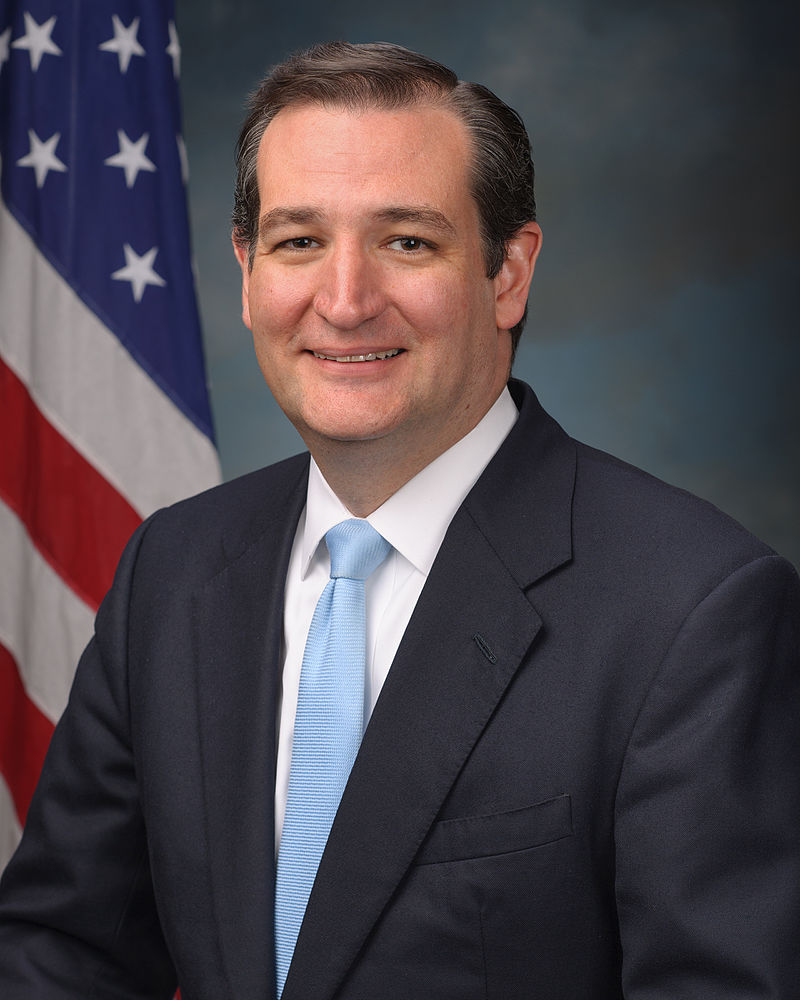
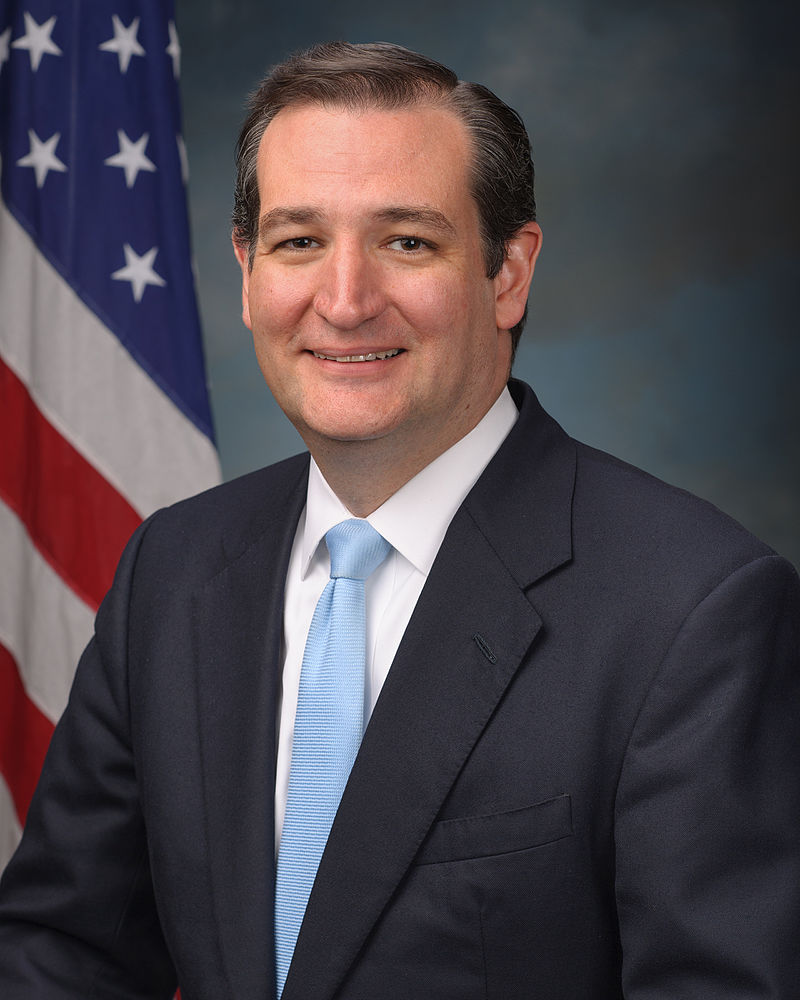
Ted Cruz – not the Zodiac Killer, but almost in as much trouble.
(Image Source:  By Frank Fey (U.S. Senate Photographic Studio) – Office of Senator Ted Cruz, Public Domain, https://commons.wikimedia.org/w/index.php?curid=25195114)

Immediately, two camps formed:  the majority pro-Trump camp, and the dwindling minority of Never Trumpers.  Within the former there are, broadly, two groups:  die-hard Trump fans, who have supported the candidate since last summer; and more tepid supporters who have given their support to Trump because they support their party’s nominee, they won’t support Hillary Clinton, they support elements of Trumpism, or some combination of the three.

The latter camp–I suspect–will continue to lose momentum now that the nomination process is complete.  Some of those voters will reluctantly vote for Trump for fear that a Clinton presidency will irrevocably shift the Supreme Court toward constitutional adaptavism and judicial activism.  Some will vote third-party, probably for Libertarian candidate Gary Johnson, or not vote at all.  A very small minority will vote for Clinton.

The kerfuffle highlights well the tensions inherent in party politics:  when does loyalty to party overcome adherence to principles, and vice-versa?

How these two groups have interpreted Cruz’s speech is predictable.  For the pro-Trump/party unity crowd, they see Cruz’s non-endorsement as a traitorous, duplicitous swipe at the nominee and his supporters, someone who went back on his word to endorse the winner of the primary process.

For the anti-Trump side, Cruz is a hero who stands on principle, even in the face of overwhelming pressure from his party to support explicitly the GOP nominee.  They argue that his pledge to support the candidate became null and void when the Trump campaign attacked Cruz’s wife, Heidi, and insinuated that his father was involved in the Kennedy assassination.

The kerfuffle highlights well the tensions inherent in party politics:  when does loyalty to party overcome adherence to principles, and vice-versa?  To what extent should a voter temper his principles for the sake of political advantage, expediency, or compromise?

These are difficult questions, and they did not start with the 2016 election cycle.  Movement conservatives were frustrated, for example, with the 2008 and 2012 GOP nominees.  They perceived Arizona Senator John McCain and Massachusetts Senator Mitt Romney, respectively, as being inconsistently conservative.  Some conservatives refused to vote for those candidates; many did.  Some voted for them enthusiastically, reasoning that their flaws were better than accepting the progressivism of President Barack Obama, or changing their thinking to align with the candidates.  Others did so more reluctantly.

***

(Full disclosure–and a disclaimer:  I voted for Senator Cruz in the 2016 South Carolina GOP primary.  The analysis to follow does not represent an endorsement or criticism of Senator Cruz’s speech or positions, but rather is an attempt–as fully as possible–at an objective analysis of the reasons for his position, and the consequences of it.  Angry advocates of both sides take note.)

So, which is it?  Is Ted Cruz a hero of the conservative movement, standing on principle at the expense of party unity?  Or is he an opportunistic traitor to the Republican Party?

It’s a tricky question, and both sides have merit.  The pro-Trump majority is broadly correct that, having committed to endorsing the ultimate nominee, Cruz should hold up that endorsement, as many other Republicans have done, if reluctantly.  Take, for example, Speaker of the House Paul Ryan, who has endorsed Trump, but also been quick to criticize the nominee when his statement’s violated Ryan’s principles.

“…while Cruz didn’t outright endorse Trump, he didn’t not endorse him, either, and in no way maimed Trump.  If anything, he mostly hurt himself.”

On the other hand, Cruz in no way denigrated Donald Trump, or even suggested that voters should not vote for him.  Given in any other context, his speech would have received uproarious applause and plaudits from conservatives.  It did not explicitly fulfill his pledge to support the nominee, but it did not seek to criticize or harm the nominee overtly.

Lost in this debate–and in media coverage of the Cruz incident–was one of the best moments of party unity and statesmanship, which came when former Speaker of the House Newt Gingrich started his speech by saying, essentially, that Senator Cruz had encouraged voters to vote their conscience for the candidate most likely to uphold the Constitution.  As Gingrich put it, the only viable candidate for president who would plausibly do so is Trump.

Some may object that Newt’s entreaty was a neat verbal trick, or point out the possibility of voting third-party (though Gary Johnson isn’t viable), but it demonstrated his ability to think on his feet and his skills at diplomacy.  He was able to restore some sense of decorum and unity to the proceedings.

In short, while Cruz didn’t outright endorse Trump, he didn’t not endorse him, either, and in no way maimed Trump.  If anything, he mostly hurt himself.

***
That gets to another question, one that I think is equally interesting:  what, if anything, did Cruz hope to gain from this speech?  Some will say it was free of any political motivation, but that seems unlikely.  Call me a cynic, but I think Cruz has his eye on the future.
I suspect–and, naturally, I could be very wrong–that Cruz is setting himself to win over the support of conservatives who either won’t vote for Trump, or will vote for him with deep misgivings.  He’s also looking for those voters who are becoming more enthusiastic about Trump, but have lingering feelings that they’ve had to talk themselves into liking the candidate a bit too much.  If anything goes majorly wrong in a Trump presidency, these voters may turn to Cruz in four or eight years.
Whether Hillary Clinton or Donald Trump wins in November, Cruz will cast himself as the principled conservative who took a stand when the overwhelming force of his party’s opinion pressured him to do otherwise.  In the event of a Clinton victory, Cruz will attempt to win the GOP nomination in 2020.  In the event of a Trump victory, Cruz is betting on Trump making enough mistakes that enthusiasm for him sours, and in their hour of need, Republicans will say, “this was the man with the wisdom to resist.”  That’s a much tougher path, as it is extremely difficult to challenge successfully an incumbent president for his party’s nomination.
In both cases, it’s assuming an awful lot, and if the reaction at the Quicken Loans Arena Wednesday night is any indication, Cruz miscalculated badly.  But politics is a fickle mistress, and the political scene could look very different in four years.
***
Will Cruz’s speech galvanize the dwindling Never Trump forces?  Or will he spur more conservatives to support the party as a rallying cry against him?  Will he be blamed for splitting the party if Clinton wins?  Or will his gambit pay off, with voters of some distant election year seeing in him a man of principle?
These are interesting questions; ultimately, they are for the voters to decide.

Romney’s Perfidy Runs in the Family

The occasion for Tucker Carlson’s trenchant insights was Utah Senator Mitt Romney’s Washington Post op-ed, in which the failed presidential candidate excoriated President Trump not on substantive policy disagreements, but because the president is a big meanie.

I’m a bit late to the party on this topic, but most of the commentary I’ve read is consistent with my own thoughts: that Romney is clinging to a vanishing, ostensibly more decorous, vestige of the (thankfully) dying neocon cell within the Republican Party. Former Speaker Newt Gingrich probably offers the best analysis of (and advice for) the freshman senator. It seems that Mitt is prepping for a Kasich-style 2020 primary challenge.

When Romney ran in 2012, I was hopeful. I’d voted for Newtie in the SC presidential primaries, and was sad to see him flame out. While I was lukewarm on Senator Rick Santorum, I was hoping he’d pull out a late victory just so we could avoid another Establishment type.

But when Romney won the nomination, I was cautiously optimistic, and his first debate performance against President Barack Obama was masterful, tenacious, and aggressive—the qualities that ultimately won the presidency in 2016. But the love of losing is strong among neocons, and decorum and tact got in the way (not to mention the lackluster response from evangelical Christians to a Mormon candidate—talk about throwing out the baby with the bathwater).

Now, Romney is characteristically backstabbing his president and his party for personal gain. Fellow blogger photog at Orion’s Cold Fire lived in Massachusetts during Romney’s tenure as governor, and describes Romney as “useless.” I highly recommend you check out his piece “Mitt Romney is the New John McCain” for some excellent, succinct analysis regarding Romney’s penchant for flip-floppery. (You can also read some of my music reviews there, too!)

All of that is introduction to the meat of this post: Romney comes by his perfidious, shape-shifting nature honestly. Indeed, it seems he inherited or learned it from his dad, former Michigan Governor and original RINO George Romney.

Over the past year, I’ve been intermittently dipping in and out of Pat Buchanan’s excellent first-hand account of Richard Nixon’s remarkable political revival in the 1960s. The Greatest Comeback: How Richard Nixon Rose from Defeat to Create the New Majority details the ins-and-outs of Nixon’s unlikely, brilliant rise to the presidency.

Recall that Nixon was considered politically D.O.A. after his twin defeats in the 1960 presidential election and the 1962 California gubernatorial election. Given those defeats—and Nixon’s own self-defeating announcement that “You [the press] don’t have Nixon to kick around anymore because, gentlemen, this is my last press conference”—every mainstream media pundit was convinced the old Red Hunter and former Vice President was done.

In reading this book, a central figure in the Republican Party was George Romney, one of Nixon’s three potential rivals for the nomination in 1968 (the other two being liberal Republican Governor Nelson Rockefeller of New York and grassroots conservative Republican Governor Ronald Reagan of California, the latter of which reached a detente of sorts with Nixon, biding his time for a future successful run of his own). Throughout the book, Buchanan details Romney the Elder’s shifting positions on the hot-button issues of the 1960s.

Of the many examples Buchanan provides, one of the most representative is in a section entitled “The Great Brainwashing” (pages 131-133 in the 2014 hardcover edition). Buchanan writes that by “the summer of ’67, Governor Romney, who in 1965 had come back from Vietnam to laud the war effort, was moving toward opposition to the war.” When Lou Gordon asked Romney about the shift in his position in a taped television interview, Romney responded that he “had the greatest brainwashing that anybody can get when you go over to Vietnam. Not only by the generals, but also by the diplomatic corps over there, and they do a very thorough job.”

Not only had Romney flip-flopped on the Vietnam War (presumably in an effort to capitalize politically on anti-war sentiment in the country), he’d stumbled into a gaffe. The claim of “brainwashing” was bizarre, but it also threw the entire US military leadership under the bus.

Further, the “brainwashing” claim seemed to be a rhetorical sop to the hard-Left elements that dominated the anti-war movement. Such an assertion fit in neatly with their view that the establishment was acting in bad faith.

Buchanan details the political toll:

“The first polls after the ‘brainwashing’ episode were devastating, deepening a decline that had already begun. Since 1966, among Republicans, Romney had been running the strongest against [President Lyndon B.] Johnson. Now, in the new Harris survey, he had fallen to fourth, behind Rockefeller, Nixon, and Reagan. Romney had fallen from 4 points behind the President to a 16-point deficit. In a Gallup poll of September 23, only 14 percent of Republicans wanted Romney as their nominee, a 10-point drop in three weeks.” (The Greatest Comeback, 133)

It would seem George Romney’s son is committing the same form of political suicide, similarly attempting to curry favor with the mainstream media and the Left in some oddball attempt to gain respectability.

The MSM will play ball—for a time. Mitt will get some accolades and cheers from the “centrist” Left and the Jonah Goldbergites of the dwindling Never Trump/Weekly Standard (ding, dong, the witch is dead!) crowd, the latter of which will crow over Romney’s superior “character” and “decorum.” But should he ever succeed electorally on the national level again, the knives will come out, and wedge themselves deeply into his back.

Such is the fate of traitors: he who lives by the back-stab, dies by the back-stab. It’s a shame Romney the Younger didn’t learn this lesson from his father’s hubristic, doomed career.

America’s Entrepreneurial Spirit

Scott Rasmussen, writing for Ballotpedia, reports that 62% of American adults say their dream job is owning their own company.  That’s encouraging news, as it suggests that, despite decades of welfare state decadence, Americans still possess our entrepreneurial spirit.

That spirit has been with Americans going back to the colonial period.  Textbooks tend to focus on the Puritan planting of the Plymouth colony, which was certainly important, but the first permanent settlement in colonial British North America was Jamestown.  That settlement, and the entire colony of Virginia, was founded as a commercial enterprise, the efforts of joint-stock company in England.

French aristocrat and political theorist Alexis de Tocqueville, writing in Democracy in America (1840) over two centuries later (during the height of the Jacksonian Era), noted Americans’ keen interest in commercial matters, and the pulsing energy and enthusiasm of always hustling.  He also noted the positive effect of trade upon liberty:

Trade is the natural enemy of all violent passions. Trade loves moderation, delights in compromise, and is most careful to avoid anger. It is patient, supple, and insinuating, only resorting to extreme measures in cases of absolute necessity. Trade makes men independent of one another and gives them a high idea of their personal importance: it leads them to want to manage their own affairs and teaches them to succeed therein. Hence it makes them inclined to liberty but disinclined to revolution.

Despite enthusiasm about the idea of starting a business, Rasmussen’s findings show that only 5% of Americans are “very likely to start their own business” in 2019, while 11% are somewhat likely.

Nevertheless, it’s refreshing to see that the desire to hustle is prominent among Americans.  The economic mojo of the Trump economy no-doubt improves Americans’ optimism (although I should note that many Americans started businesses during the Obama stagcovery, albeit for a different reason—they couldn’t find work).  That optimism likely fuels some desire to get in on the action.

On a personal note, I will say that even I, a high school teacher—teaching being a job uniquely suited to the risk-averse in general—have caught this bug (don’t worry, loyal readers—I’m not going to try to sell you massage oils with untested healing properties).  I’m excited to expand some of my side-hustles in 2019, including writing, performing live music, and teaching private lessons.

Regardless of how those pan out, the thrill of applying effort towards ones passions is exhilarating.  What could be more American?

More Trolling

It’s fun to see some trolling coming from the Right. President Trump has elevated it to an art form—somewhat literally.

During a recent cabinet meeting, a prominent poster of the president reading “Sanctions Are Coming” sat in front of him (see it here: https://www.breitbart.com/politics/2019/01/02/donald-trump-prints-poster-size-game-of-thrones-meme-warning-iran/).

Throughout American history, presidents and presidential hopefuls have leveraged new communications technologies to reach the American people. President Franklin Delano Roosevelt famously used the radio to calm and inspire a trouble nation during the Great Depression with his “fireside chats.”

Senator John F. Kennedy bested his opponent, Vice President Richard M. Nixon, in the ultra-tight 1960 presidential election in part because of his performance in a televised debate (and probably some undead Democratic voters, but who can say). Americans listening on the radio believed Nixon had won; viewers, seeing a radiant, tanned Kennedy, believed the young dynamo walked away with debate victory.

President Ronald Reagan’s acting career prepared him to use television effectively to reunite and course-correct a nation recovering from the social, cultural, and economic malaise of the 1970s. President Obama famously promised to give “fireside chats” and Internet town halls on YouTube (before cloaking his scandal-plagued administration in media obscurity). I think Senator Robert “Bob” Dole was the first presidential candidate to have a website.

Now, President Trump has effectively leveraged Twitter and Internet trolling to reach his base. Even his detractors have to appreciate his cheeky humor. Buzzkills will no-doubt argue he shouldn’t be trolling a radical, apocalyptic, Islamist regime that actively seeks to enrich uranium, but, hey, it worked with North Korea. Whatever happened to the Second Korean War everyone was talking about last year?

Keep on a-trollin’, President Trump! Decorum and taking the high road clearly haven’t worked out for conservatives—even Lindsay Graham learned that during the Kavanaugh witch hunt. Leave that to Senator Mitt Romney and the neocons.