
TBT: Federalism Denied

It’s a late post today, faithful TPP readers, as the school year is gearing up and constraints on my time increase.  Better late than never, yes?

This week’s throwback post discusses the Seventeenth Amendment, which ended the election of US Senators via their respective State legislatures, and instead moved that choice directly to the people of the several States.

One of the Progressive Era Amendments—which gave us such chestnuts as the graduated income tax (Sixteenth Amendment), Prohibition (Eighteenth Amendment), and women’s suffrage (Nineteenth Amendment)—the Seventeenth Amendment was part of a broad cultural and political shift toward, paradoxically, greater choice and enfranchisement for the electorate on the one hand, and greater government control and oversight on the other.

Americans were optimistic in the power of the government at all levels—and, increasingly, at the federal level—to solve problems like poverty and privation, naively believing that, in a democracy, the people would make wise decisions about selecting its technocratic, managerial elite.

Not surprisingly, the managerial elites gained enormous power, and the people got the shaft.

This essay explores the consequences of the direct election of US Senators, as well as why State legislatures came to support the idea.  On the one hand, States lost their representation in Congress—the Senate was designed to represent State-level interests nationally—but State legislatures were also relieved of responsibility for what was becoming an onerous duty, susceptible to corruption, or even carelessness.

Here is “Federalism Denied”:

In last Wednesday’s post, “Politics, Locally-Sourced,” I urged readers to become more interested in and educated about their local and state governments.  A keystone of modern conservative political philosophy (and of the classical liberalism of the Framers) is decentralization, the idea that power should be spread broadly, both in terms of population and geography.  Due to the massive power the federal government accrued during and after the Second World War, decentralists also argue that power should devolve from the federal government back to the States.  The federal government, of course, plays an important role in maintaining the national defense, conducting foreign affairs, and regulating interstate commerce, among a number of other constitutionally delineated areas, but a great deal of power is reserved for the States in the X Amendment.

The X Amendment reads thus:  “The powers not delegated to the United States by the Constitution, nor prohibited by it to the States, are reserved to the States respectively, or to the people.”  Clearly, then, where the Constitution is silent, the States are reserved broad powers.  They cannot become dictatorial–their constitutions must not conflict with the national supremacy of the US Constitution–but they can have broad latitude in determining statewide regulations, taxes, and the like.

In theory, at least, this federalist structure is how our nation is supposed to operate, and it manages to do so, despite significant hobbling from the federal government.  Congress has forced upon the States a number of unfunded federal mandates.  Essentially, a large portion of State budgets are consumed with fulfilling orders from Washington, D.C., without any form of assistance.  Additionally, States are often coerced into adopting certain policies or passing certain laws, lest the federal government withdraw their funding (this tactic was used to increase the drinking age from 18 to 21–not necessarily a bad thing, but the means matter almost as much as the ends; such coercion circumvents the proper amendment process).

What brought about this change, and how can we reverse it?  How can we restore the proper balance between the States and the federal government?

There are no easy answers here, and the centralization of power in the federal government occurred for a complicated host of reasons:  the acceptance of a desperate people of a greater role for the government in the economy during the Great Depression; the (temporary) success of a massively planned economy during the Second World War; the massive expansion of the welfare state during the Great Society; the (necessary) fight at the national level to protect the civil rights of black Americans; and more.

However, I would argue that a major source of this problem was the passage of the XVII Amendment.

The XVII Amendment replaced the old system of selecting senators with their direct election.  Prior to its passage, senators were selected by their state legislatures, which were themselves chosen in local elections.

There are a number of compelling arguments for why this amendment was adopted.  For one, many states had already moved to a de facto system of direct election, in which voters essentially “elected” their senator, and the state legislatures were duly pledged to vote in accord with the people’s choice.  Also, there were several scandals in which senate candidates merely bribed state legislators for their votes.  Finally, many state legislators found that voters cared more about who the legislators would elect to the Senate, not what they thought about state problems.

You can review these arguments in a (rather condescending) piece from Slate by David Schleicher entitled “States’ Wrongs.”


“[T]he States no longer have a constitutional role in the federal government.”

However, while there certainly appeared to be need for reform in senatorial elections, many of these problems still persist.  Voters are still overly-fixated on national politics, even more so than voters in the late nineteenth and early twentieth centuries.  If anything, state elections are even more focused on national issues than they were before.  Special interest groups still manage to exert influence over the Senate, and can do so even more effectively by whipping up voters.

Most importantly, though, is that the States no longer have a constitutional role in the federal government.  The Senate used to serve as the representative of the States’ interests, while the House still operates as the representative of the people’s interests.  Now the people have direct influence over both branches of Congress, and an important, necessary brake on the fickle will of the majority is gone.

States’ rights has become an ugly phrase, associated as it is with slavery and segregation.  However, just because states’ rights has been invoked to defend the indefensible doesn’t mean that it isn’t a good idea.  The States function as an important bulwark against tyranny, and federalism affords many opportunities for policy innovation and experimentation–Louis Brandeis’s “laboratories of democracy.”  Also, the geographical, ethnic, religious, and cultural diversity of the United States practically demands states’ rights, as different States have different needs, goals, and desires.

Repeal of the XVII Amendment is extremely difficult and unlikely:  people like to vote (actually, people like to know they can vote, even if they often choose not to do so).  But Congress, specifically the Senate, can do much to keep the further expansion of federal power in check.  Senator Ben Sasse of Nebraska is spearheading this effort through his speeches, delivered from the Senate floor, about the proper role of the Senate and its obligation to be an august, contemplative chamber.

We, the people, can also take steps to become more involved in state politics.  Ultimately, the drive to restore federalism starts with us.

***

For more information about the XVII Amendment and different approaches to addressing it, here are some resources:

The Campaign to Restore Federalism (pro-repeal of the XVII Amendment):  http://www.restorefederalism.org/

“Repeal the 17th:  Problems to Address” by constitutional scholar Rob Natelson:  http://tenthamendmentcenter.com/2013/08/26/repeal-the-17th-problems-to-address/

“Repeal the 17th Amendment?” by Gene Healy of the Cato Institute (great piece that is sympathetic to the idea, but recognizes the political problems involved):  http://www.cato.org/publications/commentary/repeal-17th-amendment

“States’ Wrongs” (mentioned above) by David Schleicher of Slate (anti-repeal, with some interesting historical background and a lot of elitist sneering at movement conservatives):  http://www.slate.com/articles/news_and_politics/jurisprudence/2014/02/conservatives_17th_amendment_repeal_effort_why_their_plan_will_backfire.html

Lincoln’s Favorability

One of Scott Rasmussen’s recent Number of the Day entries for Ballotpedia deals with the Abraham Lincoln’s current high favorability ratings:  90% of Americans have a favorable view of the Great Emancipator.  88% have a favorable view of our first president, George Washington.

That was certainly not the case when Lincoln was president.  He was an unlikely figure when he first took office, and many in his own party—the young Republican Party—doubted his ability to see the United States through the American Civil War.

It’s easy to forget—or even to imagine—that Lincoln believed he would not win re-election in 1864.  Thus, he picked Andrew Johnson, a pro-Union, pro-slavery Democrat from Tennessee, as his running mate.  (Of course, Lincoln never dreamed his symbolic gesture of political goodwill and unity would lead to an unqualified boor becoming president.)  Regardless, the fall of Atlanta and subsequent Union victories boosted Lincoln at the polls, securing his reelection (he was touched to find that soldiers overwhelming supported their Commander-in-Chief).

Blogger SheafferHistorianAZ at Practically Historical posted a piece recently entitled, “Finest Two Minutes,” about Lincoln’s delivery of the Gettysburg Address.  That speech is, indeed, one of the most moving and powerful political speeches in the English language, and it’s less than 300 words.

What caught my eye was this quotation:

The Chicago Times recorded, “The cheek of every American must tingle with shame as he reads the silly, flat and dishwatery utterances of the man who has to be pointed out to intelligent foreigners as the President of the United States.”

It’s instructive to remember that, while history views Lincoln fondly (SheafferHistorianAZ rates him as a “Great”-level president), he was not universally beloved at his time, and only won in 1860 because the race was split four ways:  there were two Democratic candidates (Northern and Southern), the Republican (Lincoln), and John Bell of the Constitutional Union Party.  Lincoln did not even appear on the ballot in many Southern States.  Lincoln had to earn his greatness, and much of it came with posterity.

Similarly, President Reagan was not universally beloved in his own party when he was elected in 1980.  The parallels to our current president, Donald Trump, and his own struggles with his adopted party are striking.

The lesson seems to be to aim for greatness, regardless of contemporary naysayers.  Few Americans remember George McClellan, but everyone remembers the Great Emancipator.

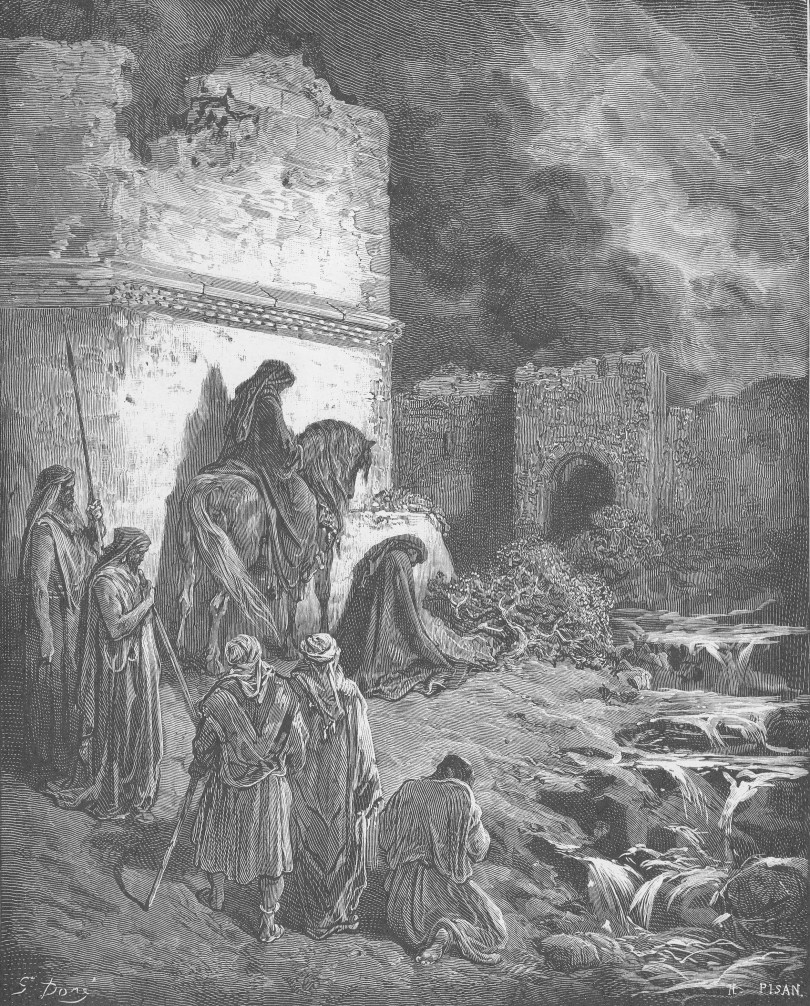
Nehemiah and National Renewal

This past Wednesday, I was asked to fill in for the pastor at the small church I attend.  Being such a small church—our average Sunday morning attendance is about forty—the pastor works another job, and he had a rare business trip.  I suppose he figured he could do worse than asking a high school history teacher to fill in for him.

Fortunately, the lesson was fairly straightforward:  he sent me a handout on Nehemiah 1:1-11, and the focus of the lesson was on the idea of spiritual renewal.

For the biblically illiterate—a shocking number of Americans today, I’m finding (I once had a class full of philosophy students who had never heard the story of the Tower of Babel, which is pretty much Sunday School 101)—the story of Nehemiah is simple:  after an extended period of exile in Babylon, the Israelites were sent back, under the auspices of the Persian Emperor Cyrus the Great, to Jerusalem.  Cyrus sponsored the rebuilding of the Temple in Jerusalem, but the city itself, as well as its walls, remained in a state of disrepair.

There were two waves of Israelite resettlement over the span of a century, but many Israelites remained in Babylon or other parts of the Persian Empire, such as the imperial capital.  Nehemiah was one of those, and would be part of a third wave of resettlement.  He served as cup-bearer to Artaxerxes, the Persian emperor at the time.  The position of cup-bearer was an important and trusted one:  he handled the emperor’s food and drink, ensuring it was not poisoned.

Beyond serving as the royal taste tester, the office carried with it important administrative duties, and gave incredible access to the emperor.  In short, it was a position of great influence, power, and prestige, which positioned Nehemiah nicely for what was to come.

Nehemiah spoke to a fellow Israelite who was visiting the imperial capital, and was distraught to hear of the poor condition of the city and its walls.  He fell to his knees, weeping and crying out to the Lord.  Nehemiah 1 details his prayer to God, calling out in adoration; confessing his and his people’s sins; thanking God for His mercy and gifts; and supplicating God for His Will to be accomplished through Nehemiah.

Specifically, Nehemiah asked God to be used to rebuild the wall around Jerusalem.  As cup-bearer, Nehemiah was able to present his petition to the emperor, who agreed to send Nehemiah to oversee the construction project.  In addition, Artaxerxes provided lumber from the royal forest, as well as funds to bankroll the endeavor.  He also sent letters with Nehemiah detailing his endorsement of the project.

Nehemiah’s work was not finished there, and it was anything but easy.  Initially, surrounding tribes criticized and mocked Nehemiah, questioning his loyalty to Artaxerxes, and saying that rebuilding the walls was a silly waste of time and effort.

However, once the wall reached half its height, his critics began plotting violence.  The plot to attack the workers reached Nehemiah, so he divided the work crews into those building the wall, and those defending their fellow workers from attack.

Having failed to stage an attack on the workers, Nehemiah’s enemies realized that the man himself was the target—cut off the head, kill the snake.  Again, God revealed this plot against Nehemiah, and he was able to avoid assassination.

Finally, the wall was rebuilt in an astonishing fifty-two days, an incredible feat of organization, ingenuity, and faithfulness.  The naysayers were humiliated, and Nehemiah instituted a period of national and spiritual renewal among the Israelites.  His reforms purified the nation spiritually and even ethnically, as old debts were forgiven and marriages to pagan women were dissolved.

It’s a powerful story—indeed, a powerful bit of history—about trusting in God in the face of extremely difficult odds.  But Nehemiah is also a story about national renewal, and the spiritual revival that came with it.

The wall around Jerusalem served a practical purpose—defending the city and its inhabitants from attack (even though the city was under the protection of the Persian Empire, the ancient Near East was, then as now, notoriously tribal, and the collapse of an empire would lead to dozens of ethnic conflicts)—but it was also a symbol of the Israelite nation.

Indeed, the author of the handout I used Wednesday evening writes that the “enemies of Israel could say, ‘What kind of God do you serve?  Look at the mess of your Holy City?’ It was a terrible witness and was cause for reproach from non-believers.”  The poor condition of the Jerusalem and its fortifications reflected the spiritual decay and corruption of the Israelites—they had intermarried with pagan women, adopting their false gods; they were living in rubble; and their reduced condition suggested that their God—the One True God—was not Who He made Himself out to Be.

It’s a bit on the nose, but I can’t help but recognize the parallels between the United States today and Jerusalem then—and between President Trump and Nehemiah (although I think Trump is closer to Cyrus the Great in terms of his spirituality and outlook).

I’m not suggesting Nehemiah was clubbing with Eastern European supermodels.  But like Trump, he faced overwhelming resistance from other nations to his wall project.  The rest of the ancient Near East feared a strong, renewed Israel.  Nehemiah’s return to Jerusalem, and the reconstruction of the wall, led to a period of national revival, as the people regained their identity, expelled the corrosive foreign influence in their midst, and renewed their commitment to God.

America is, spiritually and culturally, in similarly dire straits today.  President Trump has presented himself as a modern-day Nehemiah, come to control our borders, enforce our immigration laws, and restore America’s greatness on the world stage.  While he has made great strides in these areas, he meets resistance, duplicity, and mockery at every turn.

The story of Nehemiah tells us, however, that the struggle is worth the slings and arrows our enemies, both foreign and domestic, will lob at us.  To President Trump, I would urge the following:  stay the course, ignore the haters, take it to God, and BUILD THE WALL!

TBT: Family Matters Follow-Up Part II: The Welfare State and the Crisis of the Family

TBT for this week: https://theportlypolitico.blogspot.com/2016/08/family-matters-follow-up-part-ii.html

Last week’s featured a follow-up to one of the most read pieces on my old site, “Family Matters.”  That piece generated so many questions and comments on Facebook back in 2016 that I wrote two lengthy follow-up posts.  This post deals with the deleterious impact of the welfare state upon the family, looking first at the effect of the Great Society on the black family.  It then examines how those negative consequences spread beyond racial barriers to destroy traditional and nuclear family formation across races.

Now, over half of children born to women under 30 are born out of wedlock, regardless of race.  Economics doesn’t explain that story entirely, but misguided government policy, which placed perverse incentives on single motherhood, have driven what is ultimately a cultural and spiritual decline.

The details are in the post below, so without further ado, here is 10 August 2016’s “Family Matters Follow-Up Part II: The Welfare State and the Crisis of the Family“:

My series of posts on the decline of the traditional family unit in the United States and the West has generated a great deal of discussion (and, occasionally, some bitter recriminations).  Thus, after the overwhelming feedback and requests for clarification I received to “Family Matters,” I decided to expand upon some portions of that piece (click here to read “Follow-Up Part I” about divorce and sex education).

One of the claims of “Family Matters” concerned the “havoc” President Lyndon Johnson’s Great Society/War on Poverty wreaked on the black American families.  In the original post, I failed to link to any data or articles to substantiate this claim, but I’ve since updated the post with links to Daniel Patrick Moynihan’s famous “Moynihan Report” (actual title:  The Negro Family:  The Case for National Action) and a piece from 2015 that summarizes some of the main points of the report.

The late Daniel Patrick Moynihan–who would go on to serve as US Ambassador to India and the United Nations, then as a Democratic Senator for New York–enjoys a rare respect as a liberal among conservatives.  Though he was a leftist on many issues, he was first and foremost a scholar with a commitment to following the data wherever it took him.

The so-called “Moynihan Report”–which he wrote while working as a bureaucrat in the Department of Labor in 1965–demonstrated that many of the problems of the black community were caused only in part by discrimination, but much more so by a decline in marriage and stable family formation.  While racial discrimination was (and–I would like to think to a lesser extent–still is) a major problem in the 1960s, it alone could not explain adequately the plight of many black Americans.

Instead, what Moynihan discovered was that well-intentioned government programs inadvertently subsidized single motherhood, and were destroying the black family.  Indeed, the “national action” for which Moynihan called was that which would reinforce “the establishment of a stable Negro family structure.”  This national goal would be “difficult,” but “it almost certainly offers the only possibility of resolving in our time what is, after all, the nation’s oldest, and most instransigent, and now its most dangerous social problem.”  (Moynihan, The Negro Family)

I once heard a conservative black gentleman from Darlington, South Carolina, summarize Moynihan’s argument thus:  at a time when black men faced legitimate discrimination in the workforce, and could lose their jobs on the flimsiest of pretexts, the federal government came along offering generous support to single mothers.  By 1975–ten years after Moynihan’s prophetic report–a head of household would have to earn $88,000 (in 2015 dollars; about $22,000 in 1975) to out-earn the benefit from the federal government.  (Jack Coleman, “Juan Williams:  Daniel Patrick Moynihan ‘Had it Right’ About Breakdown of the Black Family”)  As Jason Riley, author of Please Stop Helping Us:  How Liberals Make it Harder for Blacks to Succeed wrote in a 2015 op-ed in The Wall Street Journal, “In effect, the government paid mothers to keep fathers out of the home–and paid them well.”

Not surprisingly, many women took note of this benefit.  Some of them–and, yes, I know what you’re about to read will be hard to believe, but it actually happened–calculated that they were better off divorcing their husbands or having a child out of wedlock, especially given the real, costly discrimination their husbands faced.  Government do-gooding, coupled with a legacy of racial discrimination, caused many young black children to grow up without fathers.

Initially, that might not have been a huge problem… but it metastasized.  Young boys grew up without father figures to shape them, and came to expect that leaving a woman, or having children with multiple women, was natural.  Young girls grew up thinking they had no reasonable expectation of their man sticking around.  With each generation, the problem grew worse and worse, until now roughly 72-73% of black children born in America are born to a single parent.

“[S]imply replacing one parent with a paycheck does not fulfill a child’s many needs.”

Single parenthood is sometimes the only option, but it’s a tough row to hoe.  Not only does it place financial burdens on the parent; it also removes from her or him the ability to parent a child adequately.  To quote economist Walter Williams at length:

“Whether a student is black, white, orange or polka-dot and whether he’s poor or rich, there are some minimum requirements that must be met in order for him to do well in school. Someone must make the student do his homework. Someone must see to it that he gets eight to nine hours of sleep. Someone has to fix him a wholesome breakfast and ensure that he gets to school on time and respects and obeys teachers.

“Here’s my question: Which one of those basic requirements can be accomplished through a presidential executive order, a congressional mandate or the edict of a mayor, a superintendent of schools or a teacher? If those basic requirements aren’t met, whatever else that is done in the name of education is for naught.” (emphasis added; Walter Williams, “Can Racial Discrimination Explain Much?”)

In other words, simply replacing one parent with a paycheck does not fulfill a child’s many needs.  Children born out-of-wedlock and raised by a single parent are more likely “to experience a variety of cognitive, emotional, and behavioral problems,” according to Dr. Paul Amato in “The Impact of Family Formation Change on the Cognitive, Social, and Emotional Well-Being of the Next Generation.”   That creates ripple effects for generations to come, and the cycle is difficult to break.

***

The problem was prevalent even before Moynihan wrote his report (which, not surprisingly, caused many of his fellow-liberals to accuse him of “racism” and bigotry–common tactics when faced with an unpleasant truth).  Ronald Reagan, while campaigning for Arizona Senator and Republican presidential candidate Barry Goldwater in 1964, told the story in his magisterial “A Time for Choosing” speech of a mother who divorced her husband to get a check from the government, and how she learned to do it after talking to two other women who’d also gamed the system.

We’ve now had fifty-one years of the Great Society, and while some of its programs helped alleviate malnutrition and other problems that are, thankfully, dwindling issues, its good intentions created a host of other problems.  In 1965, one could still plausibly claim that government do-gooders merely didn’t know any better.  Now, the argument seems to be, “Well, we’re trying to do the right thing, so that’s all that should matter.”  That’s prime paving stone for the road to hell.

“The decline of the family is a problem all Americans will have to address.”

Moynihan argued that black Americans in particular were experiencing the decline of family formation most heavily because of the “tangle of pathologies” stemming from centuries of slavery and a century of legal, social, and economic segregation, and that this legacy dovetailed disastrously with the perverse incentive toward divorce and single motherhood.  As he predicted, this tangle morphed into a multi-generational cycle that has ground many black Americans further into poverty.

In 2016, the negative consequences have not only magnified the problem among black Americans; it’s spread throughout American society.  There’s been a crisis among black families for fifty years; we ignored it at our peril.

The experience of black American families since the 1960s is a sad story, though there are many brave black mothers and fathers who raise their children with love and support.  They are struggling to break a dangerous cycle, one that swirls in a murky stew of cultural, social, and economic pressures against the two-parent family and traditional marriage.

Racism appears to have enhanced the deleterious effects of the welfare state in the case of black families, but now those negative consequences are increasingly color-blind.  The decline of the family is a problem all Americans will have to address.

(For additional reading, check out the works of Walter Williams, a brilliant economist and political conservative who, as it happens, is black.  Start here for an appetizer:  http://www.washingtonexaminer.com/can-racial-discrimination-explain-much/article/2556814; after that, get Race and Economics:  How Much Can Be Blamed on Discrimination?)

Happy Presidents’ Day

Happy Presidents’ Day, TPP Readers!  To honor Presidents’ Day, here is a reading list.  Enjoy with your morning coffee on a day off (or, for those of you that have to work, enjoy while engaging in rampant time-theft as you sit unnecessarily at your desk for eight hours):

I particularly like the story of the Texas Seed Bill.  Farmers in Texas were struggling through a difficult drought, and requested money from Congress to buy new seeds.  When the bill hit President Cleveland’s desk, he vetoed it, arguing that the federal government was not in the business of helping out folks with their financial problems, no matter how deserving they might be.

That was political suicide for the Democrat, who already had friction with the party’s base of Western and Southern farmers over his endorsement of the gold standard (farmers wanted “free silver” or bimetallism to inflate the currency by adding silver to it).  But, there was a silver lining:  once the Texas farmers realized they weren’t going to get the money, they worked among themselves to raise ten times the requested amount.

Once again, Americans solved their own problems.  That’s an important lesson to remember this Presidents’ Day.

Secession Saturday

Care of photog at Orion’s Cold Fire, here’s a thought-provoking piece by Christopher Roach of American Greatness, “The Left Won’t Allow a Peaceful Separation“: https://amgreatness.com/2019/01/21/the-left-wont-allow-a-peaceful-separation/

Roach touches on some of the same points I bring up in my essay “Progressivism and Political Violence,” in which I diagnose some of the well-known pathologies of the Left, including its tendency towards totalitarianism. That impulse is why the Left is never content to adopt the Right’s “live and let live” mentality. Thus, the willingness to eat their own (as in the Northam non-troversy), to demonize young conservatives, to harass conservatives at dinner, and to denounce anyone who doesn’t believe whatever the latest frontier of social justice is this week.

The idea that America is in a “cold civil war”—one that is turning increasingly hot—isn’t nothing new (sadly). Controversial Dissident Right figure John Derbyshire calls it a conflict between “goodwhites”—the limousine liberals and soccer moms who think Trump is mean and who want to virtue-signal to minorities to appear cool and progressive—and “badwhites”—the rest of us folks in “flyover country” who largely want to be left alone to enjoy our faith, family, and liberty in peace.

That the cold, cultural civil war may turn hot is a cause of concern to many folks on the Right and Left. I shudder to contemplate it. Roach, in his piece, argues that a peaceful separation may one day be the result of our current Kulturkampf, but he is pessimistic that the Left would willingly let anyone leave, due to its totalitarian nature.

He also points out that, though we often forget it, the United States is, itself, a product of secession—from merry old England. As I often point out to my students, the question of whether or not States were bound permanently to the Constitution was an open question until 1865. The Jeffersonian “compact theory” argued, essentially, that the States had formed the Union and “opted in” to the Constitution. The big, open question prior to the American Civil War, then, was thus: having opted in to this arrangement, did States have the ability to opt out? A straightforward reading of the Declaration of Independence suggests heavily that, in certain extreme circumstances, they might be able to do so.

As I’ve long told my students, the Civil War answered that question conclusively by force of arms. Now, States sue the federal government through their respective attorney generals’ offices should there be any conflicts between them and the feds.

That said, as I’ve grown older, I’ve come to realize that no political question is ever truly “settled,” and no political arrangement—even one as enduring and amazing as our federal constitutional republic—can last forever. The idea of secession could be given a renewed lease should the federal government continue to overextend its authority, and should the culture wars deepen and darken.

To be clear, I’m not advocating for secession or anything of the sort. I’m merely exploring—in a very brief way—a complex idea that is, in the balance, not entirely without merit. Regardless of the motivations for the American Civil War, the notion of States’ rights—an entirely constitutional idea, per the Tenth Amendment—and of “compact theory” are quite sound, and could enjoy renewed credibility.

There is much to chew on and mull over here. I recommend you read Roach’s piece and make up your own mind. Feel free to leave comments below.

Happy Saturday!

–TPP

TBT: The Alabama Special Election, Principles, and Persecution

Back in 2017, I was enthusiastic about the candidacy of Judge Roy Moore as he ran for US Senate in a special election in Alabama.  Moore is a darling of social conservatives because of his willingness to challenge flawed higher court rulings on the establishment of religion.  He famously refused to remove a monument of the Ten Commandments from the Alabama State Supreme Court in defiance of a federal court ruling, and was elected back to the bench after being removed for his defiance.

I relished the idea of this bumptious, no-nonsense Christian in the US Senate, and after he won the Republican nomination in a heated campaign against Establishment GOP favorite Luther Strange, I figured he would coast to an easy win.

Then, of course, the Left brought out the knives, and heretofore unspoken allegations of sexual misconduct from the murky past surfaced.  Remember, Moore ran in multiple races, often as a controversial and high-profile figure, without any of these allegations ever surfacing.  What made this race different?

In this piece from December 2017, I argue that Moore was railroaded, and that while some of the stories of his age-disparate relationships with teenage girls were likely true, they all seemed relatively benign given the times (the swingin’ 1970s).  My basic takeaway was, and is, this:  the worst of the allegations against Moore also was the most incongruous from others; Moore was super respectful to the other girls who mention dating him; and several of the girls were eager to date a successful, older attorney.  Essentially, it’s highly unlikely he did anything illegal or wrong; he was just a dude who liked dating girls in their late teens.  That’s a big unusual, but he wasn’t breaking any laws at the time.

With the modern Left, though, yesterday’s unorthodox peccadilloes become today’s wicked heresies (and vice-versa).  That Moore is a fundamentalist, evangelical Christian made him an even more appealing target for character assassination.  The noodle-wristed hand-wringers of Conservatism, Inc., were all too willing to fall over themselves proving to the Left that they, too, were good guys with their denunciations of Moore.

Here, then, is 2017’s “The Alabama Special Election, Principles, and Persecution“:

The campaign of Alabama Senate candidate Judge Roy Moore is reeling after allegations that, in the 1970s and 1980s, Moore dated several teenage girls.  The Washington Post article that broke the news focuses on Leigh Corfman, who alleges that Moore approached her at the courthouse in Etowah County, Alabama, when she was only fourteen-years old.  After obtaining her phone number, Corfman claims Moore met with her and forced her to touch him over the underwear.

Several other women also told the Washington Post that they dated Moore while he was in his early 30s and they in their late teens.  These other women were between sixteen and eighteen (sixteen is the legal age of consent in Alabama), and report that their dates with the young deputy district attorney were respectful, involving no physical contact beyond hugging and kissing.  One of the women even said her mother was thrilled that her daughter was dating a successful attorney.

Judge Moore denied all of the allegations, but each day seems to bring some fresh revelation or twist.  He has since said that he may have dated some teenagers of legal age when he was younger.  The truth is difficult to discern, but here is what we do know:

  • Four women–all above the legal age of consent–reported that Moore was respectful (one noted that after her mother forbid her from dating an older man, their relationship ended, apparently without any further fanfare).
  • Leigh Corfman, who was fourteen at the time of the alleged groping, was the only woman accusing Moore of any explicitly illegal and illicit sexual activity.
  • Tina Johnson emerged a few days into the controversy, alleging that Moore grabbed her butt in 1991. (Link)
  • Judge Moore has been married to his wife, Kayla Moore, who is younger than him by fourteen years, for decades.  She has defended her husband fiercely in the face of these accusations.
  • Moore has run multiple local and statewide campaigns–many of them controversial–and no allegations have emerged during any of these (highly contentious) campaigns.
  • Moore is a boogeyman for the political Left, and something of a Jacksonian folk hero for the Right.  He famously refused to remove a monument of the Ten Commandments from the grounds of the Alabama Judicial Building after a federal court ruled it constituted an establishment of religion (Alan Keyes eloquently denounced that federal court order in a classic essay–and, for my students, perennial Government class assignment–entitled “On the Establishment of Religion:  What the Constitution Really Says“), leading to his removal from the Alabama Supreme Court in 2003.

    He was reelected to the Alabama Supreme Court ten years later, only to be removed again in 2016 for refusing to comply with the Supreme Court’s dubious decision in Obergefell v. Hodges, the landmark case that read into the Constitution a heretofore unwritten and unrecognized right for same-sex couples to marry.

  • Moore was favored by the Bannonite-wing of the Republican Party (if such a thing exists) in the intense Republican primary run-off battle against Senator Luther Strange, who had been appointed to fill the vacant seat after Jeff Sessions was tapped to serve as Attorney General in the Trump administration.  The Republican Establishment–notably Senate Majority Leader Mitch McConnell, but also President Trump–supported Strange, while Moore was cast as the “Trumpian” candidate.
Those last two points raise my eyebrows.  Here’s a man who is no stranger to (political) controversy, the consummate culture warrior in an age when every political battle seems to connect to cultural and social values.  Moore’s firm religious convictions make him evil in the eyes of progressive Democrats, and embarrassing to well-heeled, Establishment, country-club Republicans.

It’s no secret that the Washington Post endorsed Moore’s opponent, Democrat Doug Jones.  Then the Post sought out women who claim to have had encounters with Moore.  For a heavily left-leaning publication hoping to humiliate the sitting president and the Republican Party in a deep red state, the temptation to go after a popular but controversial populist figure would have to have been palpable.

The disdain of the Establishment Republicans for Moore (and, by extension, President Trump) could explain the fervor with which they have gone after Moore, calling for him to resign within mere hours of the Post‘s story breaking.  It’s as though McConnell was just waiting for something like this to cross his desk, so he and other RINOs could rush out to denounce Moore and try to twenty-three-skidoo in their preferred candidate.

It seems that Republican leadership has succumbed to the same mania for virtue-signalling that dominates the Left.  I can barely read National Review–formerly one of my favorite publications–because of its consistently noodle-wristed editorializing whenever any populist-oriented Republican speaks out of turn.  Just read David French’s off-putting essay on “creepy Christianity” here.  With friends like these, who needs enemies?

The worst of the accusations–the groping of the fourteen-year old and the incident in 1991–don’t seem to fit the pattern of the stories the other women told the Post.  I’m fully willing to concede that, based on what we’re learning now, a young Roy Moore dated some girls in their late teens.  He married a woman fourteen years his junior.  Clearly, he had a taste for younger women, but he hasn’t committed adultery, as one of his most vocal critics, Senator John McCain, did, and his relationships, by all accounts, were above-board.  He’s remained faithful–as far as we know–to his wife.

“For a heavily left-leaning publication hoping to humiliate the sitting president and the Republican Party in a deep red state, the temptation to go after a popular but controversial populist figure would have to have been palpable.”

It may seem unorthodox now–and I am certainly not advocating that thirty-two-year old men start dating sixteen-year olds!–but such age-disparate relationships were more common and socially acceptable forty years ago.  For a fuller examination of this point, I refer you to Frank J. Tipler’s piece at American Thinker; read it here.

Regardless, the Left has no logical grounds for objection.  How can a philosophical and political movement that endorses every sexual arrangement imaginable stand against legal, age-disparate, consenting relationships and maintain even a modicum of internal consistency?  Again, this is no endorsement of such relationships, but if you’re the party of transgender, bisexual, polyamorous, gay, lesbian, queer, inter-species rights, how can you draw the line here?  You’ve already run miles past it.

Ultimately, squeamish National Review-and-Establishment types are claiming the moral high ground, arguing that a US Senate seat isn’t worth sacrificing principles.  At this point, though, their haste to condemn Moore smacks of moral cowardice and political opportunism.  Are they not going to at least entertain the idea that the man is innocent, or was just a bit unorthodox in his dating habits forty years ago?  Rather than try to scuttle a still-popular candidate before he barely has a chance to defend himself, could not McConnell and other Senate Republicans attempt to reach out to the Moore campaign?  Even if he’s not your style of Republican, you could learn to work with him, rather than prome to expel him from the Senate if he wins!

This video from Stefan Molyneux (below; WARNING–NSFW) gets down to brass tacks:  preserving the Republican’s razor-thin majority in the Senate is worth showing some political backbone, rather than allowing a partial-birth abortion-supporting Democrat to snag the seat.

This election suggests that Establishment Republicans, for all their talk of decorum and principles, are sometimes little better or different than their Democratic opponents.  They don’t want a scrappy culture warrior  And despite some dire poll numbers, the accusations may not stick:  according to RCP polling, Moore was up 3 points over Jones (as of 14 November), though he has fallen to a far more dicey 0.8% lead (as of 16 November, the date this post was written).  That’s within the margin of error, though certainly not the double-digit lead Republicans want in Alabama.  More on those poll numbers, and my analysis of them, to come.

If we learn that Moore did indeed assault Leigh Cofrman, than I’ll retract my defense of him immediately.  But for now, we have no consistent pattern of bad behavior, and what appears to be some very powerful opponents arrayed against a man who has suffered professionally for his beliefs.  From where I’m sitting, Judge Moore’s treatment looks more like persecution than justice.

The Facts on the Border Crisis

As I’ve learned more about immigration—and especially since reading Pat Buchanan’s Death of the West—I’ve come to believe it is the defining crisis of this moment in American history.  The debate is not, as it has been in the past, primarily around how much immigration is desirable; rather, the question has morphed beyond reason into “does a wealthy nation have the right to define and enforce its own immigration laws?”

That used to be axiomatic to what it meant to be a nation:  by definition, a nation had the right to defend its borders, and—of course!—to have them!

Now, there’s a twisted logic that, because the United States has loads of wealth (and won tons of land from Mexico in the Treaty of Guadelupe-Hidalgo, after we soundly defeated them and captured Mexico City), we somehow have a moral obligation to surrender our sovereignty to every hard-luck case in the Western Hemisphere (and beyond).

America is a melting pot, but if you dump a bunch of salt into the soup all at once, it becomes inedible—the salt takes over.

Case in point:  the aforementioned Mexican War.  That conflict had its root in the Texas Revolution, in which the Republic of Texas gained its independence in 1836.  Texas was a province of Mexico, and the Mexican government wanted to encourage settlement, so it invited Southern yanquis to move in with their slaves.

Those American settlers had two requirements:  they had to convert to Catholicism (the official state religion of Mexico), and they had to become Mexican citizens.  A handful of token conversions later, and the Texans were in.

In 1829, Mexico abolished slavery throughout its territories.  The slaveholding Texans protested; rather than face the threat of secession of its unassimilated but wealthy minority, the Mexican government relented, granting unprecedented, asymmetrical “states’ rights” to Texas.

While Mexicans resented Texas’s special treatment, everything was fine until the military dictator General Lopez de Santa Anna rose to power.  Santa Anna vowed to end Texas’s exemption from federal law.  When he moved to enforce his decree with the Mexican Army, the Texans declared independence; after their defeat at the Alamo, American volunteers flooded in to help Texas gain its independence.

The moral of the story here is clear:  a large minority of unassimilated foreigners successfully ignored the laws of their host country, before ultimately breaking off to form a short-lived nation, before annexing into the nation of their native culture.

Mexico is playing the same playbook in reverse; indeed, some Mexican radicals call the influx of unassimilated, illegal migrants into the southwestern United States the reconquista, or “reconquest.”

Death of the West is the best feature-length discussion of that process.  For a shorter, more immediate discussion of the impact of illegal alien migration, the White House has published a page of statistics about the crisis at the border: https://www.whitehouse.gov/briefings-statements/crisis-southern-border-urgent-ignore/

Stop screwing around—and build the wall!

Friday Musings: Populism is East versus West

I share my classroom with a veteran history teacher, who teaches my school’s eighth grade South Carolina History course.  The students are currently covering the events leading up to the American Revolution, particularly the unpopular Proclamation Line of 1763.  His discussion of the topic led me to a minor epiphany.

First, some historical context:  after the British defeated the French and their allies in the French and Indian War (the Seven Years’ War in Europe), millions of acres of land west of the Appalachian Mountains were open to American settlement.  The Americans were bursting with pride in delivering a hard-fought victory against Britain’s major European foe, and were eager to enjoy the spoils of war:  the newly opened lands.

Unfortunately, Parliament stalled land-hungry settlers with a well-intentioned but misguided policy:  the Proclamation Line of 1763.  According to an act of Parliament, there was to be no settlement west of the Appalachian Mountains.  The land was to be left to the Indians living there.

The policy was not without merit:  the British spent a great deal of blood and treasure fighting Indians during the French and Indian War, and while the conflict was global in nature, most of the fighting occurred in British North America and present-day Canada.  A major source of bad blood was the tendency of Americans to move onto Indian-owned lands; similarly, rapacious Indians would raid vulnerable settlers in the western parts of colonies (such raids fomented an early populist uprising of farmers in western Virginia, Bacon’s Rebellion, in 1676).  The British sought to avoid another costly war with the natives by preventing their future antagonism:  keep Americans off that land.

Americans, understandably, were livid.  For one, they saw it as Britain rewarding the very foes they’d just vanquished (keep in mind, too, the ferocity of native warriors—there’s a reason we name our military hardware and athletic teams “The Braves” and the like).  They also believed this land was their destiny and their birthright—having defeated a tenacious foe, they were ready to head west.

What got me thinking was a comment my colleague made; to paraphrase:  “If Parliament had just sat down with the colonists and discussed it with them, they could have avoided a lot of disaster.”  That comment made me realize:  so much populism is a conflict between an indifferent Eastern (now bicoastal) elite, and an energetic, cantankerous Western settler-class.

That is, by no means, a novel insight (see also:  Bacon’s Rebellion).  The insight, however, is the repeated unwillingness of elite interests to try to understand or cope with the sources of the common man’s difficulties.  Some differences are, indeed, intractable, but it seems that, in many cases, elites could hear out and account for the problems of the common folk.

Indeed, in many cases, both are right.  Consider the historic struggles between Thomas Jefferson and Alexander Hamilton.  Thank goodness George Washington heeded Hamilton’s advice for how to structure the finances of the young nation.  Hamilton’s fiscal policies set the United States on firm footing, building investor confidence and shoring up the American government’s credit.

On the other hand, Jefferson was right that Congress had no explicit authority to establish a national bank, and that we shouldn’t become too dependent on urban industrialization and finance, lest we lose our sense of republican virtue.

There are, increasingly, fundamental disconnects between America’s urban elites and rural commoners.  Witness New York State’s catastrophic, plainly satanic abortion law, which (from all the discussion around it), seems to allow for abortion while a woman is still in labor.  There’s no compromising with an idea that is, unarguably, evil.

That said, elites should take seriously the common American’s keen sense for fair play.  Illegal (and mass legal) immigration is deleterious not only because it is illegal, but because it hurts native-born Americans, driving down their wages (for the benefit of the elites) and transforming their neighborhoods and towns.  Americans will welcome a reasonable number of legal immigrants with open arms, but they expect immigrants to come legally, to assimilate, and to become loyal American citizens (including breaking ties with their old countries).

The elites are people, too, and often act in what they believe is for the greater good, or for long-term national preservation (at least, this statement seemed accurate in America’s past; our postmodern elites seem largely committed to undermining core American principles).  That said, they’ve adopted the Left’s prevailing ethos of de facto nihilism and materialist self-indulgence, along with the Left’s disdain for the common man.

In short, the elites have lost any sense of noblesse oblige, of obligation to maintaining a good, happy, healthy society.  They are as far removed from their fellow countrymen as East is from West.

TBT: Brexit: The Antidote to Supranational Tyranny

The first indication that a major sea-change in Western politics was underway was the historic Brexit vote in June 2016.  The mere fact that Britain voted to leave the European Union boosted nationalist movements in Europe, and reflected the growing discontent of Britons with the policies of their elites.  That frustration manifested itself outside of Britain, and seemed to presage—at least in hindsight—Trump’s unlikely, underdog victory in November of that year.

The following is my first piece on Brexit, dated 13 June 2016.  I wrote it in response to a student’s inquiry.  That launched a series of pieces on Brexit that I will—eventually—compile into an eBook, the title of which will draw from a phrase I coined for this article:  “supranational tyranny.”

In essence, I argued then (and still argue now) that Brexit was, at bottom, a referendum on national sovereignty.  Issues like trade and immigration, while quite important, were merely the outgrowth of that fundamental issue.  Brexit, in so many words and in so many ways, simply asked, “Can a country make its own decisions about its own destiny?”  Like so many fundamentals, that we even have to ask the question demonstrates how far postmodern deconstructionism has taken us.  Regardless, the people of Britain resoundingly answered, “YES!”  The vote to leave was not an endorsement of xenophobia or anything else:  it was a vote for national sovereignty.

The European Union was a classic bait-and-switch:  Britain joined under the pretense that it was entering an economic free trade zone.  That morphed—it seems, based on the EU’s charter and its goal of “ever closer union”, deliberately and by design—into the supranational, undemocratic behemoth it is today, with decisions largely dictated from Germany and its toadie, France.  When the people lost the ability to control their own borders and immigration policies—the bare-bone essentials of what constitute a “nation” and “national sovereignty”—they seized the opening and voted for liberty and sovereignty over continued acquiescence in exchange for goodies.

Here is June 2016’s “Brexit:  The Antidote to Supranational Tyranny“:

I’ve been planning to do a few pieces on the question of “Brexit”–whether or not the United Kingdom should leave the European Union, or to remain a part of it–but originally intended to wait until the 23 June referendum drew closer.  However, over the weekend I received this e-mail from a student:

A summer vacation well spent.
In case you can’t read the e-mail, here’s the text in full:
Dear Mr[.] Cook (Self entitled defender of Rock & Roll),
I know this isn’t the average email you get from a student, political. However, with one of the most impactful votes to effect [
sic] the US economy to take place in just 11 days, June 23, I would like to ask how you felt on the United Kingdom’s vote on whether to stay in the EU or leave it. US news has refused to cover this major event due to irresponsibility and foolishness. Just wanted to know your thoughts on this vital subject.

(Please note that I am blessed to teach some very bright students.)

Brexit is a hugely complicated issue; however, viewed through the lens of national sovereignty versus the dubious claims of supranational organizations, the ultimate solution is, in my mind, a no-brainer:  the people of Great Britain should vote “Leave” this June.

Now for some preliminary disclaimers, lest I be burned in effigy:

To any British readers, please do not presume that an upstart, boorish American is preaching at you about what to do with your national destiny.  If the situation were reversed, I’d rightfully scoff at any attempts from “Europeans” to tell my country how to function.  However, I ask that all readers approach my arguments for Brexit in a philosophical and rational way; that is, treat them in the context of one mind reasoning from a set a premises, not as an American lecturing foreign nationals about their sovereign politics.

(British readers–if you exist–please feel free to leave your comments, reflections, reactions, and bitter recriminations below; I respect and welcome your perspective, which is far more accurate and attuned to the realities of the situation than my own.)

I’d also like to acknowledge the influence of a book review I read over the weekend in the 9 May 2016 edition of National Review(Volume LXVIII, No. 8).  The review, written by John Fonte and entitled “The EU’s Soft Utopia,” is of the book The Totalitarian Temptation:  Global Governance and the Crisis of Democracy in Europe by Todd Huizinga, a long-time observer of European Union politics.  I highly recommend you seek out this review.  I intend to read the book soon.

 ***

Now that those pleasantries are out of the way, I’d like to lay out my case, clumsy though it may be.  My remarks are adapted from those I sent to the young man above.

The Brexit issue is one of huge importance to the US, the UK, and Europe, and while it has not been covered heavily in the mainstream media, I’ve read a number of articles about it in both National Review and the Weekly Standard.

The question of whether or not to vote “Remain” or “Leave” really depends on your perspective and your goals, or what you think the European Union is supposed to do.  The EU itself tries to appear unsure of its goals, but its mission clearly states that it seeks “ever closer union” of the various member nation-states.

The EU began life as essentially a large economic free trade zone that gradually expanded, and which then adopted a common currency in the late 1990s (a move, we now know, that was fraught with peril, especially as it is very difficult for disparate nations at different points of economic development and national sovereignty to share a single currency effectively; see also Greece).  My perception is that the EU wants to become, ultimately, the “United States of Europe”; indeed, this goal is straightforwardly expressed by many pro-Europe observers.  The question, then, is this goal desirable or not?

 The United States of Europe, where six-weeks paid vacation is a basic human right.

It certainly has elements that are attractive.  In theory, a politically unified Europe becomes a powerful check against Vladimir Putin’s Russia.  Many of the “far-right” populist parties in European nations (France’s National Front, Germany’s Alternativ für Deutschland, etc.) are gaining traction now due to the flood of (often violent) Islamic “refugees” into Europe, and many of those groups view Putin’s ultra-nationalistic Russia warmly (some, too, are allegedly bankrolled by Russia).  Moving toward greater union would help resolve the economic problems the euro faces, as it would allow the EU to change monetary and fiscal policy in its member states, which would no longer look like America under the Articles of Confederation, but would instead look more like America under the Constitution.

At least, that’s how we’re supposed to view it.  Unfortunately, that comparison quickly falls apart under scrutiny.  The constitutional order our Framers carefully constructed in 1787 functions verydifferently than the European Union conceived of by its architects.  The EU is largely run by an unelected, globalist-progressive bureaucracy that is both unaccountable to the peoples and sovereign member states of Europe, and which has already acted to oust democratically-elected leaders (see also:  Italy).  Sure, there’s the European Parliament, which is currently (and ironically) dominated by members from Euroskeptic parties like UKIP, but it has only limited functions and can essentially only vote to block decisions made by the European Commission, itself made up of unelected commissioners.

The EU, then, cares not for democratic input, national sovereignty (and, therefore, borders), or federalism.  A United States of Europe would be a heavily centralized unit that might allow some state sovereignty in some limited areas, but would ultimately have vast, unchecked control over its members, with little regard for what the people in those member states want (just look at Germany and Angela Merkel’s increasingly unpopular–and arguably dangerous–stance on the refugee crisis).

So, while a large, intact European Union would present a unified front against Russia, it would also be a largely undemocratic front against the United States.  Some have argued that the EU is necessary to keep NATO viable, but I don’t buy this argument.  NATO has functioned well, if somewhat inconsistently, with a couple of dozen or so sovereign states for decades.  If Britain votes “Leave,” how would this dynamic substantially change in the long-run?

A United States of Europe would be a heavily centralized unit that might allow some state sovereignty in some limited areas, but would ultimately have vast, unchecked control over its members, with little regard for what the people in those member states want….”

Ultimately, the Brexit vote is a referendum on national sovereignty.  If national sovereignty has any meaning and significance for the people of Britain–and for the world–British voters will resoundingly vote “no” to the EU.

Would such an outcome have ripple effects politically and economically?  Absolutely.  Britain might struggle temporarily because of the (admittedly) huge institutional and economic disruptions, but it would soon rock back to its feet, as it would find itself freed of the EU’s overbearing economic regulations and rules.  Britain is also well-positioned to leave, as it prudently maintained the British pound, and could very likely continue to accept euros for everyday economic exchanges.

The European Union might callously block trade with Britain, but Britain’s large financial and consumer markets would quickly erode any such vindictive measures.  President Obama has darkly warned that Britain would be at “the back of the queue” for future trade deals, which would be a slap to the face to the Churchillian, Anglo-American “special relationship.”  Our next president would, if he or she is wise, quickly embrace a “most-favored nation” treaty with Britain to keep trade open and affordable between our nations.

Putin might take advantage of the situation temporarily, but Europe and Britain would likely come together rapidly in the face of any Russian aggression.  Putin is wily and will take any advantage he can, which is all the more reason for the Obama administration to put aside its pro-EU stance and to support an independent Britain should the British people vote “Leave.”

Just because Putin might benefit doesn’t mean that Brexit is ultimately a bad idea.  A “Leave” vote would, in a paradoxical way, be healthy for the EU, as it would likely lead to the exit of nations that have no business being under the euro, such as Greece and Spain.  It would also inspire and embolden other nations to push for greater transparency, accountability, and democratization from the European Union’s leaders and institutions.

Most importantly, though, it would strike a blow against the totalizing, globalist elitism of the EU bureaucracy.  Brussels might see itself as enlightened, progressive, cosmopolitan–and, as a result, more humane–but it’s still authoritarian and anti-democratic-republican in the way it functions and pursues its vision.

Therefore, while I recognize the potential geopolitical and economic risks, I sincerely pray that the good people of the United Kingdom will strike a blow for republican self-government, national sovereignty, and liberty, and vote “Leave” this June.

The time for Brexit is now.  Like ripping off an old bandage, the initial pain will sting, but only briefly.  The old wound will heal, and a new, freer nation will enjoy the fruits of its sovereignty.