Buttigieg and Buchanan: Redefining Morality

It’s Good Friday here in Christendom, and while it feels like Christianity took one on the chin earlier this week, we know there’s victory in Jesus.

Indeed, Christianity has been compromised quite a bit lately, with the rise of “feel-good” non-denominational churches and the decline of High Protestant denominations, both succumbing, in different ways, to social justice pabulum. Blogger Dalrock writes extensively about how “conservative” churches are snookered into radical acceptance of homosexuality (and extremist feminism) as somehow Christ-like. That goes beyond “love the sinner, not the sin,” which is correct; Dalrock writes about “same sex-attracted” preachers in prominent non-denominational churches arguing that their gayness makes them “holy.”

Political pundit, noted paleoconservative, and devout Catholic Pat Buchanan has a piece on Taki’s Magazine this week about Mayor Pete Buttigieg, the out-and-proud Democratic presidential hopeful who is making waves because he’s a.) deceptively normal but b.) also gay, which isn’t as glamorous for the Left as being transgender, but it’s still their alternative lifestyle of choice. Buchanan examines “Mayor Pete’s” assertion that God made him gay, so he’s supposed to live that lifestyle (despite some very specific New Testament injunctions against homosexuality; unless Mayor Pete is the Second Coming of Christ, he’s adding to God’s Word).

Ultimately, gayness isn’t the issue (it’s just one of many bludgeons the Left wields in a relentless culture war). The issue is a persistent redefining of morality, not to mention the moral arrogance of Leftists who believe they, not God, can redefine thousands of years of moral absolutes.

Permit me to quote Buchanan at length:

Consider what has changed already.

In the 19th century, blasphemy was a crime.

In the Roaring ’20s the “vices” of booze and gambling were outlawed. Now they are major sources of state revenue.

Divorce was a rarity. Now half of all marriages are dissolved.

After the sexual revolution of the ’60s, births out of wedlock rocketed to where 40 percent of all children are born without a father in the home, as are half of Hispanics and 70 percent of all black children.

Pornography, which used to bring a prison term, today dominates cable TV. Marijuana, once a social scourge, is the hot new product. And Sen. Kamala Harris wants prostitution legalized.

In the lifetime of many Americans, homosexuality and abortion were still scandalous crimes. They are now cherished constitutional rights.

Yet, Mayor Pete’s assertion — that God made him gay, and God intended that he live his life this way, and that this life is moral and good — is another milestone on the road to a new America.

For what Buttigieg is saying is that either God changes his moral law to conform to the changing behavior of mankind or that, for 2,000 years, Christian preaching and practice toward homosexuals has been bigoted, injurious and morally indefensible.

The decline of the family and Christianity, I believe, are twin evils that brought us to this point. The two go hand in hand: without strong families, moral instruction falls to the wayside (or is delegated to progressive educators and the system that supports them). Without Christianity, the foundation that makes strong family formation possible is missing (at least, family formation loses its metaphysical component).

To be clear, we should not persecute homosexuals, and should treat them with dignity and respect. That said, we should not indulge their petulant outbursts, much less their insistence that their lifestyle is not just normal, but somehow godly. Statistically and morally, neither of those claims are valid or borne out by history or Scripture.

We should love one another, acknowledging we are all sinners in need of Christ. That does not mean we have to condone or enable sin, in whatever form. Homosexuality is particularly difficult to address, but we could start by not openly celebrating it all the time, nor should we encourage people struggling with those proclivities to define their entire being around their sexual preferences. What a terrible foundation upon which to build your identity!

Enjoy this Good Friday, and pray for direction on how we can renew our nation and our relationship with God.

TBT: Mark Sanford’s Ideology

Today’s #TBT mines the depths of my 2009 scribblings, during the “TPP 1.0” era of the blog.  Yesterday’s post about the “The State of the Right” got me thinking about how much the state of play has changed in the last decade, particularly since the Trump Ascendancy in 2015-2016.

One example of that change is former Congressman and South Carolina Mark Sanford.  Sanford was the first Republican I ever voted for in a general SC gubernatorial race, and I loved his fiscal conservative grandstanding (he once walked into the General Assembly carrying two piglets under his arms to oppose “pork barrel spending”; he allegedly barbecued the two oinkers later on).

He always took largely principled stands.  He refused to expand Medicare during the worst part of the Great Recession, knowing that once federal dollars were withdrawn, South Carolinians would pick up the tab.  He opposed the seatbelt law (you can now be pulled over specifically for not wearing a seatbelt in South Carolina, whereas before it was only ticketable if you were pulled over for some other infraction), arguing that adults can make their own decisions about their safety, and that traffic officers have enough to deal with already (it has to be difficult to spot through a window).

So, in my youthful naivete, I wrote a letter to my hometown paper, The Aiken Standard, showing my support for Mark Sanford.  He was under intense pressure to accept federal “stimulus” dollars, and when he relented, the opponents who argued he should take the money gleefully noted his inconsistency (a rule here:  the Left will never be satisfied).  Governor Sanford sent me a letter thanking me for the op-ed, which I still have somewhere on my bookshelf.

Then, less than a month or so later, Sanford was caught in a major sexual scandal (and I learned an important lesson about not overly-idealizing political figures).  After disappearing from the State, an aide told the press the governor was “hiking the Appalachian Trail” to clear his head.  A reporter with The State newspaper happened to see Sanford at the Atlanta airport at the time, and within days the whole sleazy story came out:  Governor Sanford had been in Argentina with his mistress (now wife), and his cloyingly sentimental love e-mails to her were blasted all over the news.

Sanford refused to step down as governor—a good call, as snake-in-the-grass, power-hungry, loafer-lightener Lieutenant Governor Andre Bauer would have taken over—and finished out his term.  Everyone was sure he was done with politics… until he ran for US Congress for SC-1, his old district during his tenure in the 1990s.

He won against incredible odds.  His opponent, Elizabeth Colbert-Busch (the sister of Comedy Central hack Stephen Colbert), received huge fundraising donations from Democrats all over the country, including from the national party.  Sanford—deprived of his wealthy ex-wife, Jenny Sanford—urged supporters to make homemade yard signs out of plywood, cardboard, or whatever they had around the house.

Outspent 4:1, Sanford won.  He successfully painted his opponent as a hollow stand-in for Chuck Schumer and Nancy Pelosi, and his grassroots, DIY campaigning worked.  Of course, as one of my former students put it, “Jesus could run as a Democrat in that district and lose.”

Sanford returned to Congress for a few terms, then lost in a primary battle against Trumpist Katie Arrington.  Sanford always had one foot firmly planted in the Never Trumper wing of the GOP, and Arrington gobbled up his support in the primary.  She would, unfortunately, end up temporarily wheelchair bound due to a bad car wreck, and lost a very tight race to her Democratic opponent in 2018, a loss that still stings.

That’s enough history lesson for today.  Here is 2009’s “Mark Sanford’s Ideology“:

There has been much discussion lately about Governor Mark Sanford’s resistance to accepting federal stimulus money.  In the face of enormous public and political pressure, the governor has accepted these funds but will exercise considerable authority in determining who gets it.  For the purposes of this letter, I am not interested in whether or not this was the right thing to do.

I am more concerned with how the governor’s opponents have characterized his decisions.  Sanford’s rivals have accused him of political posturing.  Ignoring the vehement protestation against the governor’s actions, I find this interpretation lacking.  While the cynic in me is willing to acknowledge that there might have been an element of posturing to Sanford’s resistance, it seems highly unlikely that this was his only, or even a major, motivator.

His month-long battle against the federal stimulus, however, is much more readily explained by taking a look at his ideology and his record both as governor and as a congressional representative.  Sanford is perhaps the most ideologically consistent politician in contemporary American politics.  Since entering the political arena in 1994, Sanford has been the quintessential Republican; at least, he has been what the quintessential Republican should be.  By this I mean Sanford has sustained an unwavering faith in free enterprise and the free market while also endorsing socially conservative measures.  He is not quite a libertarian, but he has the general ideological bent of Ron Paul when it comes to the economy without the gold standard baggage.

A cursory glance at a website like ontheissues.org demonstrates how consistent Sanford’s ideology is.  In fact, the only inconsistency in his voting over the past 15 years is on affirmative action in college admissions.  While in Congress in 1998, Sanford voted against ending preferential treatment by race in college admissions, but in 2002 he said that affirmative action was acceptable in state contracts but not in colleges.  A closer examination of his voting history in Congress might reveal a few more inconsistencies, but I would wager any additional irregularities would still be far less than the typical congressman.

Regardless, Sanford’s commitment to fiscal conservatism and government accountability is astounding.  Sanford has repeatedly supported term limits (for example, he imposed one on himself while a representative to Congress), a balanced budget, and lower taxes, as well as pushing for choices for citizens in education.  Therefore, if we view Sanford’s struggle against the federal stimulus through the lens of his voting record and his statements as a congressman and governor, it is clear that his position derives from his sincere belief in his ideals.

Whether or not the governor is right is another matter.  That is not the point I want to make.  Agree or disagree, Governor Sanford is not taking a stand for political attention.  He is taking a stand because he believes it is right.  And, after all, isn’t that the important thing?

The State of the Right

A major topic of discussion among conservative and/or non-Left thinkers, bloggers, and political theorists is what exactly makes one a “conservative” (or, perhaps more accurately, what combination of values and axiomatic beliefs constitute “conservatism”).  For the philosophically-minded, it’s an intriguing and edifying activity that forces one to examine one’s convictions, and the sources thereof.

I’ve written extensively about the Left and what motivates it.  To summarize broadly:  the modern progressive Left is motivated, at bottom, by a lust for power (the more cynical of Leftists) and a zealous nihilism.  These motivations take on a Puritan cultural totalitarianism that cannot tolerate even the mildest of dissent.  Witness the many examples of how Leftists across time and nations have devoured their own.

That said, I haven’t written too much lately about what it means to be a conservative.  One reason, I’m sure, is that it’s always more difficult to engage in the oft-painful exercise of self-reflection.  Another is that the lines of conservative thought have been shifting dramatically ever since Trump’s ascendancy in 2015-2016, and the cementing of his control over the Republican Party—the ostensible vehicle for conservative ideology—since then.

As such, in the kind of serendipitous moment that is quite common in blogging, today’s post shares two pieces on the lay of the conservative landscape, and the various factions within the broader conservative movement (and, politically, the Republican Party).

One is, by the standards of the Internet, an old essay by Gavin McInnes, “An Idiot’s Guide to the Right.”  Written in 2014, one month before Republicans would win control of the US Senate, McInnes’s breakdown of the Right is still fairly prescient, although it’s always interesting reading discussions of the conservative movement pre-Trump (McInnes, like many conservatives, hoped and believed that Ted Cruz was the last, best hope of the movement; that was certainly my view well into 2016).

The other is a post from Tax Day, “What’s Right,” by an upcoming blogger, my e-friend photog of Orion’s Cold Fire.  He gives a detailed breakdown of the shifting coalition of the Right at present, and his own “red-pilling” is very similar to my own (indeed, photog and I both fall somewhat on the fringes of the “civic nationlist” camp, with toes cautiously dipped into the parts of the “Dissident Right,” a term itself coined by VDARE.com‘s John Derbyshire).

Traditionally (since the end of the Second World War, that is), the old Republican coalition was a three-legged stool, bringing together economic/fiscal conservatives, social conservatives, and national security conservatives.  In the wake of the Cold War, the first two legs ceded more ground to the national security conservatives, some whom consisted of the much maligned “neoconservatives,” themselves reformed progressives who had been “mugged by reality.”

The neocons would enjoy their ascendancy during the George W. Bush administration, and they tend to be the major proponents of the dying Never Trump movement.  Their vehement hatred of Trump (see also: Bill Kristol, Senator Mitt Romney, and George Will) has largely discredited them, and they’ve shown that their true loyalty is to frosty globalism, not the United States.  They also pine for a mythical form of “decorum” in politics that never truly existed outside of the immediate postwar decades.

photog characterizes this group as essentially less strident Leftists, a group that “doesn’t shrink or grow.”  They were the “we need decorum” crowd that went big for the Never Trumpers, but who have largely made an unsteady cease-fire with the president—for now.  Bill Kristol and Max Boot, the extreme of this group, have essentially become full-fledged Leftists (making Kristol’s latest project, The Bulwark—to protect “conservatism,” ostensibly—all the more laughable).

These are the people that don’t want to vote for Trump, but might anyway, because he’s “morally reprehensible,” which is just their way of saying they think he’s icky and boorish.  These are the upper-middle class white women of the Republican Party, the ones I constantly implore to get over their neo-Victorian sensibilities and stop destroying the Republic from their fainting couches.

The biggest group, per photog, are the Conservative Civic Nationalists.  These are the people that love God and country, and like Trump because he represents the best hope to defend those very things.  McInnes, less perceptively, just calls this groups “Republicans,” although his “Libertarians” might fall into this group, too.  To quote photog at length:

The next big class of people are the Conservative Civic Nationalists.  This is the bulk of the Non-Left.  These are the normal people who have always believed in God and Country and that America was the land of freedom, opportunity and fairness.  They believed that all Americans were lucky to be living in the greatest country on God’s green earth.  They believed that the rule of law under the Constitution and especially the Bill of Rights is what made this the closest thing to heaven on earth and anyone living here should be supremely grateful to the Founding Fathers for inventing it and his own ancestors for coming here.  This is the group that has had the biggest change occur in the last couple of years.  But to define the change let’s break this group into two sub-divisions.  Let’s call them Sleepwalkers and the Red-Pilled.  Back in the early 2000s all the Civic Nationalists (including myself) were Sleepwalkers.

The “Red-Pilled” and “Sleepwalkers” dichotomy is one of the most interesting interpretations I’ve read about the Right lately, and it’s certainly true.  Trump awoke a large group of these Civic Nationalists, people that were disgruntled with the government overreach of the Obama era, but weren’t certain about the way forward.

Like myself, photog is cautiously optimistic that these folks will continue to wake up, bringing along non-political Centrists—the squishy, non-ideological middle—to bolster Trump’s reelection in 2020.  The Left’s relentless push for socialism and transgender bathrooms have done much to red-pill these folks, who find themselves struggling to articulate values that they just implicitly know are good, but which the Left insists on destroying.

There’s still much to be said about the current state of the Right, and I will be delving into it in more depth as the weeks progress.  For now, read these two essays—particularly photog’s—and begin digesting their ideas.  American politics are undergoing a major realignment, and we need people of good faith and values to stand for our nation.  Understanding the state of play is an important part of arming ourselves for the struggle.

TBT: Cold Turkey

As the fate of Brexit still hangs in the balance, it seems apropos to look back to a post I wrote shortly after the successful Brexit vote in 2016, “Cold Turkey” (by the way, why is Turkey in NATO again?).  As I wrote then, all of these objections—what’re we going to do about the Irish border, for example—are distractions.  Yes, they might require some sorting out, but just rip off the Band-Aid.  People will find a way to make money.  Europeans will be itching to keep their business in Britain—remember, London is one of the world’s financial capitals—and will find ways to get business done.

The devil’s bargain of the European Union was simple:  give up your freedom and national sovereignty in exchange for sweet government bennies.  The British people chose the better, harder option:  they voted for freedom (and probably government bennies on their own terms, just without European largesse).  Of course, the British people never got to opt-into that bargain; it was thrust upon them after the bait-and-switch of the European Common Market—a good idea!—morphed into an unholy, supranational tyranny.

So, here is 2016’s “Cold Turkey.”  Like any addiction, the best approach is to “just say no”:

Last week, approximately 52% of Brits voted to “Leave” the European Union in a national referendum.  They did so peacefully and democratically.  Already, 23 June 2016 is being hailed as Britain’s “Independence Day.”

I’ve written several posts about Brexit recently (herehere, and here).  Last Friday’s post, which I wrote as the results were coming in Thursday evening, explored why liberty–a vote for “Leave”–was worth the price of temporary economic disruption and, too, of giving up certain “benefits” bestowed to EU citizens.

(A quick aside:  I still find it interesting that a supranational organization that originated as an economic free trade zone evolved into an entity capable of forcing twenty-some-odd nation-states to pool sovereignty; didn’t Europe fight two world wars to prevent Germany from ruling the Continent?  But I digress.)

Based on several comments on my Facebook page, and from personal conversations, it seems that some of my pro-Remain friends and colleagues missed this point, or very candidly admitted that national sovereignty and liberty are not worth the price of sweet EU bennies (one colleague–a reluctant Brit–discounted the entire “Leave” campaign as fundamentally xenophobic and racist, implying that those alleged qualities alone invalidated the entire movement).  To the latter contingent, I can only hope we can agree to disagree.  To the former, allow me to address some points.

“[D]idn’t Europe fight two world wars to prevent Germany from ruling the Continent?”

One poster discussed at length that Brits have “become VERY accustomed to the benefits,” and that, whether they are in the EU or not, they “will still be governed, regulated, and heavily taxed by their own government but no longer enjoy the goodies that come with EU membership!”

Consider, if you will, a drug addict.  Let’s say someone addicted to heroin seeks treatment and begins taking daily doses of methadone.  Would we say, “Oh, well, sure he’s off heroin, but he’s still chemically dependent on methadone, and now he’s missing out on the sweet high that only heroin can provide”?  Or would we continue to encourage this recovering addict to kick his methadone habit, too, and restore a sick, dependent body to healthy independence?

Quit me cold… and don’t let me in the European Union.

Generous government benefits–whether they come from the EU or the British government–might come with some nice “perks” (every pro-Remainer I’ve talked to seems preoccupied with the ability to travel freely through Europe, something most of us plebes haven’t had the luxury of doing without a passport; this, to me, seems to be the definition of a “First World Problem”), but those “goodies” come at a price.  The British people have freely said, “Thanks, but no thanks.”

Naturally, there will be those who will start jonesing for cheap travel opportunities to economically depressed parts of Southern Europe, where they can live out leisurely, government-funded retirements.  There will also be everyday people who still find themselves frustrated by high taxes and tight regulations, and missing out on certain opportunities afforded them by EU membership.

“The Brits have thrown off one level of bureaucracy because… they realized it was not worth the cost.”

But is the solution more regulations and higher taxes?  The Brits have thrown off one level of bureaucracy because, despite the redistribution of wealth it brought (which mostly went away from productive countries like Britain and Germany and to profligate nations like Greece), they realized it was not worth the cost.  One of two things will now happen:  either Brits will demand further deregulation and reform of their own government, which will further ease their burdens and lower costs; or they will make an oft-repeated mistake and demand more redistribution and more taxpayer-funded goodies.

Crucially, though, the choice will be theirs to make.

Leaving the European Union will be like tearing off a bandage.  It will hurt like hell initially–we’re already seeing the effect on markets, which can’t stand uncertainty–but the pain will be fleeting (as I’ve argued in my earlier posts on the topic).

Similarly, any nation facing heavy regulations and stifling taxes can pursue a similar course–if it hasn’t become too hooked already.  “Austerity” failed in Greece not because it demanded that the Greek government stop paying janitors wages comparable to skilled tradesmen; it failed because the Greek government couldn’t kick its habit (and because austerity required tax increases, not stimulating decreases).  The nation–and the Greek people–have become so dependent upon handouts, they can no longer function without huge bailouts from wealthier nations.  That dependency will only perpetuate the cycle of addiction.

The best approach is not more dependency–more bureaucracy, more social programs, more taxes–but quitting cold turkey.  Rip off the Band-Aid, then get back to being free… or end up like Greece.

Reblog: Practically Historical on the Electoral College

A quick (and late) post today, as the Internet is still out at home (although this time it’s not entirely due to Frontier’s incompetence).  SheafferHistorianAZ of Practically Historical posted another classic piece yesterday defending the Electoral College.  Rather than rely solely on abstract arguments, he went to the primary sources:  in this case, the words of James Madison, the Father of the Constitution, and Alexander Hamilton, the first Secretary of Treasury.

Here is an excerpt from SheafferHistorianAZ himself, taken from before and after quotations from Madison (writing in Federal No. 39) and Hamilton (Federalist No. 68; emphasis is Sheaffer’s):

Plurality is part of the Federal electoral process, but integrated to meet the needs of federalism.  States matter in our compound republic.  Madison wanted them involved in the process of choosing the executive.

Think of the electoral vote this way…  In the 1960 World Series, the New York Yankees outscored the Pittsburgh Pirates 55-27  and out-hit the hapless Pirates 91-60.  Using the rationale of plurality as demanded by the national popular vote crowd, the Yankees were clearly world champs that year.  But runs are integrated into games, and in 1960, the Pirates won 4 games, the Yankees 3.  Runs and hits are part of a process, but the process integrates all parts of the sport into choosing a winner[.]

That sports metaphor is one that I think will resonate with many voters, and it’s one that is intuitive.  It’s probably the best I’ve heard.  It’s a tough pitch to say, “the States have rights in our system, and without the Electoral College, LA and NYC would decide every election.”

Anti-Collegiates (the best term I can come up with on the fly for the anti-Electoral College crowd) always argue that States like Wyoming would get more attention from presidential candidates, which is numerically ludicrous—what’s 600,000 Wyomans against millions of New Yorkers?—and disingenuous.  No one arguing against the Electoral College cares about the people in Wyoming; they just want progressive elites and their urban mobs to always carry presidential elections for progressive Democrats.

But the sports metaphors takes something abstract but important—States’ rights and accounting for regional differences—and puts in terms that are more concrete but trivial.  Everyone knows it doesn’t matter if you win every game by an extra point—what matters is that you win every game (college football fans may disagree slightly, but a W is a W).

One final note before wrapping up:  I’ve recently heard proposals to reform the Electoral College to conform with congressional districts, so that it’s more reflective of the popular will, while still retaining the essential “flavor” of the Electoral College.  It’s intriguing, but I also think it’s a trap:  it’s a compromise position for a side that has no leverage.  Engaging in that debate tacitly concedes that there’s something wrong with the Electoral College, when there really isn’t.

Don’t fix what isn’t broken.  Yes, we occasionally get distorted outcomes.  But those “distortions” act as an important break on mob rule and the tyranny it inevitably breeds.

April Fool’s Day: A Retrospective

Today is April 1, 2019, popularly known as April Fool’s Day.  It’s a day for good-natured pranking and mirthful fun, a bit like a poor man’s Halloween.

This April Fool’s Day holds a particular resonance for me, however.  It was ten years ago today that, in the midst of the Great Recession, I lost my job.

Technically, my teaching contract was not renewed.  I still had an obligation to finish out the year, which I did as best I could, but I would not be coming back.

I remember it vividly:  my school’s former headmaster told me he wanted to speak with me.  I went into his office, and he told me a few things:  the school was consolidating my classes into fewer sections; the school desperately needed money (the enrollment was around ninety-five kids, and things were so tight they needed the $28,000 going towards my salary); and the economy was not conducive to private school fundraising and tuition.

He told me that, as I’d studied history (he, too, was a history teacher), I knew how these kinds of economic downturns went.  I thought he was mentioning this as a bit of cold comfort, a sort of, “don’t worry, it won’t last long, as you’ll be okay.”  Instead, he continued, saying, “this thing could last an entire decade!”  Yikes!  Way to kick a man when he’s down.

I knew (or, at least, I hoped—the day isn’t over yet!) that I’d never have the opportunity, grim as it was, again, so I said, “Wait a minute—this isn’t just some elaborate April Fool’s joke, is it?”  He said, stone-faced, “I wish it were.”

So, there I was, facing imminent unemployment in the worst job market since the Great Depression, with only one year of teaching under my belt and a Master’s degree in United States Trivia.

We forget, living in the wonderful Trump economy, how hard it was back then.  Jobs were not to be found.  Remember going to gas stations, and people would start polishing your hubcaps against your will so they could sell you the cleaner?  That’s how bad it was—people were hawking hubcap polisher at rural gas stations to try to make ends meet.  “Entry level” jobs required two years of experience, at minimum, which no one fresh out of college plausibly had (unless they’d wisely done some kind of internship or work study).

Fortunately, with some help and coaching from my dad, I landed a job at the City of Sumter, after only three months of formal joblessness.  I was quite fortunate.  I managed the Sumter Opera House, where I learned to run live lights and sound.  I also met some interesting people, including the comedian Gallagher (that used to be an impressive anecdote, but now few people under thirty know who Gallagher is; it’s a shame).  He was an odd bird, which isn’t that surprising, given he made a career out of smashing fruits with a sledgehammer.

That job turned into a grind—remember, if you had a job, you had to do pretty much anything your employer demanded, lest you face termination—but I learned a great deal, and it landed me back at my old teaching gig, under a new headmaster, in 2011.

That experience—being jobless in the Great Recession—left an enduring mark on me.  My first year teaching, I definitely phoned it in.  I worked hard on lectures, of course, but beyond a little club for musicians, I didn’t do much extra.

My first year back in the classroom, in 2011, was completely different.  I was teaching World History, Government, Economics, History of American Popular Music (a course I created), and AP US History.  I had to do prep for all of them.

I was astonished how much American history I’d forgotten since high school and college (a pro-tip:  studying American history in graduate school is more about reading overly-detailed monographs about obscure bits of the story of America; when I took my exams to finish my Master’s, I essentially used information I learned in my eleventh-grade AP US History class).  I would spend hours on Sunday afternoons at the Thomas Cooper Library at the University of South Carolina writing up lesson plans.

Then, I became the de facto sound guy for school events after a talented tech kid graduated (I named an award after him, which I give to students who assist with our concerts and plays on the tech end).  It’s the ultimate in job security—no one else knows how to do it—but it’s also a major obligation—no one else knows how to do it.

Since then, I’ve grown a decent side hustle teaching private music lessons.  I also teach courses at a local technical college, mostly online, but some face-to-face.  In 2014, I taught Monday-Wednesday evenings, first from 6-7:15, then from 9-10:15 PM.  I’d come home, exhausted, and fall asleep in my recliner.  Thursdays felt like Saturdays because, even though I still had two days at the high school, it was the longest possible point before a grueling sixteen hour Monday rolled around.

I save constantly for retirement—I make the legal annual maximum contributions to my IRA, 403(b), and HSA—and spend very little money.  I still drive the same Dodge Caravan that I’ve had since 2006.  I will occasionally splurge and buy digital piano, but my saxophones are falling apart (literally—my pawn shop alto sax has a key falling off).  I occasionally worry that, on that glorious day when I do retire, I won’t know what to do with myself if I’m not working.

All that said, I have done everything possible to position myself against another recession, bad labor market, etc.  April 1, 2009, seems now like a distant memory, but it could all come back.  I’m reminded of The Simpsons episode where some repo men are repossessing property from a failed Dot Com start-up.  One of them says, “It’s a golden age for the repo business—one which will never end!” as he lights a cigar with a $100 bill.

It’s easy to fall into that mindset.  I’m optimistic for the future, but I’ll never take prosperity or security for granted again.  Constant hustling—booking new gigs, picking up more students, getting more classes, working maintenance on the weekends, leading summer camps, collecting songwriter and publishing royalties—is what it takes.

No foolin’.

TBT: What is Popular Sovereignty?

Today’s looks back at an essay entitled “What is Popular Sovereignty?”  It was a follow-up, of sorts, to “American Values, American Nationalism,” one of my most-read posts (a post that I still largely agree with, though I am moving away slightly from the idea of American as absolutely a “propositional nation”—I do think it was an outgrowth of a distinctly Anglo-American culture, though it’s proven remarkably adaptive as peoples of different nationalities and cultures have settled here).  A friend posted a Facebook comment taking issue with the idea of popular sovereignty as I presented it in that essay, and this was my attempt to address his objections.

As I point out in the essay below, I do think we should have some un-elected positions within government.  If the government is building a hydroelectric dam, I don’t want to hold an election for the lead engineer.  I’m also not advocating for pure democracy, which the Framers of the Constitution rightfully saw as an odious and dangerous form of government that would, inevitably, collapse into mob rule and, ultimately, tyranny.

What I do warn against is the law-making power invested increasingly in the hands of an unaccountable federal bureaucracy, one that is technically under the control of the executive branch, but which functionally operates independently—the “Deep State,” as it were.  If the President did have control over the bureaucracy, it would be bad enough—the executive would wield legislative powers.  But an unaccountable bureaucracy that even the executive cannot rein in is even more frightening.  At least we could hope for an “enlightened despot” executive who would minimize the damage of his bureaucracy, but if the bureaucracy runs itself, regardless of who holds the presidency, liberty is deeply threatened.

So, here is 2016’s “What is Popular Sovereignty?”:

On Wednesday, 8 June 2016, I posted a piece entitled “American Values, American Nationalism.”  In that piece, I discussed the “Five Core Values of America,” a set of values inspired by a government textbook I used to use with my US Government students.  The second value, “popular sovereignty,” is deals with the idea that power in our political system ultimately derives from the people–as Abraham Lincoln said in the Gettysburg Address, our government is “by, of, and for the people.”

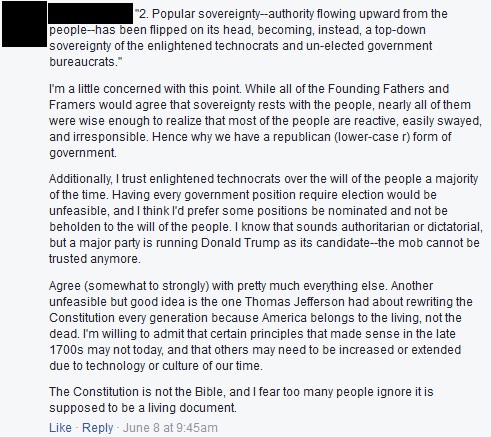
This post received quite a few comments on my Facebook page, including this one from a good friend of mine:

Now watch as I set my progressive-libertarian friend straight–respectfully.

My friend raised a very valid point:  the Framers of the Constitution were suspicious, if not outright terrified, of democracy.  Aristotle had identified democracy as one of the “bad” forms of government that came when rule by the people went bad.  The Framers had seen the consequences of a federal government that was too weak, namely the barely-contained chaos of Shays’ Rebellion in 1785.  Naturally, they wanted a government by, of, and for the people–thus the requirement that the Constitution be ratified by 3/4ths of the States in special ratifying conventions (designed to circumvent the Anti-Federalist state legislatures)–but they recognized that unbridled populism would lead to demagoguery.  It’s pedantic to say it, but Nazi Germany is the quintessential example of a desperate people granting dictatorial powers to a charismatic individual.

Pure democracy, without any checks on the majority’s power, quickly turns to one-man authoritarianism.”

The French political philosopher Montesquieu argued that the English government succeeded because it balanced monarchy, aristocracy, and democracy effectively, which further influenced the belief of the Framers that government should filter the will of the people through a complex system of checks and balances, and a rigorous, jealously-guarded separation of powers.  Thus we have such institutions as the much-maligned (but quite brilliant) Electoral College, and a Senate that is designed to act as a break on the people’s (often fickle) will.  Indeed, before it was corrupted by the XVII Amendment, the Senate was intended to represent the interests of the States themselves, rather than the will of the people, which is represented in the House of Representatives.

***

So, how did I address my friend’s concerns?  Here is my reply (with some minor edits for clarity and brevity) to my friend’s remarks, and to elaborate on the concept of “popular sovereignty”:

You are correct in noting the skepticism with which the Framers viewed unbridled democracy. There was much wisdom in their skepticism, precisely out of concern that a well-positioned demagogue could, in the right circumstances, sway the fickle populous to his whims. Pure democracy, without any checks on the majority’s power, quickly turns to one-man authoritarianism.

When I write about popular sovereignty, then, perhaps it would be more accurate to say that I mean “consent of the governed.” The people consented through our constitutional order when they elected delegates to special state ratifying conventions (circumventing the generally Anti-Federalist-controlled state legislatures). The people, then, ultimately gave consent to that government, and continue to do so through regular elections. Of course, a complex system of checks and balances tempers the will of the people (voiced primarily through the House of Representatives, which controls the power of the purse), balancing with it the will of the States, and vesting a great deal of authority to halt dubious legislation in the hands of the executive.

As for Thomas Jefferson’s love of revolutions and his proposal to rewrite the Constitution each generation, the actual Constitution provides a useful mechanism that makes such rewrites generally unnecessary, but possible: the amendment process. So far, every proposed amendment has come from the Congress, and all but two have been ratified in state legislatures (the other two were ratified, like the Constitution itself, in special state ratifying conventions). However, the Constitution provides another method–one that has yet to be used–to propose amendments: 2/3rds of the States can convene a constitutional convention to propose amendments. Texas’s current governor, Greg Abbott, is currently working on just such a convention of the States. In short, the Constitution provides us a way to change it to fit current needs without throwing out the whole document.

Of course, I would argue strenuously for an originalist reading of the Constitution and its amendments, all of which should be read in the context of those who proposed them. This still allows for changes through the amendment process, and for congressional elaboration. The Constitution is not meant to cover ever eventuality, and gives a great deal of space to Congress and (this is important and often forgotten) the States.

“It approaches something like tyranny when the President has the power to write laws (indirectly through the bureaucracy he manages) and to enforce them.” 


As for your comments about technocrats, perhaps I should clarify here, too. What I am primarily concerned about is the ability of federal agencies to write their own rules, many of which have the force of law. This practice is dangerous because most of these federal agencies operate within the executive branch and have little congressional oversight. Law-making powers are meant to rest solely within the Congress, and the job of the President is to duly enforce those acts to the best of his ability. It approaches something like tyranny when the President has the power to write laws (indirectly through the bureaucracy he manages) and to enforce them. Even scarier is the prospect that the federal bureaucracy has become so large that the President cannot exercise effective control over it, or even know what it’s doing! Many presidents–particularly our current one–have used bureaucratic rule-making to push unpopular measures without input from the people’s representatives. Congress is complicit in this, as it has delegated these powers to the executive bureaucracy, and the Supreme Court has allowed it to do so.

That being said, you are absolutely correct that there is a need for an intelligent, qualified, and motivated civil service, and, naturally, we want our dams to stay sealed tight and our roads to be paved and efficient. I would never dream of proposing we elect, say, the head of the South Carolina Department of Transportation. Here, again, the Constitution provides precedent: at the national level, the President appoints his cabinet heads, as well as federal and Supreme Court judges and justices. The Senate, however, has the responsibility of confirming these nominations, helping to prevent egregiously bad appointments.

If these proper checks and balances are maintained–if the different branches stick to their constitutional duties and limits, and if the proper relationship exists between the federal government and the several States–even a reckless executive can only do so much damage. If Congress vigorously protects its legislative prerogatives, an unqualified or authoritarian-minded president may still do some harm, but his ability to do so will be greatly diminished, and the damage can be contained.

***

This conversation went back and forth for a few more posts, which I will possibly include in future pieces.  In the interest of space–as this rumination is already quite lengthy–I will refrain from sharing them now.

However, I would ask that you permit me one parting thought:  we should be on guard against the lionization of the presidency.  The Congress–which represents the people and is, therefore the seat of popular sovereignty–may be consistently unpopular, but it is the proper branch to resist the huge expansion of the presidency.  Presidents increasingly attempt to speak for the people, but in a country that is divided between two entrenched, fundamentally incompatible political philosophies, it is nearly impossible to do so.  Indeed, attempting to do so leads to a Rousseau-style attempt to impose “the common will” on people–whether they want it or not.

Instead, let’s speak for ourselves.  We can do that through involvement in local politics, but also by communicating with our Congressmen and Senators.  Let them know that we expect Congress to reclaim its proper legislative powers from the executive bureaucracy.

Lazy Sunday III: Historical Moments

My Internet is out at the house, and the technician won’t be out until Friday, so posting this week may be a bit dicey and inconsistent.  As a result, I’m phoning it once again this Sunday—the perfect way to start (or end, depending on your perspective) the week.

Brace yourself for “Lazy Sunday III:  Historical Moments” (read “Lazy Sunday” and “Lazy Sunday II“).  These posts are derived from a series of short talks I gave to the Florence County (SC) GOP in 2018.  They are presented in chronological order.

1.) “The Formation of the Republican Party” – this post was featured in “Lazy Sunday II:  Lincoln Posts,” as is the second piece in this list (sorry for the redundant recycling).  It’s a quick overview of the origins of the Republican Party in the 1850s.

2.) “Lincoln and Education” – another post from “Lazy Sunday II,” this Historical Moment explores Lincoln’s education, as well as his views on the subject.

3.) “Veterans’ Day 2018, Commemoration of the Great War, and Poppies” – like President George W. Bush, I am not one of the great orators of our time, but when I delivered this Historical Moment, it was probably the most powerful oratorical presentations I’ve ever given.  That is not due in any way to my own speaking abilities (although I do possess a rich, chocolate-y baritone when speaking), but to the emotional power of John McCrae’s “In Flanders Field.”  It was an arresting moment when I delivered the lines of that simple, sweet poem.

4.) “The Influence of Christianity on America’s Founding” – this talk was a longer-form version the usual Historical Moments, which are usually about five minutes long.  I was asked to give a slightly longer speech about the influence of Christianity on the founding of our nation at a joint FCGOP-Darling County GOP Christmas dinner.  It’s a complex topic, but, yes, Christianity was and is key to the American experiment in self-government.

So there you have it—more TPP greatest hits.  Enjoy, and have a restful Sunday!


Lazy Sunday II: Lincoln Posts

I’ve been out of town all weekend—thus yesterday’s very belated post—and it’s getting to the point in the academic year where all the craziness hits at once.  That being the case, I’m posting another one of these “compilation” reference posts to give you, my insatiable readers, the illusion of new content.  It’s like when a classic television show does a clip show episode:  you relive your favorite moments from the series (or, in this case, the arbitrary theming I foist upon you).

Today’s “Lazy Sunday” readings look back at my posts that pertain to President Abraham Lincoln, the Great Emancipator (read the first “Lazy Sunday” compilation).  I noticed that I’ve been writing more about Lincoln over the past week (perhaps my quiet homage to the recently-completed Black History Month?), so I decided to compile, in one place, all of my Abraham Lincoln posts (at least, the ones I could find on this blog).

Without further ado, here are The Portly Politico‘s Lincoln Posts (in chronological order):

  • TBT: Happy Birthday, America!” – a reblog from the old TPP site, this post largely lets Lincoln speak for himself, as it features a full transcript of the Gettysburg Address.  Always good for patriotic goosebumps.
  • Historical Moment – The Formation of the Republican Party” – this short post was adapted from a brief talk I gave to the Florence County Republican Party.  The purpose of the meeting, I recall, was to focus Republicans on who we are as a Party and what we believe, so I thought it would be useful to give a brief introduction to the formation of the GOP.  As the first Republican President (although not the first Republican presidential candidate—that honor goes to John Charles Fremont of California, who ran in 1856), Lincoln obviously exercised huge influence on the young party.
  • Lincoln on Education” – another “Historical Moment” adaptation (I’m all about recycling material), I was supposed to deliver this moment before a forum of candidates for the Florence School District 1 race in autumn 2018.  I was all set to deliver it, but the FCGOP Chairman (accidentally?) skipped over me in the agenda, so I saved it until the following month’s meeting (again, why let good copy go to waste?).
  • Lincoln’s Favorability” – here’s one of TWO posts from last week about Abraham Lincoln.  I’m going to give Lincoln a rest after tonight—he worked hard enough during the Civil War—but this piece looked at an interesting Rasmussen poll, that shows Lincoln is massively beloved by the American people.
  • Reblog: Lincoln and Civil Liberties” – this post is a reblog from Practically Historical, the blog of SheafferHistorianAZ.  Sheaffer—a fellow high school history teacher—wrote a post detailing how Lincoln’s suspension of the writ of habeus corpus was, indeed, constitutional.

Happy Sunday!

–TPP

Reblog: Lincoln and Civil Liberties

One of the joys of blogging is the opportunity to read the work of other writers in the “blogosphere.”  Recently, I’ve been reading SheafferHistorianAZ‘s work at his blog, Practically Historical.  Sheaffer writes brief, pithy posts about various historical figures and problems, and seems to have a particular interest in both Abraham Lincoln and Dwight Eisenhower, two of my favorite presidents.

Yesterday, he posted a piece entitled “Lincoln and Civil Liberties” that touches on an interesting constitutional question:  did the Great Emancipator violate the Constitution when he suspended the writ of habeus corpus and arrested Americans without due process or the chance to see a judge?

Sheaffer argues that Lincoln was completely justified, as those arrested were actively seditious and traitorous.  He cites the case of John Merryman, the Marylander arrested for his attempt to spur Maryland to secede from the Union.  From Sheaffer (all links are his):

John Merryman was not an innocent victim… of government tyranny as portrayed by Chief Justice Roger Taney.  Merryman led a detachment of Maryland militiamen in armed resistance to troops in Federal service.  Taney was a partisan Democrat staunchly opposed to Lincoln and supportive of secessionist doctrine.  Ex parte Merryman is not legal precedent at all and cannot be cited as such- it is a political document designed to hinder Lincoln’s attempts to protect Washington and preserve the Union.  It was issued by Taney alone- scholars often make the mistake of assuming that the Supreme Court concurred with the ruling.

As Sheaffer points out, there is a trend in Lincoln scholarship that recasts the president as an out-of-control tyrant.  The most prominent figure in this revisionist school is probably Thomas DeLorenzo, and the idea has circulated broadly, even if it hasn’t penetrated the American psyche (remember, Lincoln enjoys a 90% favorability rating among Americans today).

No doubt the American Civil War expanded federal powers, and indelibly changed the relationship between the States and the federal government, in some ways to the detriment of constitutionalism.

Consider that, prior to the Civil War, many States assumed they could “opt out” of the Constitution, having previously “opted in” to it.  Lincoln argued that the Union predated the Constitution, and therefore could not be left; Daniel Webster earlier argued that the Union and the Constitution were “one and inseparable.”

Regardless, the American Civil War resolved by force of arms what could not be resolved in Congress or debating societies (of course, no political question is ever settled permanently).  After that, the States would never have quite the same leverage over the federal government (probably for the better, but perhaps for the worse in some ways), and would lose even more with the ratification of the Seventeenth Amendment.

These are interesting questions to consider.  Sheaffer’s contribution to this discussion is sober and direct.