Guest Post: Sudo Nonym’s “The Man from Historical Accuracy” – Chapter 2

The English writer Sudo Nonym, a regular over at Free Speech Backlash, sent yours portly a treasure-trove of fiction stories for readers here to enjoy.  Many of these stories have already run at FSB, but Tom, the proprietor over there, is cool about cross-posting and republishing, and I’m never one to say no to intriguing content—especially when someone else has done 90% of the work for me!

Also, he has two eBooks on Amazon (that’s an Amazon Affiliate link; I receive a portion of any purchases made through that link at no additional cost to you—TPP)!

But I digress.  Today’s story is the second chapter or part of a longer piece, The Man from Historical Accuracy.  The premise is simple:  a bureaucratic agency, Historical Accuracy, tweaks history to keep things trucking along as they should.

With that, here is Sudo Nonym with Chapter 2 of The Man from Historical Accuracy:

Read More »

Guest Post: Sudo Nonym’s “The Man from Historical Accuracy” – Chapter 1

This Wednesday kicks off something a bit different.  The English writer Sudo Nonym, a regular over at Free Speech Backlash, sent yours portly a treasure-trove of fiction stories for readers here to enjoy.  Many of these stories have already run at FSB, but Tom, the proprietor over there, is cool about cross-posting and republishing, and I’m never one to say no to intriguing content—especially when someone else has done 90% of the work for me!

Also, he has two eBooks on Amazon (that’s an Amazon Affiliate link; I receive a portion of any purchases made through that link at no additional cost to you—TPP)!

But I digress.  Today’s story is the first chapter or part of a longer piece, The Man from Historical Accuracy.  The premise is simple:  a bureaucratic agency, Historical Accuracy, tweaks history to keep things trucking along as they should.

Put another way:  there are drunken druids watching DVDs on Stonehenge.

With that, here is Sudo Nonym with Chapter 1 of The Man from Historical Accuracy:

Read More »

Lazy Sunday CCCXLXIII: Empire

It’s been the week of American imperialism here on the blog, and I don’t necessarily mean “imperialism” negatively.  Here are some posts about how the United States is embracing its destiny (and the peaks and pitfalls of doing so):

Happy Sunday!

—TPP

SubscribeStar Saturday: American Imperialism

Today’s post is a SubscribeStar Saturday exclusive.  To read the full post, subscribe to my SubscribeStar page for $1 a month or more.  For a full rundown of everything your subscription gets, click here.

Apologies for the evening post, dear readers; Dr. Wife and I played a key role in balloon arch construction for a friend’s baby shower, and yours portly took an extended nap after overindulging on chicken wings and fried pickles.  Now that all of that succulence has gone straight to fat, I’m slowly rubbing my neurons together to hammer out this post.  —TPP

The excellent website Free Speech Backlash ran a lengthy essay of mine this past Thursday, 15 January 2026.  “Trump: Nationalist or Imperialist?” is an attempt to place the Nicolás Maduro arrest in the broader context of American diplomatic history, specifically as it pertains to our hemispheric policy.  That policy dates back to the 1823 Monroe Doctrine, which received an overhaul in the first years of the twentieth century during the presidency of Theodore Roosevelt.  The so-called Roosevelt Corollary to the Monroe Doctrine argued that, in order to prevent European intervention in Latin America, the United States would intervene instead.

President Trump is clearly aware of this history—thus his invocation of the “Donroe Doctrine,” his own revival of the Roosevelt Corollary.  Chinese and Russian influence in the Western Hemisphere is increasing, and The Donald has to take action.  The action in Venezuela was not strictly about securing oil—we have plenty of it—but to prevent China from controlling major oil reserves in the Western Hemisphere.  The United States also sought to prevent China and Russia paying for that oil with their own currencies, as the purchasing of oil in US dollars ensures the dominance of our increasingly devalued currency.

China has also sought to make inroads into Panama, where the Panamanians currently run the canal that Roosevelt took drastic steps to ensure could be built—under American auspices.  One reason Trump wants to reclaim the Panama Canal is precisely because if we don’t, the Panamanians will likely fold to the Chinese.

Even Greenland, the most memeable of Trump’s neo-Monrovian ambitions, is an application of the Monroe/Donroe Doctrines.  The Arctic is emerging as a major trade route for global goods—the fabled Northwest Passage now a reality—and China has already made attempts to bring the Danish colony under its thumb.  The Danes lack the will and the capacity to improve and defend Greenland—or even to exploit its vast natural resources effectively—and The Donald sees this island as the key to securing dominance in the Arctic in the Western Hemisphere.

Indeed, it was Greenland that generated the most commentary (and heart-bleeding) in the comments section.  The most common refrain from the opposition was that the Greenlanders have the right to self-determination.  It’s an argument I’m sympathetic with in principle, but in Reality, Greenland has a population of fewer than 60,000 people—only barely double that of the municipal population of my hometown growing up in South Carolina.  If the world were a peaceful place, an independent Republic of Greenland could probably be viable as an extremely small (demographically) nation.  In the world of cutthroat geopolitics, with China and Russia on the rise and the Arctic opening up new strategic challenges and opportunities, an independent Greenland is a costly fantasy.

To read the rest of this post, subscribe to my SubscribeStar page for $1 a month or more.

TBT: Make Greenland American

Yours portly has a lengthy post over at Free Speech Backlash today about Trump, Venezuela, and the intersection between American nationalism (“America First”) and American imperialism (the piece is called “Trump: Nationalist or Imperialist?“).  “Imperialism” is a dirty word, but America is an empire, whether we like it or not.  Indeed, we’ve been an empire since at least 1898, when the United States gained Puerto Rico, Guam, and the Philippines from Spain, and occupied Cuba for several years.  Cuba became nominally independent, but remained a virtual American protectorate until Fidel Castro’s Communist revolution in the 1950s.

Many on the Right are concerned that the Maduro capture is something of a “heel turn,” to use wrestling parlance, for Trump’s foreign policy, and that he’s abandoning America First principles in favor of open-ended American adventurism abroad.  My piece details why Maduro’s arrest is not another quagmire, and how it’s very consistent with traditional American foreign policy dating back to the Monroe Doctrine of 1823.

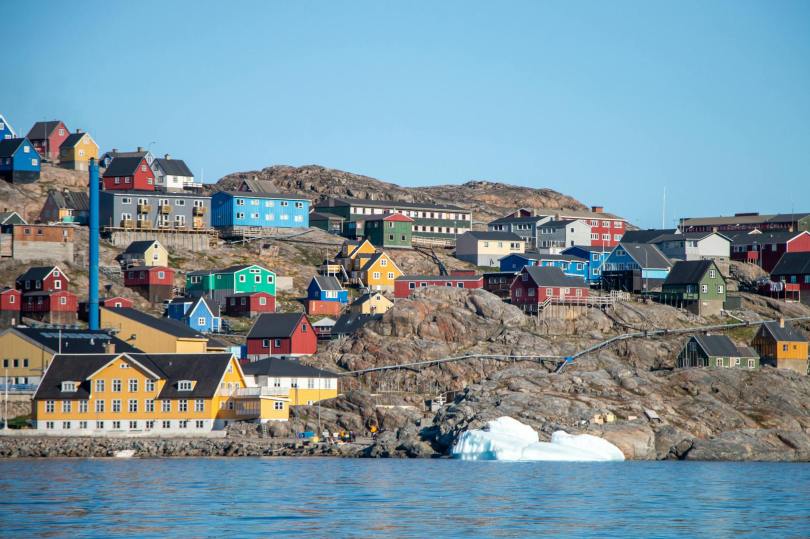
Similarly, Trump’s desire to annex Greenland, which sounds like a joke or someone playing a True Start Location Earth map in Civilization VI, is quite serious.  Greenland is in the Western Hemisphere, which—whether we like it or not—is America’s hemisphere.  American geopolitical strategy since 1823 has been to dominate this hemisphere to avoid a balance-of-power situation like Europe’s in the nineteenth century.  It is also seeks to prevent foreign intervention into the independent nations of this hemisphere.  One reason for the Maduro operation was to prevent Maduro from selling his country off to the Chinese, which would put America’s primary geopolitical rival in our backyard.

Similarly, China and Russia have designs on the Arctic, with the former particularly attempting to gain influence over the tiny Greenlandic population.  Denmark is entirely too venal to combat foreign intervention in its colony, so greater, more serious powers will do so.  With ice caps receding, the Arctic is the great oceanic chokepoint of the twenty-first century, and America needs Greenland to secure our interests in the Western Hemisphere—and to keep China out.

It’s unpleasant to think about Great Power politics in the twenty-first century, when we’re supposed to be beyond all that foolishness.  But it is the rules-based international order of the 1990s that is the aberration, not the kinds of aggressive power plays we’re seeing today.

Taking Greenland—which the Trump Administration seems intent to do—is part of the broader return to Reality the world is experiencing.  Reality is often hard, but it cannot be ignored.

I wish no violence upon Greenland or Denmark—far from it!  Greenland does not need to be taken by force.  At a certain point, the United States can offer Greenlanders a package so enticing, they cannot refuse.  Denmark should be eager to offload an expensive asset that they are not using—and that the bankroller of their social welfare state is willing to go to great lengths to obtain.

With that, here is 15 January 2025’s “Make Greenland American“:

Read More »

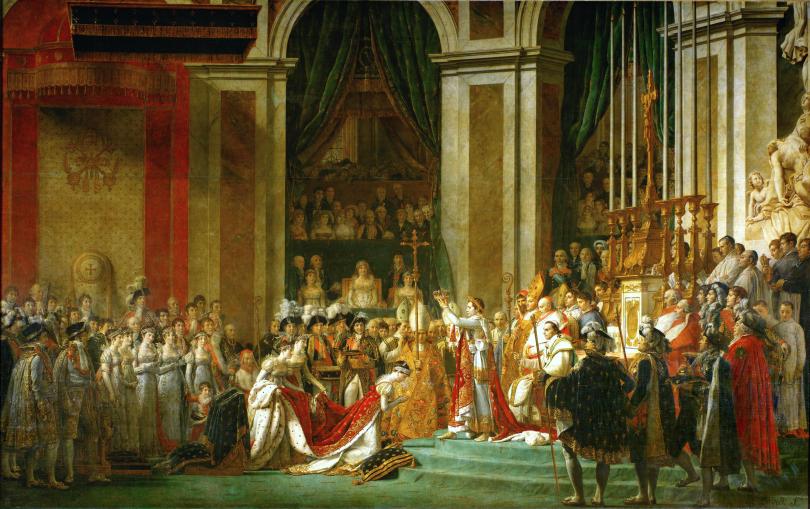
TBT^4: Napoleonic Christmas

It’s Christmas!  It’s Christmas!  And it’s a Thursday, so yours portly is TBT’ing to a classic of yesterchristmas.

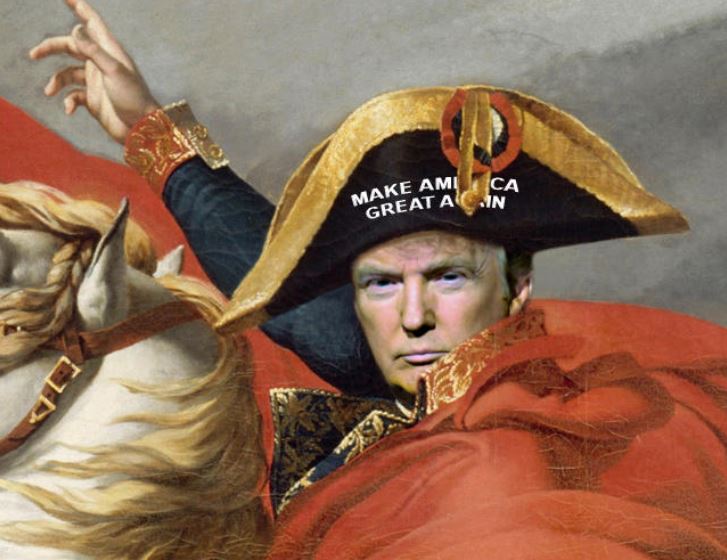
Back in 2019, I wrote this piece about Napoleon.  It took off because it gained some traction on WhatFinger News, which came along after Matthew Drudge inexplicably went woke.  The name of this alternative news aggregator always strikes me as vaguely inappropriate, but they ran my link and it got tons of views at a time when I was getting discouraged with the blog (a perennial issue, it seems—perseverance is a virtue for a reason).

Napoleon is a complex and intriguing figure.  Whatever his personal and professional attributes, he indelibly changed Europe and the world.  It’s hard for us to understand today, fixated as we are on the failed Austrian painter with the Charlie Chaplin mustache, but Napoleon’s impact was still being discussed actively in the early twentieth century.  He totally upended the gameboard of Europe—for good or for ill—and the fear and/or hope of another Napoleon endured for quite awhile.

YouTube philosopher Agora made a great video linking the two figures—and warning about why those links miss some key differences:

The important thing to remember, however, is that humanity’s conception of “greatness” is false.  Remember, Christ Was Born today as a simple baby in the most humble of circumstances—literally bedding down in a feeding trough for barnyard animals.  He Died a humiliating Death on the Cross.  He Rose from the dead and Conquered Death, and Will Return again!

No Napoleon could ever achieve what He Did.

With that, here is 26 December 2024’s “TBT^2: Napoleonic Christmas“:

Read More »

Retro Tuesday: Veterans’ Day 2018, Commemoration of the Great War, and Poppies

Today marks the 107th anniversary of Armistice Day, the day that the Great War (the First World War) ended.

The First World War has come back into vogue as an example of the absurd, murderous capacity of even seemingly enlightened humans to engage in massive, needless violence.  I think that’s true, but I also think the First World War is when the West lost confidence in itself.

Consider:  if the allegedly “enlightened” moderns of Western Civilization could lead their armies into senseless, ceaseless warfare for four years, how did that make us any better than the rest of the world?  Indeed, it seemed to make us and our advancements seem even worse.

That analysis misses some key points, however.  The war wasn’t just about nationalism-run-amok, or secret alliances swinging into a deadly, almost automatic catastrophe of geopolitics gone wrong.  It reflected the dehumanization of modernity itself, the turning of people into, first, mere cogs in vast industrial machines and, second, into fodder for a brutal meatgrinder.

The First World War may have caused the West to lose its “mojo,” as I’ve argued before, but the West was already losing its soul before that great, terrible conflict.  Fast forward 107 years, and Europe is a place so venal, so atheistic, so nihilistic, so devoid of meaning, that it’s gladly and eagerly invited its own replacement by foreign nationals and faiths.  The very same civilization that resisted Islamic domination for 1400 years has now given up without a fight.  As long as the endless welfare benefits keep coming, no one cares.

It’s truly tragic.  The World Wars cost millions of lives and wrought untold damage upon the world.  They also destroyed what little will the West had left to preserve itself, at least in Europe.  The West may very well have died 107 years ago.

I hope I am wrong.

With that, here is 13 November 2018’s “Veterans’ Day 2018, Commemoration of the Great War, and Poppies“:

Read More »

Remember, Remember, the Fifth of November

Today is Guy Fawkes Day (or Night) in merry old England, a holiday that is unapologetically nationalist, monarchist (in the best English tradition of that form of government) and Protestant Christian.  There’s something fun and refreshingly patriotic about a holiday dedicated to burning a treacherous Papist in effigy.  Not to make everything about America, but it smacks of the Fourth of July, albeit without the anti-monarchist undertones.

Most Americans will be familiar with Guy Fawkes Day and the iconic mask from the film V for Vendetta (2005), in which the meaning of Guy Fawkes focuses on the man’s role as a would-be freedom fighter for English Catholics against an oppressive Protestant regime.  In the context of the film, the titular V dons the mask in the context of a freedom fighter against a fascistic, quasi-religious British government.

Read More »

Flashback Friday: Happy Halloween!

Woooooooot—it’s Halloween!  At long last!

Halloween is particularly fun when it’s on a Friday.  My little town “observed” trick-or-treating last night, but I’m going with Dr. Fiancée and my niece and nephews tonight (we’re not dressing up, but the kids are).  I’m looking forward to some family time.

How are you celebrating tonight, readers?

With that, here is 31 October 2019’s “Happy Halloween!“:

Read More »