TBT: What is Popular Sovereignty?

Today’s looks back at an essay entitled “What is Popular Sovereignty?”  It was a follow-up, of sorts, to “American Values, American Nationalism,” one of my most-read posts (a post that I still largely agree with, though I am moving away slightly from the idea of American as absolutely a “propositional nation”—I do think it was an outgrowth of a distinctly Anglo-American culture, though it’s proven remarkably adaptive as peoples of different nationalities and cultures have settled here).  A friend posted a Facebook comment taking issue with the idea of popular sovereignty as I presented it in that essay, and this was my attempt to address his objections.

As I point out in the essay below, I do think we should have some un-elected positions within government.  If the government is building a hydroelectric dam, I don’t want to hold an election for the lead engineer.  I’m also not advocating for pure democracy, which the Framers of the Constitution rightfully saw as an odious and dangerous form of government that would, inevitably, collapse into mob rule and, ultimately, tyranny.

What I do warn against is the law-making power invested increasingly in the hands of an unaccountable federal bureaucracy, one that is technically under the control of the executive branch, but which functionally operates independently—the “Deep State,” as it were.  If the President did have control over the bureaucracy, it would be bad enough—the executive would wield legislative powers.  But an unaccountable bureaucracy that even the executive cannot rein in is even more frightening.  At least we could hope for an “enlightened despot” executive who would minimize the damage of his bureaucracy, but if the bureaucracy runs itself, regardless of who holds the presidency, liberty is deeply threatened.

So, here is 2016’s “What is Popular Sovereignty?”:

On Wednesday, 8 June 2016, I posted a piece entitled “American Values, American Nationalism.”  In that piece, I discussed the “Five Core Values of America,” a set of values inspired by a government textbook I used to use with my US Government students.  The second value, “popular sovereignty,” is deals with the idea that power in our political system ultimately derives from the people–as Abraham Lincoln said in the Gettysburg Address, our government is “by, of, and for the people.”

This post received quite a few comments on my Facebook page, including this one from a good friend of mine:
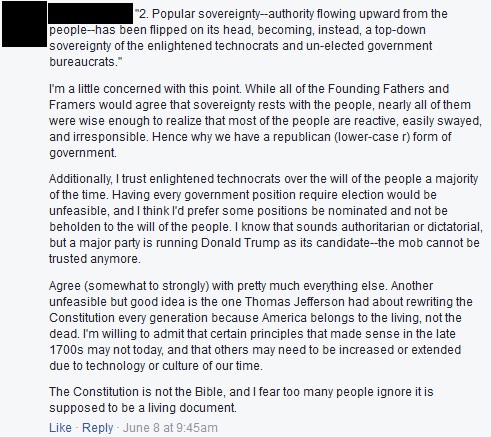
Now watch as I set my progressive-libertarian friend straight–respectfully.

My friend raised a very valid point:  the Framers of the Constitution were suspicious, if not outright terrified, of democracy.  Aristotle had identified democracy as one of the “bad” forms of government that came when rule by the people went bad.  The Framers had seen the consequences of a federal government that was too weak, namely the barely-contained chaos of Shays’ Rebellion in 1785.  Naturally, they wanted a government by, of, and for the people–thus the requirement that the Constitution be ratified by 3/4ths of the States in special ratifying conventions (designed to circumvent the Anti-Federalist state legislatures)–but they recognized that unbridled populism would lead to demagoguery.  It’s pedantic to say it, but Nazi Germany is the quintessential example of a desperate people granting dictatorial powers to a charismatic individual.

Pure democracy, without any checks on the majority’s power, quickly turns to one-man authoritarianism.”

The French political philosopher Montesquieu argued that the English government succeeded because it balanced monarchy, aristocracy, and democracy effectively, which further influenced the belief of the Framers that government should filter the will of the people through a complex system of checks and balances, and a rigorous, jealously-guarded separation of powers.  Thus we have such institutions as the much-maligned (but quite brilliant) Electoral College, and a Senate that is designed to act as a break on the people’s (often fickle) will.  Indeed, before it was corrupted by the XVII Amendment, the Senate was intended to represent the interests of the States themselves, rather than the will of the people, which is represented in the House of Representatives.

***

So, how did I address my friend’s concerns?  Here is my reply (with some minor edits for clarity and brevity) to my friend’s remarks, and to elaborate on the concept of “popular sovereignty”:

You are correct in noting the skepticism with which the Framers viewed unbridled democracy. There was much wisdom in their skepticism, precisely out of concern that a well-positioned demagogue could, in the right circumstances, sway the fickle populous to his whims. Pure democracy, without any checks on the majority’s power, quickly turns to one-man authoritarianism.

When I write about popular sovereignty, then, perhaps it would be more accurate to say that I mean “consent of the governed.” The people consented through our constitutional order when they elected delegates to special state ratifying conventions (circumventing the generally Anti-Federalist-controlled state legislatures). The people, then, ultimately gave consent to that government, and continue to do so through regular elections. Of course, a complex system of checks and balances tempers the will of the people (voiced primarily through the House of Representatives, which controls the power of the purse), balancing with it the will of the States, and vesting a great deal of authority to halt dubious legislation in the hands of the executive.

As for Thomas Jefferson’s love of revolutions and his proposal to rewrite the Constitution each generation, the actual Constitution provides a useful mechanism that makes such rewrites generally unnecessary, but possible: the amendment process. So far, every proposed amendment has come from the Congress, and all but two have been ratified in state legislatures (the other two were ratified, like the Constitution itself, in special state ratifying conventions). However, the Constitution provides another method–one that has yet to be used–to propose amendments: 2/3rds of the States can convene a constitutional convention to propose amendments. Texas’s current governor, Greg Abbott, is currently working on just such a convention of the States. In short, the Constitution provides us a way to change it to fit current needs without throwing out the whole document.

Of course, I would argue strenuously for an originalist reading of the Constitution and its amendments, all of which should be read in the context of those who proposed them. This still allows for changes through the amendment process, and for congressional elaboration. The Constitution is not meant to cover ever eventuality, and gives a great deal of space to Congress and (this is important and often forgotten) the States.

“It approaches something like tyranny when the President has the power to write laws (indirectly through the bureaucracy he manages) and to enforce them.” 


As for your comments about technocrats, perhaps I should clarify here, too. What I am primarily concerned about is the ability of federal agencies to write their own rules, many of which have the force of law. This practice is dangerous because most of these federal agencies operate within the executive branch and have little congressional oversight. Law-making powers are meant to rest solely within the Congress, and the job of the President is to duly enforce those acts to the best of his ability. It approaches something like tyranny when the President has the power to write laws (indirectly through the bureaucracy he manages) and to enforce them. Even scarier is the prospect that the federal bureaucracy has become so large that the President cannot exercise effective control over it, or even know what it’s doing! Many presidents–particularly our current one–have used bureaucratic rule-making to push unpopular measures without input from the people’s representatives. Congress is complicit in this, as it has delegated these powers to the executive bureaucracy, and the Supreme Court has allowed it to do so.

That being said, you are absolutely correct that there is a need for an intelligent, qualified, and motivated civil service, and, naturally, we want our dams to stay sealed tight and our roads to be paved and efficient. I would never dream of proposing we elect, say, the head of the South Carolina Department of Transportation. Here, again, the Constitution provides precedent: at the national level, the President appoints his cabinet heads, as well as federal and Supreme Court judges and justices. The Senate, however, has the responsibility of confirming these nominations, helping to prevent egregiously bad appointments.

If these proper checks and balances are maintained–if the different branches stick to their constitutional duties and limits, and if the proper relationship exists between the federal government and the several States–even a reckless executive can only do so much damage. If Congress vigorously protects its legislative prerogatives, an unqualified or authoritarian-minded president may still do some harm, but his ability to do so will be greatly diminished, and the damage can be contained.

***

This conversation went back and forth for a few more posts, which I will possibly include in future pieces.  In the interest of space–as this rumination is already quite lengthy–I will refrain from sharing them now.

However, I would ask that you permit me one parting thought:  we should be on guard against the lionization of the presidency.  The Congress–which represents the people and is, therefore the seat of popular sovereignty–may be consistently unpopular, but it is the proper branch to resist the huge expansion of the presidency.  Presidents increasingly attempt to speak for the people, but in a country that is divided between two entrenched, fundamentally incompatible political philosophies, it is nearly impossible to do so.  Indeed, attempting to do so leads to a Rousseau-style attempt to impose “the common will” on people–whether they want it or not.

Instead, let’s speak for ourselves.  We can do that through involvement in local politics, but also by communicating with our Congressmen and Senators.  Let them know that we expect Congress to reclaim its proper legislative powers from the executive bureaucracy.
Sailer on Progressive Split

Demographer and statistician Steve Sailer has a piece up at Taki’s Magazine entitled “Bernie vs. Ta-Nehisi,” detailing the major split within modern progressivism between old-school Marxists and social justice warriors.  Naturally, there’s a great deal of overlap between those groups, but Sailer looks at the major wedge between them:  their views on race.

First, let’s define our terms here:  the “old-school Marxists” like Bernie think race is a tool of the upper classes to divide the social classes.  Part of this approach, as Sailer points out, is electoral pragmatism:  align the have-nots against the haves, regardless of race, to maximize voters.  There are more non-rich people than there are rich, so promising Medicare for all and to “soak the rich” Huey Long-style can bribe voters of all stripes.

The other side—what I’ve referred to broadly referred to as the “social justice warriors”—are the ones obsessed with race, and who see racial injustice everywhere.  For Sailer, the symbolic leader of this group is racialist mediocrity Ta-Nehisi Coates, the former blogger made good because white liberals feel good about themselves when reading his rambling essays.

(I imagine it’s a sensation of righteous self-flagellation that isn’t too dangerous or life-altering for the reader:  they get the sadistic satisfaction of acknowledging their own implicit bias, racism, and privilege, while feeling like they’re making a difference because they breathlessly show their support for an erudite-sounding black guy.  But I digress.)

The former group wants to buy off all voters with as many publicly-funded goodies as possible; the latter wants to buy off minority voters with reparations and other publicly-funded goodies, all while chastising white voters (and gleefully awaiting the approaching day that whites are a minority, too).

Sailer, who refers to Coates as “TNC,” sums this division up succinctly:

The war between Bernie and TNC pits the old Marx-influenced left, with its hardheaded obsession with class, power, and money, against the new Coatesian left, which cares more about whether Marvel’s next movie features a black, female, or nonbinary superhero.

The rest of Sailer’s essay focuses on the obsession with racial identity and representation that dominates “Coatesian left.”  It’s not enough that everyone, black or white, share in Sanders’s redistributionist schemes; rather, blacks specifically must benefit at the expense of whites as a form of payback for slavery, alleged “redlining” in during the Depression, and “institutional racism.”

Further, the Coatesian/social justice Left demands “representation,” because a black superhero will magically improve the lot of black Americans.  Another Sailer quotation:

Coates’ notion that mass entertainment culture has been devoted to stereotyping black people as undeserving is, of course, absurd. But it helps explain some of his popularity in an era in which it is considered sophisticated to argue that Will Smith shouldn’t be cast as Serena and Venus Williams’ tennis dad because he’s not as dark-skinned as Idris Elba (while others argue that Smith, unlike Elba, deserves the role because he is an ADOS: American Descendant of Slaves).

Can you imagine what Socialist Senator Sanders thinks of these energies devoted to which millionaire should get richer?

Unlike Bernie, Coates is concerned with the old-fashioned comic-book virtues that appeal to 9-year-old boys: honor, status, representation, heredity, antiquity, and vengeance.

Revenge is a dish best served cold.  Maybe that’s why so many prominent Democratic presidential hopefuls are reheating such a tired idea.

Neither Sanders-style Marxism or Coatesian racial grievance will repair the United States’s fractured culture, but it will be interesting to see which side wins the Left.  Demographics suggest the latter will prevail over time.

Regardless, at bottom, both of these movements are redistributionist, and seek to plunder accumulated wealth and productivity to unprecedented degrees.  One might be traditional Marxism and the other Cultural Marxism—but they’re both Marxism.

Irish Troll

For Saint Patrick’s Day, the GOP sent out a cheeky tweet of Beto O’Rourke’s mugshot from a DUI incident (the senatorial hopeful tried to flee the scene, but bypassers stopped him from doing so) that occurred when he was 26.  The tweet (embedded below) features O’Rourke sporting a cartoon leprechaun hat and sign board reading “PLEASE DRINK RESPONSIBLY”:

That is some grade-A trolling right there.  John Nolte of Breitbart breaks down the brilliance of the tweet, and why it works on so many levels, viscerally.  He also catalogs the outrage from the Left and the noodle-wristed Establishment/Never Trump “Right.”

In my mind, the tweet succeeds most immediately in two ways:  it highlights O’Rourke’s sordid past, and it draws attention to his lame attempt to Hispanicize himself by going by “Beto” instead of “Robert” (how’s this for an Irish Catholic name:  his real name is Robert Francis O’Rourke).

As Nolte points out, Leftists gleefully roasted George W. Bush for his youthful DUI.  But Bush took the hit, paid his dues to society, and redeemed himself.  Perhaps O’Rourke has made his peace with God about this issue—we can’t know his heart—but he walked away from the DUI scot-free.  The two-tiered justice system that punishes conservatives and lets well-connected libs walk free was at work once again.

One of the more ludicrous criticisms from the Right is that the tweet is “racist.”  Please.  The tweet isn’t suggesting that Irishmen are drunks; it’s suggesting that this particular Irishman actually was.  The only reason they call O’Rourke an “Irishman” in the tweet is, again, because he’s desperately pretending to be another ethnicity to get votes.

It’s the same story with Massachusetts Senator Elizabeth Warren.  When President Trump calls her “Pocahontas” (he should call her “Fauxcahontas,” but the point remains), he’s not making fun of Native Americans; he’s drawing attention to Warren’s use of (falsified) Native American heritage to get an edge in her professional and academic career.  If anything, Warren and O’Rourke are the ones using race as a political tool, not the Republicans and Trump.

None of that should need saying, but that’s why small-time bloggers like me have stuff to write about every day:  if it were as obvious as it seems to us, it wouldn’t need saying.

Oh, well.  Kudos to the GOP for some excellent, cheeky, fun-filled trolling.  It’s the most harmless kind of effective trolling possible.  Remember:  that tweet didn’t hurt anyone, except for maybe O’Rourke’s already-tarnished reputation.  But Robert Francis O’Rourke did risk harm to real people with his actions.  His policies—like radically open borders and deconstruction of existing border barriers—would risk countless more lives.

Let’s hope this dweeb flames out, and soon.

Conservative Divestment

Conservative readers are likely familiar with the odious BDS Movement—the movement to “Boycott, Divest, and Sanction” Israel because of its alleged “crimes” against legions of peace-loving Palestinian Arabs (oy vey).  Participants in this movement are encouraged to pull their money out of Israeli companies (or companies that do business with Israel), and to refuse to buy Israeli products, thereby pressuring Israel to be even more tolerant (it’s quite ludicrous—I’d wager an Arab Muslim in the Middle East would enjoy greater liberty to exercise his religion in Israel than anywhere else in the region).

Charlie Kirk of Turning Point USA has a video for Prager University called “DivestU” in which he argues for another kind of divestment:  denying American colleges and universities donations.

It’s a fairly commonsensical idea:  conservatives are well aware of the corrupting influence of Cultural Marxism on university faculty, and the persistent indoctrination of vulnerable young people at a particularly impressionable moment in their lives.  We’ve all known the friend or relative who came back after a semester of college convinced “xyr” knows everything about the world, possessing a sneering, elitist attitude against everything good and decent (“hugs are an oppressive form of non-consensual affection!  Smash the Patriarchy!”).  Why keep feeding the beast?

It makes sense that we pay tuition—for better or worse (and mostly for the worst), we need that catskin to land a job—but Kirk points out that Americans are voluntarily donating money to colleges, institutions already bloated with federal loan dollars.

Kirk cites that American colleges and universities received $44 billion in donations in 2017.  Scott Rasmussen’s Number of the Day for 15 February 2019 notes that in 2018, colleges and universities received $46.73 billion, a whopping $1.4 billion of which went to Harvard University.  Harvard already has an endowment of over $37 billion (the benefit of being an institution for nearly 400 years:  compounding interest has lots of time to work its magic).

Indeed, Rasmussen writes that “while there are more than 4,000 colleges in the United States, 28% of that money went to just 20 schools. Those 20 universities serve 1.6% of the total student population.”  Those schools are not conservative bastions like Hillsdale College, but often the epicenter of Ivy League elitism and disdain for traditional values.

As Kirk points out in his video, even if you donate money to a specific school within a college—say, the medical school—money is fungible.  You might think you’re helping train future doctors, but you could easily be funding gender reassignment surgery (read: butchery and mutilation), or an Assistant Vice Dean of Diversity, Inclusion, and Homeopathic Cultural Healing.  Bah!

Education is a mess in the United States.  Pouring more money into institutions that are anathema to our values and hostile to our way of life is insane and masochistic.

As such, I’d encourage you to avoid donating to colleges and universities.  Put that money to use in better ways, like retirement savings.

Lazy Sunday IV: Christianity

Ah, yes, the sweet smell of at-home, high-speed Internet access in the morning.  It’s good to be back online.

For this week’s edition of “Lazy Sunday,” I thought I’d look back at some posts I’ve written about or related to the Christian faith.  For those of you that “choose to worship God in my own way” by staying home and watching televangelists in your underwear, these throwbacks are, perhaps, a timely addition to your Sunday morning.

Without further ado, here are some of my Christianity-related posts from the past few months:

    • The Influence of Christianity on America’s Founding” – I featured this piece in “Lazy Sunday III – Historical Moments,” so you can read a more thorough synopsis of it there.  After giving this talk, I walked outside to find it snowing.  Snow in December in South Carolina:  a miracle!
    • ‘Silent Night’ turns 200” – a short Christmas post, on the occasion of the 200th anniversary of “Silent Night.”  Next to “O, Holy Night”—objectively the best Christmas song ever written—“Silent Night” is one of my favorites.  The story behind it is almost as beautiful as the song itself.
    • How the Reformation Shaped the World” – the title for this post comes from a Prager University video of the same name.  The post explores—in a very broad way—the ripple effects of Martin Luther’s courageous act of faith.  The piece is a short introduction to a very complex idea; feel free to leave your thoughts below or on the original post.
    • Nehemiah and National Renewal“; “Nehemiah Follow-Up” – these companion posts deal with the Book of Nehemiah, and how the rebuilding of the wall around Jerusalem was a symbolic and practical recommitment to God and restoration of Israelite national identity.  The parallels to President Trump are a bit on the nose, but obvious.
    • The Desperate Search for Meaning” – this piece came about as many of my posts do:  I read something that floated through my transom, and thought I’d write about it.  Essentially, an online, New Age fraud was selling cheap spirituality, and was herself a troubled, possessive individual.  The real crux was how she pulled susceptible, gullible women into her orbit, women desperately searching for some meaning in their lives.  There are all manner of online charlatans who try to fill men and women’s “God-hole.”

So, enjoy your churchy Lazy Sunday with these timeless classics.

Other Lazy Sunday posts:

1.) Lazy Sunday – APR Pieces

2.) Lazy Sunday II: Lincoln Posts

3.) Lazy Sunday III: Historical Moments

TPP Weekend Update

Readers will know that this week has been pretty insane for TPP, so the quality and length of blog posts have suffered accordingly.  My Internet connection woes, coupled with an unusually hectic work schedule, limited my ability to get posts out by 6:30 AM EST—and I had to write several entries on my phone on public WiFi.

Indeed, I’m writing today’s post amid the hectic South Carolina Junior Classical League Spring Forum, which my little school is hosting this weekend.  I just wrapped up moderating Certamen (proposed team name:  “Certamen Noodles”), which is basically quiz bowl or academic team for Latin nerds (take your average nerd and dollop even more nerdiness on top; one kid in one of the Certamen matches literally “meeped” at random, to give you a mental picture).

There’s been a lot going on this week that I’ve been unable to comment upon, like the college athletic scholarships corruption scandal and the mosque shootings in New Zealand.

The best statement I’ve seen on the latter is from an Australian Senator from Queensland, Fraser Anning, who condemned the violence, but also pointed out that Islam endorses such violence against non-Muslims on a regular basis.  Best line:  “The entire religion of Islam is simply the violent ideology of a sixth century despot masquerading as a religious leader….”  Dang.  Well said, sir.

Fortunately, the Internet is working again at home, after the valiant efforts of a gracious Frontier technician, Harold.  I’m still quite frustrated with Frontier; they told me they had no technicians in the field, but Harold told me he’d been sitting in the local office all day waiting to get dispatched.  This after I’d spent an hour on the phone with a Frontier supervisor demanding answers as to why the company couldn’t keep a four-hour appointment window scheduled a week out.

It turns out that someone in the local office unplugged a jump cable, which caused me to lose Internet.  I literally could have walked 1000 feet around the corner and talked to someone.  Now I’m armed with the general location of the local office (which is just where Frontier technicians maintain the local access point for the town, apparently, and not a true “office”) and Harold’s number, so I can (hopefully) fast-track repairs in the future.

My takeaway:  Frontier still sucks, but their technicians are great.  The whole company is just riddled with incompetence at the customer service level, and they make a lot of unforced errors (like accidentally unplugging my Internet for a week), and they operate in the Stone Ages of cable/Internet provides (a two-year contract, really?).

Enough whining.  Tomorrow we’ll be back with another installment of “Lazy Sunday” (I, II, and III), and then (hopefully) back to more substantive material.

God bless, and Happy Saturday!

–TPP

Frontier Sucks

A quick phone post: I’m sitting on my front porch, waiting for Frontier, my awful rural Internet service provider, to show up to fix my connection, which has been down slightly over a week.

That’s right: I’ve been without Internet access at home for one week.

I can see Spectrum trucks down the street running high-speed fiber optic lines. I’ll be switching over to them at the earliest opportunity, two-year contract be damned (that’s right: in 2019, there are still ISPs that make you commit to a two-year contract).

It’s not been all bad: I’ve watched some great DVDs, like Evil Dead and Big Trouble in Little China (“China is here”), and I’ve gotten more sleep.

On the other hand, so much of our lives and work are online, and it’s been quite difficult getting everything done during the day. In addition to teaching high school and maintaining this little blog, I also teach classes online. Talk about a conundrum.

So, here I am, desperately using my planning period to wait at home during my four-hour appointment window, which expires in about thirty minutes.

When Frontier installed my Internet—about six weeks after I placed the original order—I burned an entire personal day waiting for their arrival. They simply never showed. After a series of angry phone calls, a nice technician arrived two days later.

They also charge a mandatory modem rental fee of $10/month. ¡Ay caramba!

I don’t have much else to say. This post is pure self-indulgent complaining. But I do have some takeaways:

1.) Life in a rural town, while very pleasant, comes with certain challenges. Everything operates the way it did thirty years ago—for better and for worse.

My mail wasn’t delivered for two weeks because the rural mail carrier wouldn’t stop because I put my mailbox in front of my house—not across the street, like the only other box on the street (most folks still get mail delivered to the local post office). Finally, my neighbor—not anyone I talked to at the post office—told me my carrier wouldn’t stop until I moved the mailbox across the street.

2.) Adults are meant to work in pairs: a breadwinner and a household manager. My “wife” is my job, unfortunately, and she’s an overbearing, possessive bitty. That’s the case for most everybody. Someone needs to be at home, keeping the home fires burning and keeping the place running efficiently.

TBT: Conservatives and Country Music

This week’s is another throwback from 2009, entitled “Conservatives and Country Music.”  It’s been a music-filled week at my job, so this topic seemed apropos.

Indeed, I’ve written about the intersection of music and politics before, such as my classic post “Music is for Everyone.”  There I expressed concerns about the politicization of music, which I originally voiced in this piece from 2009.

In looking back at these decades-old posts, I’m struck by how bad my writing was, and how much liberalism seeped into my supposedly conservative ideas.  The whole discussion about Sean Hannity’s love of country music seeming disingenuous is way too long and rambling, even if it might be a correct instinct.

It’s interesting seeing, though, how Senator Ted Cruz of Texas claimed that, after 9-11, he stopped listening to classic rock—which, as much as I love the man, sounds ridiculous, and a tad pandering—and only listened to country music.

Of course, my fretting in 2009 was, sadly, prophetic—the Mandalay Bay shooter in Vegas targeted a country music festival, and one Lefty ensconced in the upper tiers of ivory tower media progressivism opined that the victims deserved it because they were “likely Trump supporters.”   I’m not sure we’ve gotten any clear explanation as to why that guy shot all of those people—somewhat suspicious in and of itself—but that callous remark spoke volumes about the extent of our cultural divide, and how indicative musical tastes have become of political leanings.

And, for all that, I (in?)famously expressed excitement about Kid Rock’s senatorial ambitions… which turned out to be an elaborate publicity stunt.  Yeesh!

Well, what can you do.  Enjoy this lengthy discourse from a younger, fatter version of myself:

I am an avid fan of talk radio. Therefore, I am a fan of conservative talk radio. When one speaks of talk radio, it’s pretty much understood that one is speaking of conservative talk show hosts like Rush Limbaugh, Sean Hannity, Neal Boortz, etc. Despite their best efforts, liberals have never been able to establish much of a foothold on the radio, although Alan Colmes does have a show that airs pretty late at night on 560 AM in Columbia. Air America, the one serious attempt at a talk radio network with a stable of liberal hosts, has filed for bankruptcy at least once, if not more, and I have honestly never heard an original Air America broadcast.
Of course, I could go off on a whole discussion of the ridiculous Fairness Doctrine and the recent attempts to get it reinstated (for the unfamiliar, the Fairness Doctrine, which the FCC abolished in 1987, stated that those holding broadcast licenses were required to give contrasting views of controversial issues), but I won’t. It’s painfully obvious that liberals want the Fairness Doctrine back because they aren’t being heard anymore because, for whatever reason, most listeners don’t want to hear what they have to say. In fact, since the Fairness Doctrine was abolished the spirit of the doctrine–to engender open debate–has been fulfilled in a way it never was while the doctrine was in effect. Whether we want to admit it or not, the mainstream news media is basically left-leaning and pro-Obama, and talk radio is basically right-leaning and pro-limited government. The left-leaning news media reports on events with its bias built-in, and right-leaning talk radio hosts ferret out the liberal bullcrap.
I’m not interested in any of this debate, however, at least not for this discussion. Suffice it to say, I know talk radio, and there’s something that has struck me as rather odd: conservative hosts love country music. They absolutely adore it, and I don’t know why.
Well, that’s a lie. I have some theories and, naturally, I’m going to offer them up for your consumption. But first let’s take a look at some talk radio hosts. Sean Hannity is probably the most obvious example. While taking a class in Columbia this past semester, I listened to Sean on 970 AM in Florence on my weekly drive down, and at the top of every hour his show would lead in with Martina McBride’s “Independence Day,” a soaring, super-patriotic ode to the American way of life. Okay, one song, no big deal. Then, about a week ago, Sean started promoting a series of pro-American, pro-limited government concerts that he has helped to organize, featuring, among others, Billy Ray Cyrus and Charlie Daniels. Add to that the occasional visit by a country music artist, and The Sean Hannity Show is a veritable hee-haw of country music royalty.
One show doesn’t say much, though. Maybe Sean Hannity, a New Yorker, just loves country music. I’ll even admit that I’m biased in thinking that Northerners aren’t country music lovers, and that Sean has proven me wrong.
Then something happened that made me rethink this whole issue. This week the students at the school where I teach are taking their final exams, and so teachers are permitted to leave school early if they have nothing to do. I finished up my various tasks and hit the road around 11 this morning, and so I tuned in to 970 AM as always. At this time Laura Ingraham broadcasts her show, which I had never heard before because I’m usually knee-deep in lesson plans at 11 in the morning. So I’m listening to Laura when, all of a sudden, she starts talking about how much she loves country music. Can’t get enough of it.
Sean Hannity was a hardworking construction worker in a former life. I can completely buy Hannity standing over his sledgehammer, wiping the sweat from off his brow, and listening to Garth Brooks. But Laura Ingraham? Besides the fact that she’s a woman–and chicks love country music, for whatever reason–it makes no sense. The name “Ingraham” is probably the least countrified name in the world.
Now, I’ll admit that I don’t know much about Laura Ingraham and that I’m probably being a little sexist when I write things like “chicks love country music,” but there is an undeniable trend on the right toward country music. In fact, there’s a corresponding trend on the left toward rock music. How else can you explain this sudden glut of conservatives espousing their love of country music? At the same time, observe all of the activist, left-wing rockers out there: U2, The Clash, Neil Young, Elvis Costello, etc.
This is not an original revelation. South Park did an entire episode on pro-war country music lovers and anti-war rock ‘n’ roll protesters. I mention it because I find it all a bit disturbing–and, in a way, potentially dangerous. First of all, I really don’t like country music. There are always the obvious exceptions, and I should probably qualify that by saying that I don’t like new country music, but generally speaking I can’t stand it (the odd thing is, most of it is just classic rock with banjos and twangy vocals).
Secondly, why should conservatives give up rock music? Chuck Klosterman, author of Fargo Rock City: A Heavy Metal Odyssey of Rural North Dakota,argues that glam metal in the 1980s “latently adopted the Republican persona of the 1980s,” which was “an incredibly popular way of thinking, especially (and surprisingly) among young males” who made up the bulk of heavy metal’s listeners. Heavy metal in its biggest, glammiest, most capitalistic form has fallen by the wayside, but for its time it was a musical movement that, according to Klosterman, was completely in-tune with the prevailing conservative sentiments of the Reagan era. Sure, heavy metal was an exaggeration of the already-exaggerated excesses of the 1980s, but it was the popular music of the time and reflected the mood of the nation and the political establishment, something that is pretty rare as far as pop music goes. Just look at the pop music of the 1960s and 1970s, which cast itself in a light that was decidedly anti-establishment.
So, why is this dangerous? Because I get the impression that most conservative talk show hosts are being a tad disingenuous when they talk about their love of country music. They’re playing to their audience–or so they think–which they assume is made up largely of pro-war, pro-limited government, anti-Obama listeners, which is true. However, they’re making the assumption that most of those listeners love country music because those are the things they believe, and I don’t think that’s the case. I believe in all of those things and I much prefer rock–even crappy modern rock–to country music.
The danger also comes in the increasing fragmentation of American political life geographically and culturally. I think it’s safe to assume that most fans of country music are, well, those who live in the country (although every good ol’ boy I’ve ever known has been a fan of country and rap simultaneously). But when country music becomes synonymous with one political ideology and rock music with the other, it serves to intensify political fragmentation. Suddenly, McBride’s “Independence Day” becomes a post-9/11 rallying cry for anti-Obama revolutionaries instead of a genuine appreciation for the United States and its freedoms.
Instead of looking at genres of music as inherently politicized, we should be using music as a way to bridge the ever-widening gap between different ideologies. I love my talk show hosts, but if I’m right, I have to fault them on their constant peddling of country as some kind of conservative alternative to mainstream music. At the same time, liberals deserve much more of my ire, as they’ve effectively hijacked rock music and have been using music politically for much, much longer than conservative radio personalities. Woodstock, anyone?

You Can’t Cuck the Tuck

Tucker Carlson is amazing.  He says the true things on national, primetime television that the folks on the Dissident Right can only whisper on blogs.

As I alluded to Monday, Carlson made some cheeky remarks over a decade ago on a call-in shock jock radio show, Bubba the Love Sponge Show.  The Left-wing website Media Matters compiled his most controversial statements into an audio compilation, in which Carlson made rhetorically-bombastic-but-mostly-accurate observations about all kinds of hot-button social and gender topics.

Rather than issue a grovelling apology, Carlson challenged anyone who took issue with his comments to come onto his show and debate him—what we used to do in the United States when we disagreed with someone.

Last night, Carlson opened his hit show on Fox News with a blistering monologue, calling out Media Matters and its tawdry relationship with other mainstream media outlets and the Democratic Party.  Carlson called CNN anchor Brian Stelter the “house eunuch at CNN.”

It just goes to show that you can’t cuck the Tuck.  Hopefully Fox News backs up their host.  It’s also interesting seeing how based Tucker Carlson was as far back as 2006, which suggests he’s sincere in his populist peccadilloes.