Saturday Reading: Communist Infiltration is Real

Thanks to fridrix of Corporate History International for sharing this piece with me a couple of weeks ago.  Check out his excellent blog, then read the piece linked below.  Happy Saturday!

Former British radical Peter Hitchens offers a lengthy, eye-opening account of alleged Communist infiltration into the highest ranks of British academia and government.  In particular, he admonishes readers to forget about socialist Jeremy Corbyn, and instead argues that the real Marxists were New Labour Blairites.  You can read the full piece here:  https://www.dailymail.co.uk/debate/article-6197097/amp/PETER-HITCHENS-reveals-REAL-truth-Communist-infiltration-Britain.html

Hitchens’s account is riveting for several reasons.  For one, it further confirms the fact of Marxist infiltration of the institutions.  That story is best told in Roger Kimball’s The Long March: How the Cultural Revolution of the 1960s Changed America, which made my popular Summer Reading List in 2016.  As a reformed social justice radical of the 1960s, Hitchens knows the figures involved—and he names names in this piece.  It’s not as conclusive as the declassified Venona cables, but he demonstrates the likelihood of widespread Cultural Marxist infiltration.

For another, I was struck by how much tougher the old-school, Soviet-style Communists were.  Hitchens writes about the true-believer, 1930s Commies who were fighting in Spain against Franco, and engaging in cloak-and-dagger espionage.  Sure, they were misguided, or even willfully wicked, people, but they were men and women of action.  Contrast that with today’s generation of snowflakes and safe-space seekers, and it seems that modern-day Communists have lost some of their luster.

Finally, Hitchens details that the “Deep State” is not a uniquely American phenomenon.  In the 1990s, British intelligence destroyed most of the documentation detailing who was involved in Marxist organizations in key positions in British society and government.  He suggests this destruction was a willful act of obfuscation, undertaken in part to shield the Blair government from suspicion of Marxist ties.

I could quote many sections of this lengthy piece, but in it’s better to read through it yourself.  Hitchens writes as a journalist, with those mildly annoying one-sentence “paragraphs,” and since it’s The Daily Mail, there are YUGE pictures of 1960s radicals that load-up slower than a porn site on dial-up, but it’s worth scrolling through to get to the meat.

That said, here’s one representative excerpt among many that demonstrates the chilling nature of Communist infiltration:

‘Moscow Gold’ was never a myth. Well into modern times, Soviet Embassy officials would leave bags of used banknotes at Barons Court underground station in London, to be collected by the Communist official Reuben Falber, who stored them in the loft of his bungalow in Golders Green, North London.

At times this rather shameful secret subsidy, direct from a police state, reached £100,000 a year – in an era when that was a lot of money.

Who knows what it was used for? But the Communist Party spent a great deal on its industrial organisation, which fomented trouble in British workplaces and strove to get Communists and their sympathisers installed in important positions in British trade unions.

This enabled Moscow to wield huge, indirect influence over the Labour Party, especially on Foreign and Defence policies.

Labour’s embrace of unilateral nuclear disarmament in the middle of the Cold War, for instance, was greatly helped by the covert Communist machine in the unions.

That machine could be incredibly unscrupulous and hard to fight.

Hardly anyone, alas, now remembers the way the tough ex-Communist Frank Chapple took on, exposed and defeated blatant Communist ballot-rigging in the crucial Electrical Trades Union (ETU) between 1959 and 1961. Much more was at stake than who ran the ETU.

How deeply we were penetrated at that time we shall probably never know, and it is certain that many of those caught up in the pro-Stalin wave of the 1940s quietly peeled away after the Soviet invasions of Hungary in 1956 and of Czechoslovakia in 1968.

But 1968 did not kill off Communism.

It began a new movement – Eurocommunism, which renounced Soviet methods but kept the key aims of transforming our society.

It would seem that the European Union, rather than being a bulwark against Marxist influence, was almost deliberately conceived as a way to advance “Eurocommunism,” a means by which to foist Cultural Marxist pabulum on the peoples of a “united” Europe.  That makes Brexit all-the-more crucial.

Happy reading, and Happy Saturday!

Reblog: The Falling Down Revolt

Blogger photog of Orion’s Cold Fire has written a trenchant, insightful essay about the political and cultural revolution occurring in the United States now.  It’s called “The Falling Down Revolt,” taking its name from the 1993 film Falling Down, starring Michael Douglas.

In that film (as photog explains in a follow-up essay, “I’m the Bad Guy? How Did That Happen?“), Douglas plays a disgruntled private defense contractor who, despite obeying all the rules and following the script that was meant to guarantee a decent life, has lost his job, his family, and, ultimately, his sanity.  After facing numerous obstacles and inconveniences of post-modern life—gang violence, traffic jams, fast-food bureaucracy, etc.—the protagonist snaps, going on an intense, cathartic killing spree.

For photog, the film serves as a metaphor for average Americans who do everything they’re supposed to do—work, support their families, pay their taxes, obey the law—but are, in turn, rewarded with scorn, derision, and indifference (or even hatred) from political and cultural elites.  Those elites don’t see these Americans as the backbone of the country, but as “backwards” rubes who cling to outmoded, bourgeois and traditional social values.

Neither photog or myself are suggesting that working- and middle-class Americans should erupt into a bev-rage this summer; rather, the frustration many Americans (including ourselves) feel is that of being hoodwinked.  Instead of the beautiful cheeseburger in the picture, we got a squishy, shriveled mess.

In a comment on photog’s essay, I drew a parallel to the 2018 remake of Death Wish starring Bruce Willis.  To self-indulgently and arrogantly quote myself:

[T]his guy [Willis’s character] that did everything right was screwed by an elite indifferent to and incapable of addressing a rising tide of criminality and violence. He finally broke and took matters into his own hands. I’m not endorsing vigilantism, but he realized he was a chump.

I think (metaphorically) the country has woken up to the chumpitude our elites foisted on us for so long. Tucker Carlson’s monologue diagnoses this malady thoroughly, as you and I have both written about.  (Hyperlink added)

The “Falling Down Revolt” is an excellent name for this movement of normal, traditional Americans who just want a fair shake—and who are tired of being blamed for everyone else’s problems while their own are steadfastly ignored or ridiculed.  Kudos to photog for coining and applying such an apt metaphor.

TBT: Ted Cruz – Conservative Hero, or Traitor to His Party?

Given Mitt Romney’s perfidious WaPo op-edit seemed germane to look back to a seemingly forgotten moment from the 2016 Republican National Convention:  Ted Cruz’s convention speech in which he did not endorse (or, as I noted, not not-endorsed) nominee Donald Trump.  While Senator Cruz has become a steadfast supporter of President Trump’s agenda, at the time it was unclear where the conservative firebrand stood on Trump’s candidacy.

Cruz’s speech in 2016, however, was different in tone, tenor, and emphasis than Senator Romney’s traitorous op-ed.  Cruz fought a grueling series of primaries and caucuses against Trump.  Trump had insulted Cruz’s wife’s looks—a point Cruz made to a group of angry Texans who questioned why the Senator had not endorsed the candidate outright.  And Cruz largely aligned, in practice, with Trump’s policies, albeit in a more conventionally Conservative, Inc. way.

Romney, on the other hand, reeks of the kind of Jeff Flake/Bob Corker Republican who will undermine Trump’s agenda given the slightest chance, in exchange for the fleeting applause of the mainstream media.

Much of the analysis below assumed a stronger, more enduring Never Trump movement within the Republican Party, as well as a less successful Trump presidency.  Trump, fortunately, has exceeded expectations.  His successes on tax cuts, foreign policy, the judiciary, and elsewhere have taken the wind out of neocon sails, and energized the populist-nationalist conservative movement.

With that, here is my lengthy analysis of Senator Cruz’s fateful, mostly forgotten, speech:

On Wednesday, 20 July 2016, Texas Senator Ted Cruz delivered a speech at the Republican National Convention in Cleveland, Ohio, in which he congratulated his primary opponent and Republican presidential nominee Donald Trump on his victory, then urged voters to “vote your conscience” in November.  Boos filled the arena.

What convention delegates were booing was not the admonition to vote their conscience–for many of them, that means voting for Donald Trump–but the lack of an explicit endorsement from Senator Cruz to endorse Trump.

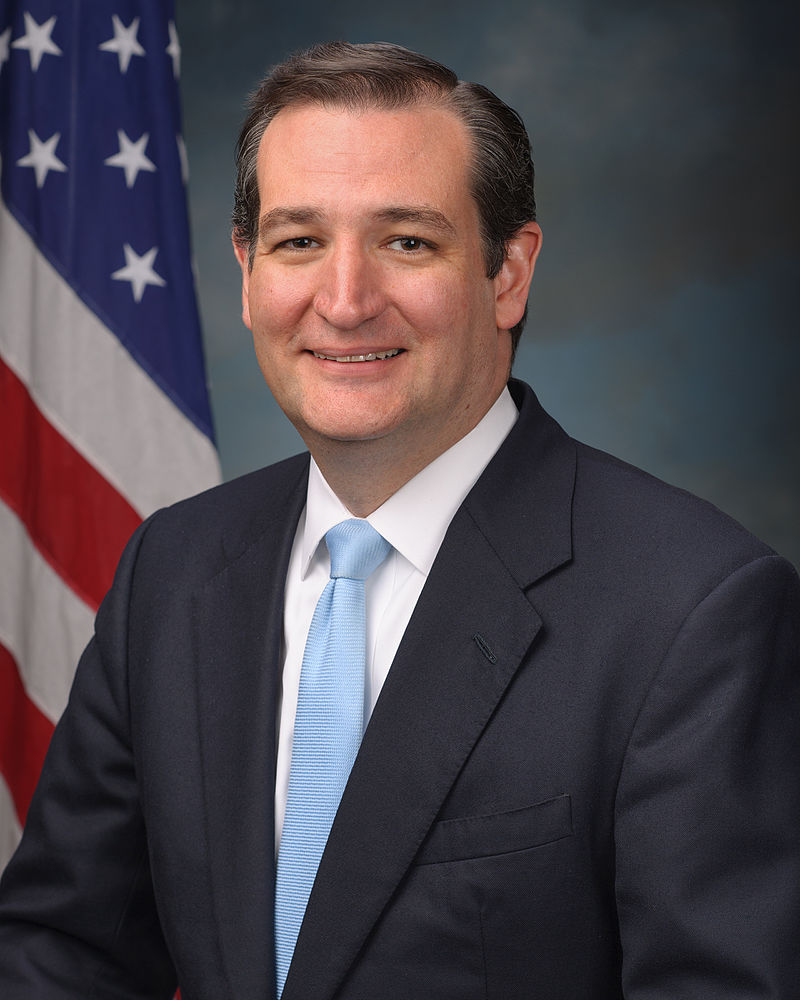
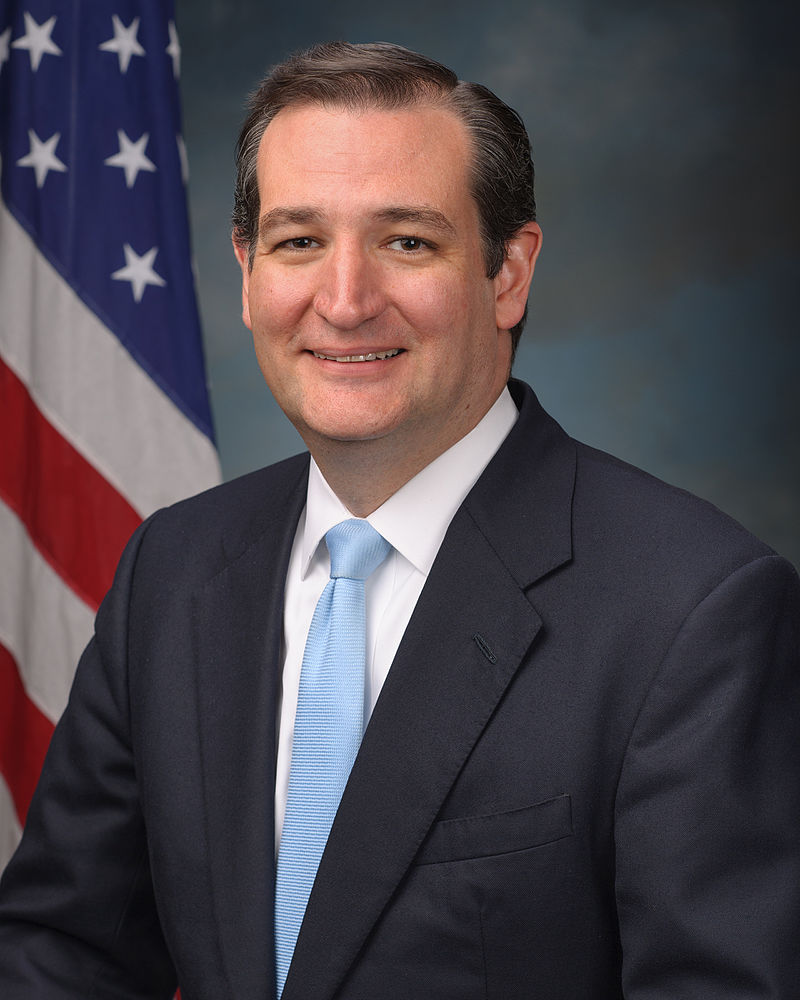
Ted Cruz – not the Zodiac Killer, but almost in as much trouble.
(Image Source:  By Frank Fey (U.S. Senate Photographic Studio) – Office of Senator Ted Cruz, Public Domain, https://commons.wikimedia.org/w/index.php?curid=25195114)

Immediately, two camps formed:  the majority pro-Trump camp, and the dwindling minority of Never Trumpers.  Within the former there are, broadly, two groups:  die-hard Trump fans, who have supported the candidate since last summer; and more tepid supporters who have given their support to Trump because they support their party’s nominee, they won’t support Hillary Clinton, they support elements of Trumpism, or some combination of the three.

The latter camp–I suspect–will continue to lose momentum now that the nomination process is complete.  Some of those voters will reluctantly vote for Trump for fear that a Clinton presidency will irrevocably shift the Supreme Court toward constitutional adaptavism and judicial activism.  Some will vote third-party, probably for Libertarian candidate Gary Johnson, or not vote at all.  A very small minority will vote for Clinton.

The kerfuffle highlights well the tensions inherent in party politics:  when does loyalty to party overcome adherence to principles, and vice-versa?

How these two groups have interpreted Cruz’s speech is predictable.  For the pro-Trump/party unity crowd, they see Cruz’s non-endorsement as a traitorous, duplicitous swipe at the nominee and his supporters, someone who went back on his word to endorse the winner of the primary process.

For the anti-Trump side, Cruz is a hero who stands on principle, even in the face of overwhelming pressure from his party to support explicitly the GOP nominee.  They argue that his pledge to support the candidate became null and void when the Trump campaign attacked Cruz’s wife, Heidi, and insinuated that his father was involved in the Kennedy assassination.

The kerfuffle highlights well the tensions inherent in party politics:  when does loyalty to party overcome adherence to principles, and vice-versa?  To what extent should a voter temper his principles for the sake of political advantage, expediency, or compromise?

These are difficult questions, and they did not start with the 2016 election cycle.  Movement conservatives were frustrated, for example, with the 2008 and 2012 GOP nominees.  They perceived Arizona Senator John McCain and Massachusetts Senator Mitt Romney, respectively, as being inconsistently conservative.  Some conservatives refused to vote for those candidates; many did.  Some voted for them enthusiastically, reasoning that their flaws were better than accepting the progressivism of President Barack Obama, or changing their thinking to align with the candidates.  Others did so more reluctantly.

***

(Full disclosure–and a disclaimer:  I voted for Senator Cruz in the 2016 South Carolina GOP primary.  The analysis to follow does not represent an endorsement or criticism of Senator Cruz’s speech or positions, but rather is an attempt–as fully as possible–at an objective analysis of the reasons for his position, and the consequences of it.  Angry advocates of both sides take note.)

So, which is it?  Is Ted Cruz a hero of the conservative movement, standing on principle at the expense of party unity?  Or is he an opportunistic traitor to the Republican Party?

It’s a tricky question, and both sides have merit.  The pro-Trump majority is broadly correct that, having committed to endorsing the ultimate nominee, Cruz should hold up that endorsement, as many other Republicans have done, if reluctantly.  Take, for example, Speaker of the House Paul Ryan, who has endorsed Trump, but also been quick to criticize the nominee when his statement’s violated Ryan’s principles.

“…while Cruz didn’t outright endorse Trump, he didn’t not endorse him, either, and in no way maimed Trump.  If anything, he mostly hurt himself.”

On the other hand, Cruz in no way denigrated Donald Trump, or even suggested that voters should not vote for him.  Given in any other context, his speech would have received uproarious applause and plaudits from conservatives.  It did not explicitly fulfill his pledge to support the nominee, but it did not seek to criticize or harm the nominee overtly.

Lost in this debate–and in media coverage of the Cruz incident–was one of the best moments of party unity and statesmanship, which came when former Speaker of the House Newt Gingrich started his speech by saying, essentially, that Senator Cruz had encouraged voters to vote their conscience for the candidate most likely to uphold the Constitution.  As Gingrich put it, the only viable candidate for president who would plausibly do so is Trump.

Some may object that Newt’s entreaty was a neat verbal trick, or point out the possibility of voting third-party (though Gary Johnson isn’t viable), but it demonstrated his ability to think on his feet and his skills at diplomacy.  He was able to restore some sense of decorum and unity to the proceedings.

In short, while Cruz didn’t outright endorse Trump, he didn’t not endorse him, either, and in no way maimed Trump.  If anything, he mostly hurt himself.

***
That gets to another question, one that I think is equally interesting:  what, if anything, did Cruz hope to gain from this speech?  Some will say it was free of any political motivation, but that seems unlikely.  Call me a cynic, but I think Cruz has his eye on the future.
I suspect–and, naturally, I could be very wrong–that Cruz is setting himself to win over the support of conservatives who either won’t vote for Trump, or will vote for him with deep misgivings.  He’s also looking for those voters who are becoming more enthusiastic about Trump, but have lingering feelings that they’ve had to talk themselves into liking the candidate a bit too much.  If anything goes majorly wrong in a Trump presidency, these voters may turn to Cruz in four or eight years.
Whether Hillary Clinton or Donald Trump wins in November, Cruz will cast himself as the principled conservative who took a stand when the overwhelming force of his party’s opinion pressured him to do otherwise.  In the event of a Clinton victory, Cruz will attempt to win the GOP nomination in 2020.  In the event of a Trump victory, Cruz is betting on Trump making enough mistakes that enthusiasm for him sours, and in their hour of need, Republicans will say, “this was the man with the wisdom to resist.”  That’s a much tougher path, as it is extremely difficult to challenge successfully an incumbent president for his party’s nomination.
In both cases, it’s assuming an awful lot, and if the reaction at the Quicken Loans Arena Wednesday night is any indication, Cruz miscalculated badly.  But politics is a fickle mistress, and the political scene could look very different in four years.
***
Will Cruz’s speech galvanize the dwindling Never Trump forces?  Or will he spur more conservatives to support the party as a rallying cry against him?  Will he be blamed for splitting the party if Clinton wins?  Or will his gambit pay off, with voters of some distant election year seeing in him a man of principle?
These are interesting questions; ultimately, they are for the voters to decide.

Put Your Money Where Your Poll Is

According to a 2018 Gallup poll, 16% of Americans said they want to leave the United States permanently.  Not surprisingly, you can guess who most of these borderless, loyalty-deficient Americans are.

National Review reports that “Those who said they wanted to leave the U.S. tended to be members of groups that lean Democratic, such as women, youth, and low-income people.”  Indeed, 20% of women told Gallup they want to live permanently in another country, compared to just 13% of men; 30% of Americans aged 15 to 29 want to move.

So, young radical feminists, why don’t you put your money where your poll is?  I’d wager less than 1% of those who indicated they want to leave will actually do so.

The most generous argument, of course, is that relocating to another country is expensive and a lengthy process (the result of properly enforcing a nation’s immigration laws).  Also, American citizenship is, despite cheapening from birth-right citizenship and massive immigration, a golden ticket, one that people are willing to move across oceans and deserts to gain.

The real reason is that no person with a shred of common sense would ever give up the sweet bennies and lavish standard of living the United States provides, or at least not for merely political reasons.  Remember all those progressive celebrities who vowed hollowly to leave the country should Trump win?  Why is Lena Dunham still here?

What this polling boils down to, then, is a reverse of the “Trump Effect” from 2016 presidential polls.  A major, compelling theory for why those polls were so wrong is that Trump voters were afraid or embarrassed to tell a pollster they intended to vote for Donald Trump.

In the case of this Gallup poll, the opposite is occurring:  progressives are eager to virtual-signal their disdain for their country and president; thus, the inflated numbers.

Let’s put this out there for consideration:  the government could purchase cheap plane tickets for anyone who wants to relocate.  I’m sure Justin Trudeau will take in these “refugees.”  This policy, while initially expensive, would drain off some of America’s Leftists (they’d find plenty of jobs in Canada’s multicultural, social justice bureaucracy), and would be almost as beneficial as erecting the border wall.  Leftists would love getting free, permanent travel to another land, with the added benefit of feeling cool and sophisticated.


Reblog: The Normalization Of Ugliness Inevitably Becomes The Denigration Of Beauty

A piece demonstrating the virtue-signalling of our techno-elites, c/o Chateau Heartistehttps://heartiste.wordpress.com/2019/01/02/the-normalization-of-ugliness-inevitably-becomes-the-denigration-of-beauty/

In short, Facebook rejected an ad because it either idealized a healthy body type, and/or portrayed flabby abs and belly fat in a negative light.

Beauty is in the eye of the beholder, to be sure, but there are certainly qualities broadly accepted and recognized as beautiful—so much so that we could reasonably assume these qualities to be universal. The “body positivity” movement, like most such Leftist sacred cows, has a sympathetic appeal at its heart, but is otherwise a potentially lethal lie.

The appeal is simple, and good: we shouldn’t be needlessly mean to people based on their appearance. The lie, however, takes that appeal to good-natured sympathy and twists it into a forced acceptance—indeed, a celebration—of habits and lifestyles that are inherently unhealthy (and, dare I write it, ugly).

As a Formerly Fat American (FFA), I’m not unsympathetic to the difficulty of losing and keeping off weight. I understand that, for some Americans, glandular issues, or weight-gain stemming from other conditions, make losing weight harder than normal.
But these are the exceptions, not the rule. Healthy habits are difficult to maintain, and require self-discipline—a quality once considered virtuous. Now, rather than urge people to stop overeating or to go for a walk, we applaud them for their poor health, or try to make excuses.  I can also safely assert that I was fat for so many years because I lacked the discipline and willpower not to be—it was my own fault!

Beyond physical beauty, I fear this “normalization of ugliness” is prevalent in the arts, notably the visual arts, but also in music, dance, poetry, etc. Any sense of objective standards, of an understanding of and appreciating the great masters that came before, is abandoned for politically-correct drivel. “Art,” in the truest sense of that word, should not be willfully, knowingly ugly. We may produce bad art in the pursuit of learning our crafts, but we shouldn’t set out to create more ugliness (and, by extension, chaos) in the world.

These are some off-the-cuff reflections. Again, my goal is not to get some clicks at the expense of chubby Americans. Rather, we should be willing to recognize that obesity, like many social maladies, should be treated seriously, and should be gently but firmly discouraged, rather than celebrated as a “lifestyle choice.”

Teachers Quitting in Record Numbers – Reflections on Education

Today, I resume my teaching duties for the remainder of the 2018-2019 academic year.  In the spirit of that return from two weeks of glorious holiday loafing (and the prolific blogging it enabled, however briefly), the Wall Street Journal ran a piece over break about teachers quitting their jobs in record numbers.

I don’t plan on quitting education anytime soon—I rather enjoy teaching kids useful trivia and getting paid for it—but I would like to offer an “insider’s perspective” on the education field.  Granted, I teach in private school, but many of the issues teachers face are similar (albeit thankfully muted in a private school setting).

Generally, there seem to be two approaches to looking at the massive problems of education:  one is that we should spend more on education; the other is to pile more responsibilities onto teachers, and even to blame them for children’s lackluster performance.  Both of these approaches are, to different extents, flawed.

I’ll consider the second perspective first.  Conservative politicians will occasionally scapegoat teachers, sometimes fairly (as in the egregious examples from New York public schools with pedophiles on permanent, paid leave and the like), but usually without a solid understanding of what teaching entails.

I commonly see teachers—who get very prickly when people start noting the profession’s many perks—post online about how we don’t just get out at 3 everyday, etc.  There’s some truth to that; if you really do your job right, you’re spending a good bit of your time either before or after school, not to mention the weekends, grading or planning.  That’s especially true for first- and second-year teachers, who really have to do everything from scratch.

That said, if you stick with it—and if you don’t fall for the perennial educational fads that circulate every five years or so, all of which claim the previous fad was fatally incorrect, but that this one is the Brave New World of Education and is inerrant—you can pretty much tweak your lesson plans and approaches at the margins, rather than reinvent the wheel, from year to year.  I’ve known (and been taught by) many teachers that are overzealous about totally rebuilding their courses on a regular basis, but the perceived gains they see in the classroom are probably due more to their own passion than to whatever bold new system they’ve conjured up.

Which brings me to the other perspective mentioned above.  Progressives, who have an overly romantic view of education—and who see it as a means to indoctrinate generations to spew Leftist pabulum uncritically—think the education system can solve all of society’s ills if we just invest in it more.  Part of it comes from a desire to create more government jobs (and loyal Democratic voters) for people dubiously qualified to do anything productive.  Part of it comes from a sincere belief that they can save underprivileged kids.

That clearly doesn’t work.  So what is the truth when it comes to education, and how can we begin solving some of its problems?

For one, the complaints from those outside of the profession about our hours and summer vacation are not without merit, but they miss the point, too.  As noted above, good teachers—by which I mean teachers who will do their jobs as they should—will put in time over and beyond the classroom time.  You have to if you’re actually going to be prepared for class.

Summer vacation is a perk—we shouldn’t pretend otherwise.  Many teachers use it as an opportunity for professional development, but, c’mon, it’s also a time to hit the beach (I might be an exception to both—I do maintenance and grounds work at my school to make extra money, because I want to retire someday).  But it’s a big draw for many to the profession, especially women (and particularly mothers), who make up a huge portion of the teaching population.  As with the perennial debates about the mythical wage gap, teachers should acknowledge that less months worked = less pay.  The counterargument, one that I’ve made frequently, is that many of us put in twelve months’ worth of work in nine or ten.

As far as putting more money into schools, that’s all well and good—but where does the money go?  If it’s going to build some needless Mall of America school complex, or to hire another Assistant Vice-Principal of Islamic Outreach, it’s not doing much beyond feathering the nests of over-credentialed M.Ed. holders who took a couple of online classes in between naps and diversity seminars.

New technology and facilities are great, but they don’t teach kids.  All I need to teach history or music is some kind of board, something to write on, and some dog-eared notes.  I could probably get by without the board.  Jesus taught multitudes without a SmartBoard.  Aristotle taught Alexander the Great, probably with nothing more than some tablets and scrolls, and that guy conquered the known world.

More importantly, teachers need administrators to give us the space to do our jobs.  We all have little duties that cut into prep time, and that’s the nature of the beast.  But when politicians start decreeing ever-more tasks for schools to take on, they inevitably fall to the teachers.  The aforementioned AVP of Islamic Outreach isn’t the one writing the lesson plans about Muhammad’s views on marrying nine-year olds, even if xyr is forcing the Social Studies Department to add it; the Social Studies teachers are the ones figuring out how to make it happen, all the way complying with a thicket of misguided federal and State “guidelines.”

Ultimately, there are some behavioral issues that drive teachers from the biz, too; these are problems that, in part, begin at home (or, sadly, the lack thereof).  Those are social and cultural problems that are, frankly, beyond the power of educators and administrators to solve on the macro level.  We all do our part, to the extent we can, at the micro level.  I fear that some teachers overdo it, but that’s a topic I’d have to cover separately.

To summarize these stream-of-consciousness reflections, here are some things that would help aid retention in the field—and align educational goals more with reality:

  • Offer better pay if people are leaving; have flexible pay-scales that allow teachers with good track records (measurable in a variety of ways) better pay or bonuses (to be clear:  I don’t advocate blanket pay raises for all teachers in all districts—I’m sure some are well-compensated, and some not).  This doesn’t have to be pegged to test scores, but to a “holistic” assessment of a teacher.  If you’re teaching in Allendale County, South Carolina, you’re not going to have stellar test scores, so you can’t rely solely on those to assess the efficacy of a teacher.
  • Offer more flexible forms of alternative certification.  South Carolina currently has a severe shortage of teachers, but still insists that those without a teaching certificate endure a long, expensive, three-year process of alternative certification.  My proposal—which I pitched briefly to my former SC State Representative Jay Jordan—is to make it possible for private school teachers with, say, five years of classroom teaching to gain their certification automatically, or after taking the Praxis exam in their field or fields.  If the teacher holds a Master’s degree or Ph.D., knock two or three years off of that requirement.  You’d instantly have access to a huge pool of teachers, many of whom would be qualified from years of experience.  Also, there are a lot teachers that have their certification that are, quite frankly, crummy, so that magic piece of paper does not automatically a good teacher make.
  • Reduce administrative bullcrap.  Teachers quite principals, not schools—that’s a common maxim in education circles, and it’s true.  Administrators should realistically be support for teachers, and should avoid overloading their teachers with a bunch of paperwork (except where necessary).  Teachers can be whiny and catty—they tend to think they need more stuff to do their jobs than they actually do—but that just means you’ve got to have a firm but flexible hand steering the ship.
  • Allow teachers flexibility in lesson planning and sequencing.  A big complaint I hear from my public school teacher friends is that they can barely take time to answer an intriguing student question if the lesson plan doesn’t allow it.  As a private school teacher with a penchant for discursive asides, this blows my mind.  Nothing will kill a child’s interest in a subject (especially history) faster if he can’t ask some off-the-wall question and at least hope to get some interesting explanation or discussion.  Obviously, you can’t do this every class, but teachers shouldn’t live in fear of going “off script.”  Indeed, I don’t think there should be a script—just a broad, skeletal outline (of course, I recognize that this assumes the teacher is independently motivated and reasonably good at his or her job; sadly, I don’t think that’s the case with a substantial minority of public school teachers, per my comments above).

That’s a short, incomplete list of some possible proposals.  It’s not exhaustive, and as every teacher and wag will point out, there’s always an exception (I can’t tell you how many faculty meetings I’ve endured where some new policy has been discussed, and immediately dozens of exceptions or unique scenarios arise, to which I would say either a.) figure it out yourself or b.) just follow the policy as best you can, knowing weird exceptions will crop up—ask forgiveness, not permission).

If nothing else, I hope these reflections are useful (and, for any of my parents, colleagues, or school administrators who might be reading, know that I love my job and all of you, and that our little school is the best in South Carolina) and can spark some discussion.  Education is hugely important to the future of South Caroline and our nation; it deserves to be discussed frankly and dispassionately.

Romney’s Perfidy Runs in the Family

The occasion for Tucker Carlson’s trenchant insights was Utah Senator Mitt Romney’s Washington Post op-ed, in which the failed presidential candidate excoriated President Trump not on substantive policy disagreements, but because the president is a big meanie.

I’m a bit late to the party on this topic, but most of the commentary I’ve read is consistent with my own thoughts: that Romney is clinging to a vanishing, ostensibly more decorous, vestige of the (thankfully) dying neocon cell within the Republican Party. Former Speaker Newt Gingrich probably offers the best analysis of (and advice for) the freshman senator. It seems that Mitt is prepping for a Kasich-style 2020 primary challenge.

When Romney ran in 2012, I was hopeful. I’d voted for Newtie in the SC presidential primaries, and was sad to see him flame out. While I was lukewarm on Senator Rick Santorum, I was hoping he’d pull out a late victory just so we could avoid another Establishment type.

But when Romney won the nomination, I was cautiously optimistic, and his first debate performance against President Barack Obama was masterful, tenacious, and aggressive—the qualities that ultimately won the presidency in 2016. But the love of losing is strong among neocons, and decorum and tact got in the way (not to mention the lackluster response from evangelical Christians to a Mormon candidate—talk about throwing out the baby with the bathwater).

Now, Romney is characteristically backstabbing his president and his party for personal gain. Fellow blogger photog at Orion’s Cold Fire lived in Massachusetts during Romney’s tenure as governor, and describes Romney as “useless.” I highly recommend you check out his piece “Mitt Romney is the New John McCain” for some excellent, succinct analysis regarding Romney’s penchant for flip-floppery. (You can also read some of my music reviews there, too!)

All of that is introduction to the meat of this post: Romney comes by his perfidious, shape-shifting nature honestly. Indeed, it seems he inherited or learned it from his dad, former Michigan Governor and original RINO George Romney.

Over the past year, I’ve been intermittently dipping in and out of Pat Buchanan’s excellent first-hand account of Richard Nixon’s remarkable political revival in the 1960s. The Greatest Comeback: How Richard Nixon Rose from Defeat to Create the New Majority details the ins-and-outs of Nixon’s unlikely, brilliant rise to the presidency.

Recall that Nixon was considered politically D.O.A. after his twin defeats in the 1960 presidential election and the 1962 California gubernatorial election. Given those defeats—and Nixon’s own self-defeating announcement that “You [the press] don’t have Nixon to kick around anymore because, gentlemen, this is my last press conference”—every mainstream media pundit was convinced the old Red Hunter and former Vice President was done.

In reading this book, a central figure in the Republican Party was George Romney, one of Nixon’s three potential rivals for the nomination in 1968 (the other two being liberal Republican Governor Nelson Rockefeller of New York and grassroots conservative Republican Governor Ronald Reagan of California, the latter of which reached a detente of sorts with Nixon, biding his time for a future successful run of his own). Throughout the book, Buchanan details Romney the Elder’s shifting positions on the hot-button issues of the 1960s.

Of the many examples Buchanan provides, one of the most representative is in a section entitled “The Great Brainwashing” (pages 131-133 in the 2014 hardcover edition). Buchanan writes that by “the summer of ’67, Governor Romney, who in 1965 had come back from Vietnam to laud the war effort, was moving toward opposition to the war.” When Lou Gordon asked Romney about the shift in his position in a taped television interview, Romney responded that he “had the greatest brainwashing that anybody can get when you go over to Vietnam. Not only by the generals, but also by the diplomatic corps over there, and they do a very thorough job.”

Not only had Romney flip-flopped on the Vietnam War (presumably in an effort to capitalize politically on anti-war sentiment in the country), he’d stumbled into a gaffe. The claim of “brainwashing” was bizarre, but it also threw the entire US military leadership under the bus.

Further, the “brainwashing” claim seemed to be a rhetorical sop to the hard-Left elements that dominated the anti-war movement. Such an assertion fit in neatly with their view that the establishment was acting in bad faith.

Buchanan details the political toll:

“The first polls after the ‘brainwashing’ episode were devastating, deepening a decline that had already begun. Since 1966, among Republicans, Romney had been running the strongest against [President Lyndon B.] Johnson. Now, in the new Harris survey, he had fallen to fourth, behind Rockefeller, Nixon, and Reagan. Romney had fallen from 4 points behind the President to a 16-point deficit. In a Gallup poll of September 23, only 14 percent of Republicans wanted Romney as their nominee, a 10-point drop in three weeks.” (The Greatest Comeback, 133)

It would seem George Romney’s son is committing the same form of political suicide, similarly attempting to curry favor with the mainstream media and the Left in some oddball attempt to gain respectability.

The MSM will play ball—for a time. Mitt will get some accolades and cheers from the “centrist” Left and the Jonah Goldbergites of the dwindling Never Trump/Weekly Standard (ding, dong, the witch is dead!) crowd, the latter of which will crow over Romney’s superior “character” and “decorum.” But should he ever succeed electorally on the national level again, the knives will come out, and wedge themselves deeply into his back.

Such is the fate of traitors: he who lives by the back-stab, dies by the back-stab. It’s a shame Romney the Younger didn’t learn this lesson from his father’s hubristic, doomed career.

Tucker Carlson’s Diagnosis

A recent monologue from Tucker Carlson’s Fox News program is blowing up the right-wing blogosphere, and understandably so.  Carlson has been a vocal critic of the neoliberal deification of economic efficiency at all costs.  I used to be a member of this cult, until the candidacy of Donald Trump (and lived experience) knocked the idealistic scales from my eyes.

Normally, it bugs me when people send me video clips to watch.  If they’re cutesy videos of the variety that drive clicks—think cats playing piano, or Goth versions of Christmas songs—I usually ignore them, no matter how hyped they are.  That’s not some virtue on my part; I just don’t want to take the time to watch them, especially on a cell phone (a pet peeve:  someone making me watch a video on their cell phone; I will refuse).

That said, I’m indulging in some hypocrisy:  you must watch this video as soon as you’re able.

For those of you that don’t want to take the time, here are some highlights:

  • Elites care only about maximizing economic efficiency, regardless of the human costs to individuals, families, and communities
  • That lust for efficiency drives income inequality, particularly benefiting the technology sector/Silicon Valley
  • “We are ruled by mercenaries, who feel no long-term obligation to the people they rule”—a key idea; I’ve read a similar analysis from controversial blogger Z-Man, in which he argues that leaders in a democracy are, inherently, renters rather than owners, and therefore are heavily tempted towards asset-stripping while in office, rather than building and maintaining a nation:  http://thezman.com/wordpress/?p=15929
  • Because of the hollowing out of American manufacturing and declining wages (again, due in part to the quest for efficiency), men struggle to find employment or to improve their wages
    • Because of that, rural parts of the country are dominated increasingly by healthcare and education, female-dominated fields
    • While better wages for women is fine, Carlson claims that—whether or not they should—women are less likely to marry men who earn less than them, therefore

These are just some of the most interesting insights, but Carlson sums up in fifteen minutes what would take a legion of hack bloggers like me hours or weeks to explain.

Again, I urge you to watch this videohttps://video.foxnews.com/v/5985464569001/?playlist_id=5198073478001#sp=show-clips

America’s Entrepreneurial Spirit

Scott Rasmussen, writing for Ballotpedia, reports that 62% of American adults say their dream job is owning their own company.  That’s encouraging news, as it suggests that, despite decades of welfare state decadence, Americans still possess our entrepreneurial spirit.

That spirit has been with Americans going back to the colonial period.  Textbooks tend to focus on the Puritan planting of the Plymouth colony, which was certainly important, but the first permanent settlement in colonial British North America was Jamestown.  That settlement, and the entire colony of Virginia, was founded as a commercial enterprise, the efforts of joint-stock company in England.

French aristocrat and political theorist Alexis de Tocqueville, writing in Democracy in America (1840) over two centuries later (during the height of the Jacksonian Era), noted Americans’ keen interest in commercial matters, and the pulsing energy and enthusiasm of always hustling.  He also noted the positive effect of trade upon liberty:

Trade is the natural enemy of all violent passions. Trade loves moderation, delights in compromise, and is most careful to avoid anger. It is patient, supple, and insinuating, only resorting to extreme measures in cases of absolute necessity. Trade makes men independent of one another and gives them a high idea of their personal importance: it leads them to want to manage their own affairs and teaches them to succeed therein. Hence it makes them inclined to liberty but disinclined to revolution.

Despite enthusiasm about the idea of starting a business, Rasmussen’s findings show that only 5% of Americans are “very likely to start their own business” in 2019, while 11% are somewhat likely.

Nevertheless, it’s refreshing to see that the desire to hustle is prominent among Americans.  The economic mojo of the Trump economy no-doubt improves Americans’ optimism (although I should note that many Americans started businesses during the Obama stagcovery, albeit for a different reason—they couldn’t find work).  That optimism likely fuels some desire to get in on the action.

On a personal note, I will say that even I, a high school teacher—teaching being a job uniquely suited to the risk-averse in general—have caught this bug (don’t worry, loyal readers—I’m not going to try to sell you massage oils with untested healing properties).  I’m excited to expand some of my side-hustles in 2019, including writing, performing live music, and teaching private lessons.

Regardless of how those pan out, the thrill of applying effort towards ones passions is exhilarating.  What could be more American?

More Trolling

It’s fun to see some trolling coming from the Right. President Trump has elevated it to an art form—somewhat literally.

During a recent cabinet meeting, a prominent poster of the president reading “Sanctions Are Coming” sat in front of him (see it here: https://www.breitbart.com/politics/2019/01/02/donald-trump-prints-poster-size-game-of-thrones-meme-warning-iran/).

Throughout American history, presidents and presidential hopefuls have leveraged new communications technologies to reach the American people. President Franklin Delano Roosevelt famously used the radio to calm and inspire a trouble nation during the Great Depression with his “fireside chats.”

Senator John F. Kennedy bested his opponent, Vice President Richard M. Nixon, in the ultra-tight 1960 presidential election in part because of his performance in a televised debate (and probably some undead Democratic voters, but who can say). Americans listening on the radio believed Nixon had won; viewers, seeing a radiant, tanned Kennedy, believed the young dynamo walked away with debate victory.

President Ronald Reagan’s acting career prepared him to use television effectively to reunite and course-correct a nation recovering from the social, cultural, and economic malaise of the 1970s. President Obama famously promised to give “fireside chats” and Internet town halls on YouTube (before cloaking his scandal-plagued administration in media obscurity). I think Senator Robert “Bob” Dole was the first presidential candidate to have a website.

Now, President Trump has effectively leveraged Twitter and Internet trolling to reach his base. Even his detractors have to appreciate his cheeky humor. Buzzkills will no-doubt argue he shouldn’t be trolling a radical, apocalyptic, Islamist regime that actively seeks to enrich uranium, but, hey, it worked with North Korea. Whatever happened to the Second Korean War everyone was talking about last year?

Keep on a-trollin’, President Trump! Decorum and taking the high road clearly haven’t worked out for conservatives—even Lindsay Graham learned that during the Kavanaugh witch hunt. Leave that to Senator Mitt Romney and the neocons.